How Long Do AC Units Last in Arizona? (The Real Numbers)
How Long Do AC Units Last in Arizona? (The Real Numbers)
TL;DR: In Arizona, most central AC systems last 10–15 years — significantly shorter than the 15–20 year national average. The extreme summer heat (115°F+), monsoon humidity, desert dust, and hard water accelerate wear in ways that simply don't happen in other climates. If your system is 10+ years old, it's worth starting the replacement conversation now — before July forces your hand. Units that are well-maintained, properly sized, and protected from direct sun can push toward the higher end. Neglected systems in older Phoenix-area homes often don't make it to 12.
Your AC unit is working harder in Arizona than it would anywhere else in the country. Not slightly harder — categorically harder.
In Cleveland, an AC system might kick on for four months a year. Here in the Phoenix metro, yours runs 8–10 months. It hits 110°F+ days in June, then humidity spikes to 60%+ during monsoon season in July and August, then layers in desert dust that clogs coils. The load on an Arizona system is roughly 2–3× what a Midwestern home experiences. That math shows up in the lifespan numbers.
The honest average: 12–13 years. Some systems make it to 15. Some die at 9 or 10. The factors that determine where yours lands are almost entirely within your control — or were.
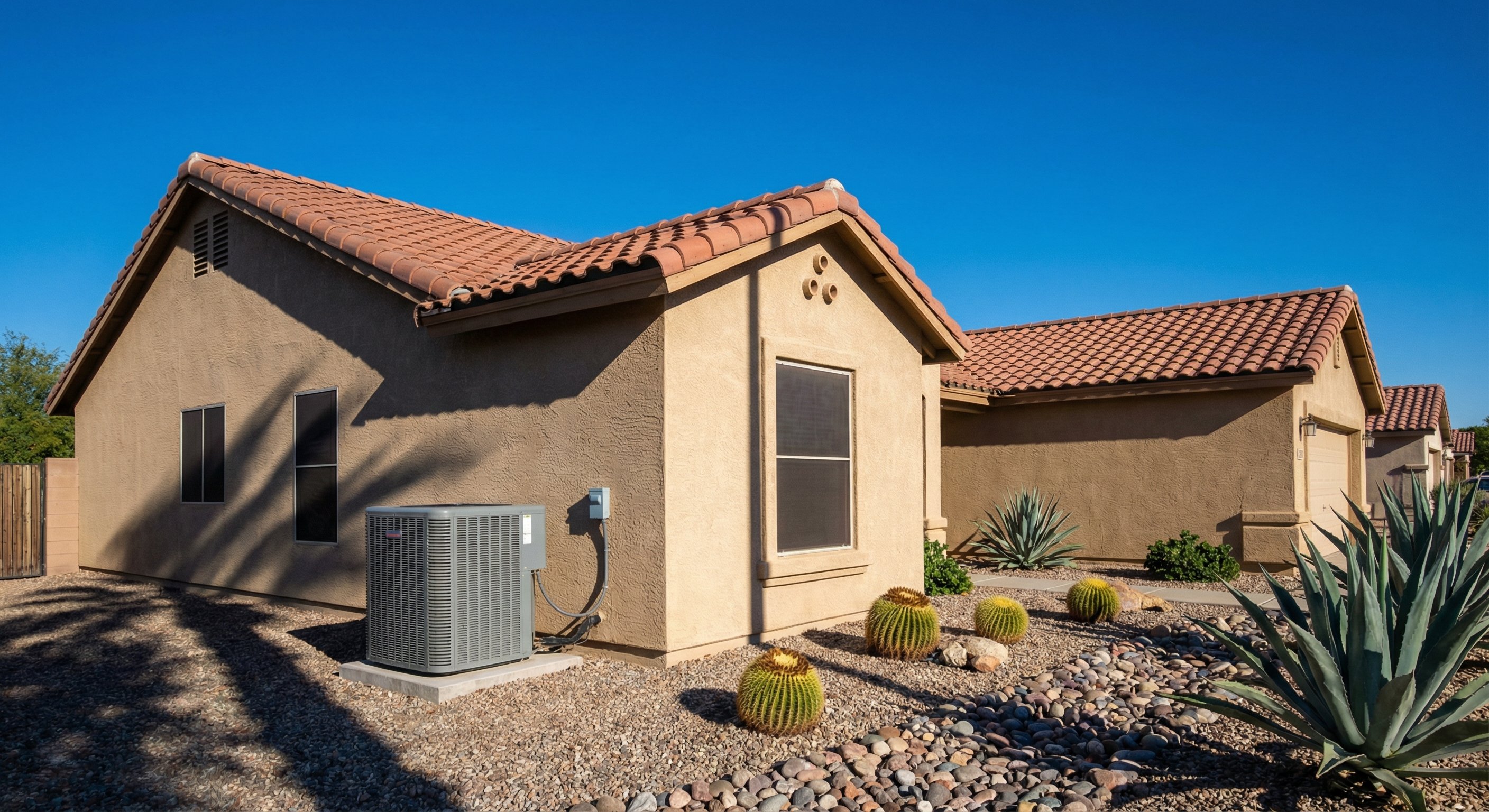
Why Arizona Eats AC Units Faster Than Other States
Let's get specific about what's actually happening inside your system on a 115°F July afternoon.
The hours add up fast. The national benchmark for AC "full-load equivalent hours" is around 1,000–1,500 per year. In Phoenix, that number is closer to 2,800–3,200 hours per year. Run any machine at twice the hours and it ages twice as fast. That alone closes most of the gap between the 20-year national average and Arizona's 12.
Dust and debris clog coils. Arizona's desert dust is fine, constant, and pervasive. It works into condenser coils, insulates them from airflow, and forces your compressor to work harder to push the same amount of cooling. An uncleaned coil in Peoria or Tempe can reduce efficiency by 20–30% — and the extra strain goes straight to compressor hours.
Hard water builds scale on evaporator coils. Phoenix-area water is notoriously hard — mineral content 2–3× higher than national averages. When condensation forms on your evaporator coil, those minerals deposit over time. Scale is an insulator. Insulated coils make the compressor work harder. Harder-working compressors fail earlier.
Monsoon humidity stresses refrigerant systems. Your AC is calibrated for dry desert conditions. When monsoon season hits and humidity climbs from 15% to 60%, the system has to work significantly harder to pull moisture out of the air along with the heat. July and August are when Arizona AC systems take their biggest annual beating.
Most homes use their heat pump function zero days a year. Counterintuitively, systems that run in both heating and cooling modes see more balanced wear. Phoenix homeowners who run pure cooling for 9 months put asymmetric stress on the cooling circuit.
What to Expect by System Age
Here's a realistic breakdown of what your Arizona AC system's age means:
| Age | Status | What You're Looking At |
|---|---|---|
| Under 8 years | Healthy | Routine maintenance only. No concerns. |
| 8–10 years | Watch | Annual inspection becomes critical. Start noting repair costs. |
| 10–12 years | Decision zone | Minor repair: fix it. Major repair (compressor, coil): run the numbers against replacement. |
| 12–15 years | End of life | System is statistically near failure. Budget for replacement. |
| 15+ years | Borrowed time | If it dies today, you're not surprised. If it hasn't died, you've been lucky AND diligent. |
A 14-year-old Trane in Chandler that's been professionally maintained every spring is a different machine than a 10-year-old unknown-brand unit in a Gilbert rental that's never been serviced. Age is one variable — condition and maintenance history are the others.
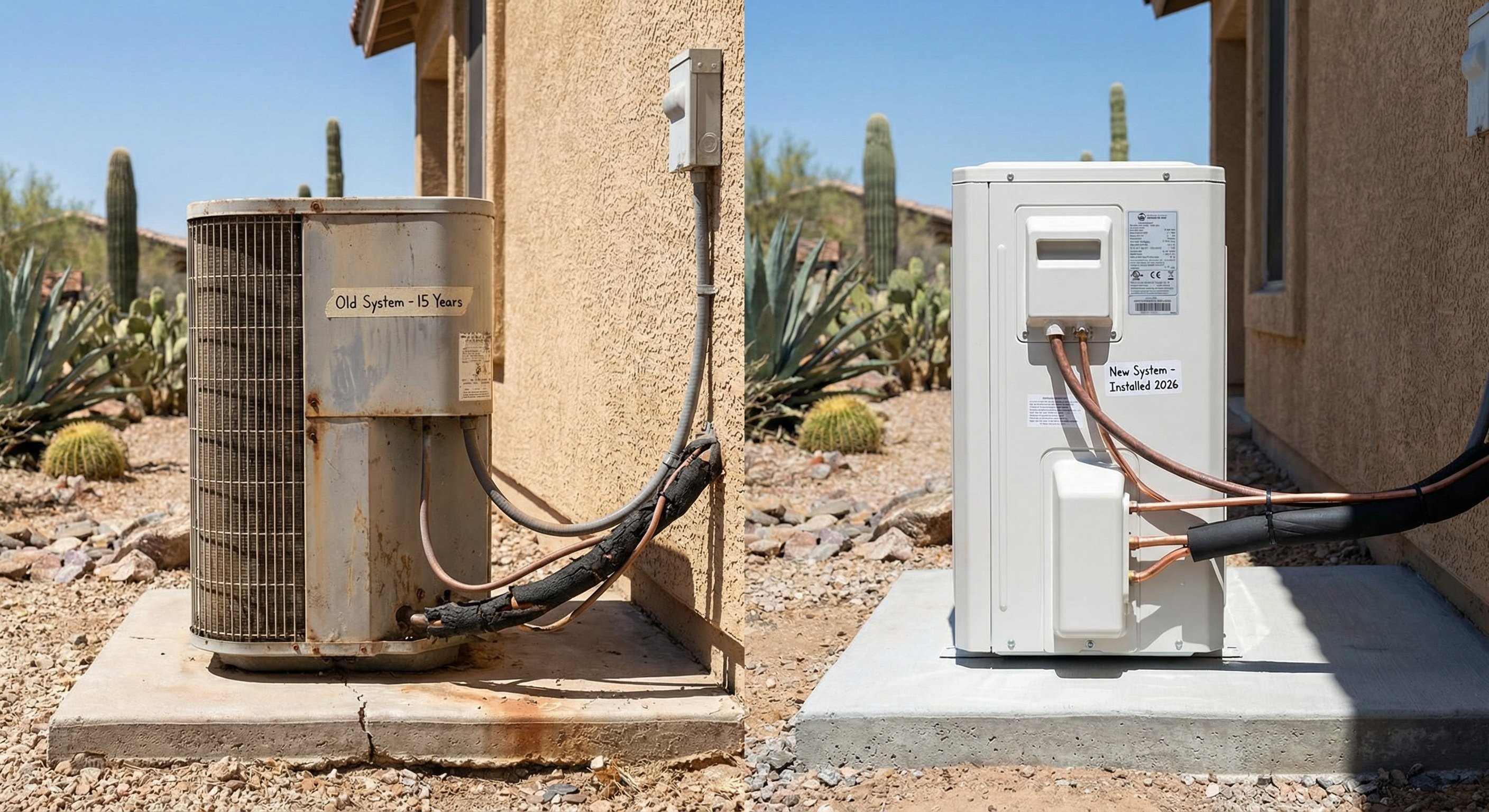
The Specific Warning Signs to Watch For
Your system will usually tell you it's heading toward the end before it flat-out dies. Here's what to listen for:
Compressor short-cycling. If your system turns on, runs for 2–3 minutes, shuts off, then turns on again repeatedly — that's a stressed or failing compressor. In Arizona summer, a compressor failure means temperatures hit 90°F inside your home within 2–3 hours. This one's urgent.
Rising utility bills with no behavior change. If your APS or SRP summer bill jumped $60–$80 month-over-month but you didn't change your thermostat settings, your system's efficiency is degrading. A 15-year-old unit might be running at 8–9 SEER effective efficiency even if it was rated higher when new. That energy cost gap is essentially a slow-motion repair bill.
More than one repair in two years. The industry rule of thumb is: if repair costs exceed 50% of replacement cost over two years, replace. In Arizona, I'd make that more aggressive — if you're hitting the shop twice in 18 months, you're in the tail end of the reliability curve.
Refrigerant recharges on an R-22 system. If your system is old enough to use R-22 refrigerant (Freon), and it's losing charge, you're looking at $150–$300+ per pound for a refrigerant that's no longer manufactured. R-22 systems should've been replaced by now. If yours hasn't, every recharge is borrowed time.
Uneven cooling across rooms. When a system starts failing to maintain consistent temperatures — master bedroom is 72°F, living room is 79°F — it's often a sign of refrigerant issues, failing capacity, or ductwork problems that compound with an aging system.
Skip the dealer markup
See What a New AC Actually Costs in Phoenix Metro, AZ
AC Rebel shows you the real equipment price — no sales pitch, no inflated quote. Get matched with a licensed installer and keep $3,000–$5,000 in your pocket.
Get My Direct Price →What Extends (or Kills) Arizona AC Lifespan
Things that buy you years:
- Annual spring tune-up — coil cleaning, refrigerant check, capacitor and contactor inspection. Budget $150–$250/year. This is the single highest-ROI maintenance item.
- Monthly filter changes — In Arizona, every 30 days minimum. Desert dust loads up 1-inch filters fast. A clogged filter restricts airflow and forces the system to work harder.
- Shading the condenser unit — A condenser sitting in direct afternoon sun (west-facing in Phoenix — brutal) runs hotter and works harder. A shade structure or strategic planting that blocks afternoon sun can add years.
- Proper sizing at installation — An undersized system runs constantly and dies young. An oversized system short-cycles and dies young. Both are wrong. Proper Manual J load calculations matter.
Things that shorten lifespan:
- Skipping the annual tune-up — coils accumulate debris, capacitors fail without warning
- Ignoring filter changes — restricted airflow is slow strangulation for a compressor
- Cheap installation — unlicensed or poorly trained installers leave systems mis-charged and poorly connected
- Running on R-22 past the point of recharge — you're gambling every summer
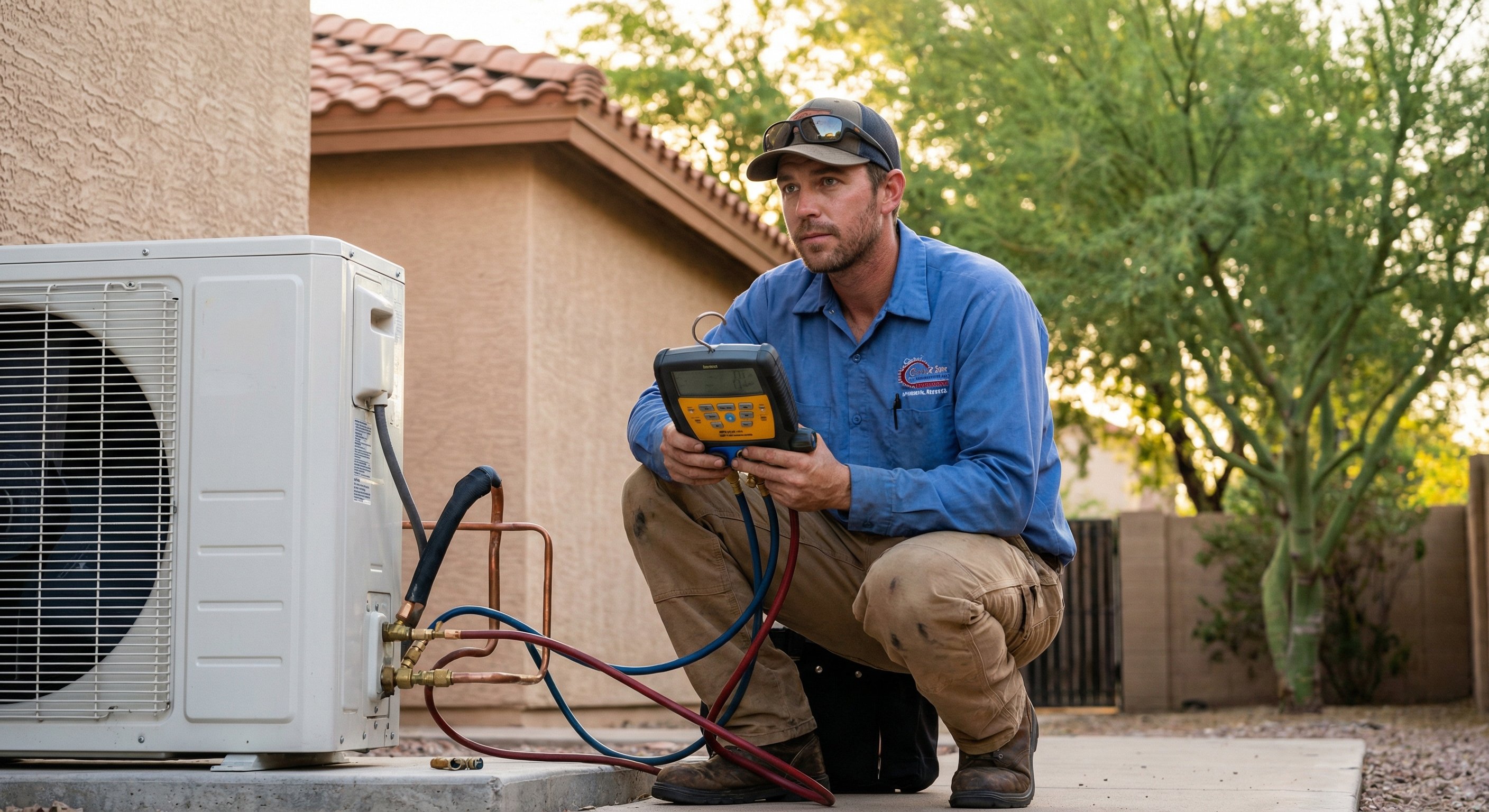
The Repair vs. Replace Calculus (Arizona Version)
Here's the framework I'd use:
If your system is under 8 years old: Repair almost anything short of a compressor. A $400–$800 repair on a system with 8+ years of life left is a good deal.
If your system is 8–12 years old: Run the numbers. Multiply repair cost × expected years remaining. If a $1,200 repair buys you 4 more years, that's $300/year — compare that to financing a new system at $47–$87/month. The math often favors repair, but not always.
If your system is 12+ years old: Major repairs (compressor, evaporator coil, heat exchanger) should almost always trigger a replacement conversation. You're repairing a system that's 2–3 years from end-of-life anyway, and the new repair won't prevent the next failure. New units also run at 16–20 SEER vs. your aging unit's effective 8–10, so energy savings compound.
The emotional math also matters. When an AC dies in Phoenix on a 115°F day in July — and it will die on the hottest day of the year, because that's when it's working hardest — emergency replacement timelines are measured in days, not weeks. Supply chains are stressed, installers are booked out, and you're choosing from whatever is available rather than what's best. The proactive replacement done in March or April is a different decision than the emergency one in July.
Most homeowners who replace proactively save $1,000–$2,000 versus those who wait for failure. Emergency premium on installation, rushed delivery, and no time to compare options adds up fast.
When to Start the Replacement Conversation
If your system is 10 or older: Start getting quotes this spring. Not because you're definitely replacing it, but because knowing the number removes the fear. Most Phoenix homeowners are shocked to find replacement costs are $3,000–$6,000 less than they assumed — especially when they price AC units directly rather than through a contractor who marks them up.
If your system has had any major repairs in the past two years: Same answer. The next failure is coming.
If your utility bills have been creeping up: Get a quote. The monthly energy savings from a modern high-efficiency system often pay for a significant portion of the replacement cost.
The traditional process — calling a contractor, having them quote you the unit AND the labor — adds substantial markup to the unit cost. The contractor buys from a distributor who bought from a manufacturer. Each step adds margin. By the time the unit reaches your quote, you're looking at a 2–3× markup on the equipment alone.
There's another way to do it. See what your replacement would cost at direct pricing — no dealer markup — at AC Rebel. Takes about 2 minutes. You see the unit cost, separate from installation. That number is usually eye-opening.

Quick Reference: Arizona AC Lifespan Summary
- Average lifespan: 10–15 years (national average: 15–20)
- Best-case (well-maintained): 15 years
- Typical Phoenix reality: 12–13 years
- Warning zone starts: Age 10
- Decision zone: Age 12+
- Most common failure point: Compressor, usually in summer at peak load
- Most preventable cause of early failure: Skipped annual maintenance
If your system is in the 10–13 year range and you're heading into summer without a tune-up, schedule one now. A $200 inspection could give you another summer of confidence — or confirm what you already suspected and give you time to plan.
Frequently Asked Questions
Q: How long does a Trane AC unit last in Arizona?
Trane, Carrier, and Lennox are all tier-1 brands with comparable quality and comparable lifespan in Arizona conditions. Expect 12–15 years with good maintenance. Brand matters less than installation quality, proper sizing, and annual tune-ups. A well-maintained Lennox will outlast a neglected Trane every time.
Q: Does Arizona heat really shorten AC lifespan that much?
Yes. The combination of extreme temperatures (115°F+ days), high run hours (2,800–3,200/year vs. national 1,000–1,500), monsoon humidity swings, and desert dust creates conditions that stress systems at roughly 2× the rate of moderate climates. The national 15–20 year average simply doesn't apply here.
Q: Should I repair or replace a 12-year-old AC in Phoenix?
For minor repairs (capacitor, contactor, blower motor) — usually repair. For major repairs (compressor, evaporator coil, heat exchanger) — almost always replace. A $2,000+ repair on a 12-year-old Arizona system rarely makes financial sense when a new system is 3–5 years away regardless.
Q: What's the best time of year to replace an AC in Arizona?
February through April is ideal. Contractors have more availability, you're not making panic decisions in 115°F heat, and you have time to compare options. Prices don't vary dramatically by season, but your negotiating position and option set are much better in spring.
Q: How much does a new AC system cost in the Phoenix area?
A complete central AC replacement in the Phoenix metro typically runs $6,000–$12,000 installed, depending on home size, unit tier, and installation complexity. Buying the unit direct (separate from installation) instead of through a contractor can save $2,000–$4,000 off that number. See AC Rebel's pricing tiers for current direct costs by system size.
AC Rebel is a direct-to-consumer HVAC marketplace serving the Phoenix metro area. We help homeowners buy AC units at near-wholesale pricing and get matched with vetted local contractors for installation — cutting the traditional dealer markup out of the equation.
Ready to stop overpaying?
See Your Direct AC Price in 2 Minutes
Skip the dealer. Buy your AC unit at direct pricing and pay a vetted local installer only for the installation. No sales calls. No hidden markup. Most homeowners save $3,000–$5,000+ compared to a traditional quote.
Get My Direct Price — No Credit Card2-minute quote · Licensed installers · 10-year warranty options