
Is Your AC Quote Too High? How to Read One Line by Line (Arizona)

Is Your AC Quote Too High? How to Read One Line by Line (Arizona)

TL;DR: Most Phoenix homeowners getting their first AC replacement quote have no idea they're often looking at $5,000–$8,000 in pure dealer markup baked into a single number. A fair 3-ton AC installation in the Phoenix metro runs $7,500–$10,500 for a quality system. If you've been quoted $14,000–$19,000, something in that quote is inflated — and this guide breaks down exactly where. Read the line items, compare the unit cost separately from labor, and always get at least three quotes before signing anything.
Here's what nobody tells you when your AC dies in Phoenix: the quote you're holding isn't a price. It's a negotiating position.
That number — whether it's $9,200 or $14,800 or $18,000 — started as a calculation that includes the actual unit cost, the actual install labor, and then a markup layer that can range from reasonable to absolutely outrageous. The problem is you can't see the layers. It all shows up as one number, sometimes with vague line items, sometimes without any at all.
A Phoenix homeowner recently posted on Reddit about getting a quote from a major local HVAC company. He happened to scroll to a tablet screen the salesperson left visible: the base unit price listed was $16,500 for a 3.5-ton system. A fair installed price for that same equipment: $8,000–$10,500. The rest? Markup.
He's not alone. This is normal in Phoenix's HVAC market. And it's not always malicious — some of it is just how the traditional dealer-distributor-contractor chain works. But you deserve to understand what you're paying for before you sign.
Here's how to read any AC quote you receive.
The Supply Chain Behind Every Quote
Before we get into line items, you need to understand why the numbers are what they are.
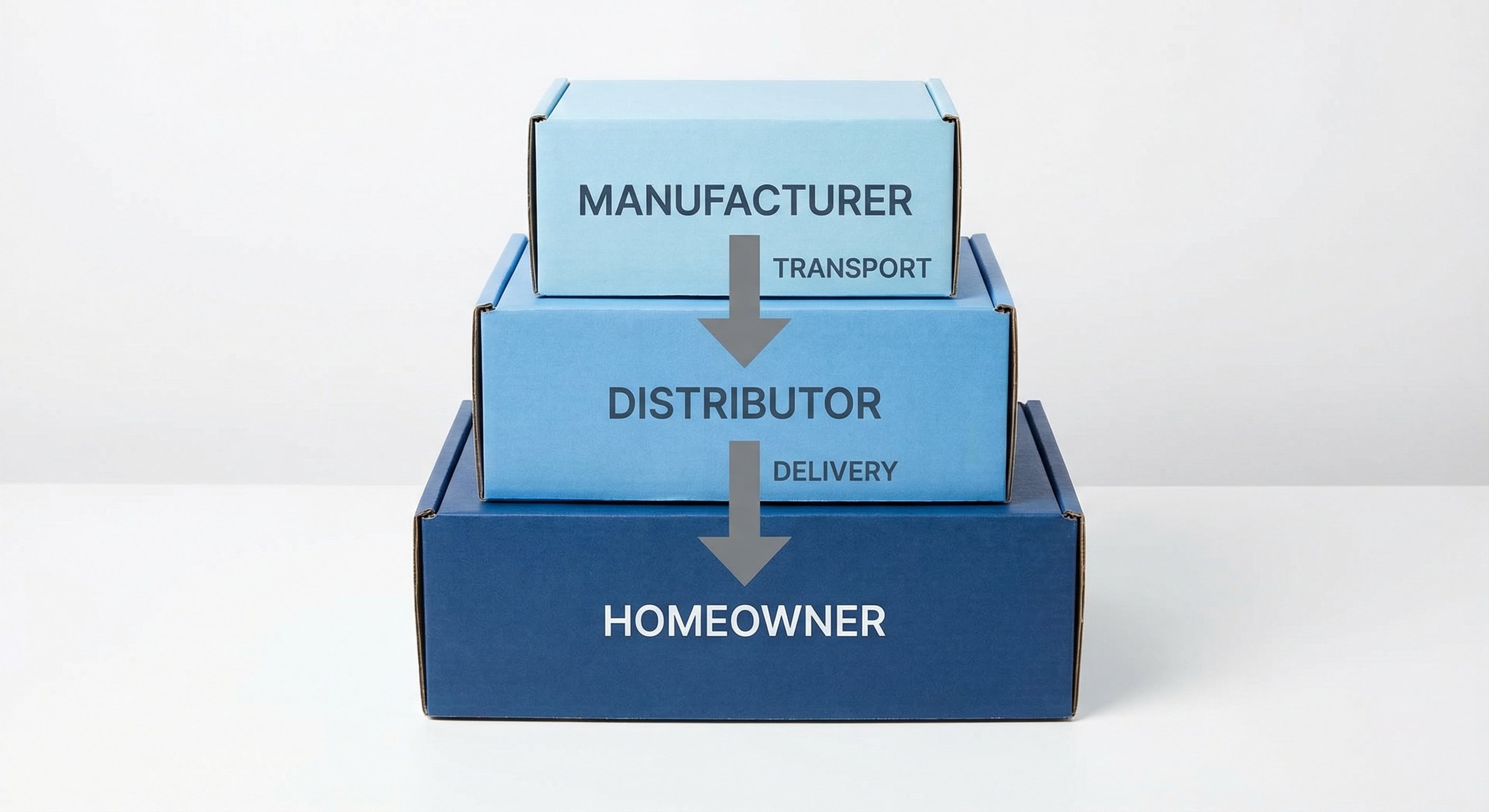
Traditional HVAC pricing follows a chain: manufacturer → distributor (+10–15%) → HVAC dealer/contractor (+30–50%) → you. Every handoff adds margin. By the time a system that cost the manufacturer $3,200 to build reaches your house as an installed unit, you might be paying $11,000–$14,000 for it.
That markup pays for the contractor's trucks, office staff, advertising (those bus bench ads cost money), commission-based sales reps, and profit. None of that is inherently wrong — businesses have overhead. But when you're a homeowner in 115°F Phoenix heat in July trying to make a $10,000+ decision in 48 hours, you deserve to know the structure you're buying into.
The alternative that's gaining traction among savvy Arizona homeowners: buy the unit direct, pay a contractor only for the install. That's what AC Rebel does — and the savings are real.
But even if you're going through a traditional contractor, understanding this chain helps you negotiate.
What Every HVAC Quote Should Include (And What It Actually Means)
A legitimate, detailed AC replacement quote has five components. Here's what each one should look like in Phoenix — and what the numbers should roughly be.
1. The Equipment Cost
This is the line item that can vary most wildly, and it's the one most contractors hide inside a bundled price.
What it is: The actual cost of the AC unit — the outdoor condenser, indoor air handler (or coil if you have a gas furnace), and thermostat.
What's fair in Arizona:
- Entry-level 3-ton system (16 SEER, Goodman/Rheem): $2,200–$3,500
- Mid-range 3-ton system (18 SEER, Carrier/Lennox/Trane): $3,500–$5,000
- High-efficiency 3-ton system (20+ SEER, variable speed): $5,000–$7,500
The tonnage you need depends on your home size. Most Maricopa County homes in the 1,400–2,200 sq ft range need a 3-ton to 4-ton system. Bigger homes or those with poor insulation can need up to 5 tons.
Red flag: If the quote shows only a bundled "system + install" number with no breakout of equipment cost, ask for it. Any reputable contractor will provide it. Refusal to show you the unit cost is a major warning sign.
2. Labor / Installation
What it is: The cost to remove your old unit, install the new one, run new refrigerant lines if needed, and test the system.
What's fair in Arizona: $1,500–$3,000 for a standard single-system home. More if your home has unusual access challenges, needs a new line set, or has complex ductwork issues.
For rooftop package units (common on older Phoenix flat-roof homes), labor can run slightly higher — $2,000–$3,500 — because of rooftop access and additional crane or lift fees if needed.
Red flag: Labor line items above $4,000 for a straightforward install deserve an explanation. Ask what specifically is included.
3. Refrigerant
What it is: Modern systems use R-410A or the newer R-454B (Puron Advance). New installs include a refrigerant charge.
What's fair: For a new system, refrigerant should be included in the quoted install price or listed at $150–$400 for the initial charge. It should NOT be a $1,200+ line item on a new install.
The R-22 caveat: If you have an older system (pre-2010) and you're getting a repair quote rather than replacement, R-22 refrigerant is now $100–$150+ per pound because it's been phased out. A system needing 5 lbs of R-22 can cost $500–$750 just for refrigerant. This is actually a signal that replacement often makes more sense than repair.
4. Permits
What it is: Maricopa County and its cities require a mechanical permit for any new AC installation. The permit triggers an inspection that confirms the work was done correctly.
What's fair: Permit fees in Phoenix, Mesa, Chandler, Gilbert, and surrounding cities run $75–$250. Labor to pull the permit and coordinate the inspection: included in a professional install.
Red flag: If a contractor's quote doesn't mention permits at all, ask whether they're included. Skip the permit and you could have trouble selling your home later, or void your equipment warranty. Some lower-ball quotes quietly skip permits to hit a number — that's not a deal, it's a risk.
5. Miscellaneous / Add-Ons
This is the category where quotes diverge most dramatically.
Legitimate add-ons that may be needed:
- New line set (copper refrigerant lines): $300–$700
- Electrical disconnect upgrade: $150–$400
- Ductwork repair/sealing: $300–$1,500 depending on scope
- Attic insulation work: varies
- New thermostat (if not already included): $100–$400
Add-ons that are often upsells:
- Extended service contracts bundled at full price
- Air purifiers and UV lights added to every quote regardless of need
- Drain pan treatments, "system optimization" packages
- Maintenance plans that inflate the upfront cost
None of these are automatically bad — some are genuinely useful. But they're often presented as if they're standard when they're optional. Ask specifically: "What happens if I remove this line item?"
What a Fair Total Looks Like in Phoenix
Here's the range you should be benchmarking against for a standard Maricopa County home:
| Home Size | Typical Tonnage | Fair Installed Price (2026) |
|---|---|---|
| Under 1,400 sq ft | 2–2.5 ton | $6,500–$8,500 |
| 1,400–2,200 sq ft | 3–3.5 ton | $7,500–$10,500 |
| 2,200–3,000 sq ft | 4 ton | $9,500–$13,000 |
| 3,000+ sq ft | 5 ton | $11,000–$15,000+ |
These are for quality mid-range equipment (Carrier, Lennox, Trane, Rheem) with a fully licensed installation, permits included, and 10-year manufacturer warranty. Variable-speed or high-efficiency systems run toward the top of these ranges.
If you're being quoted significantly above these ranges for a straightforward install, the difference is probably markup — not superior equipment or service.
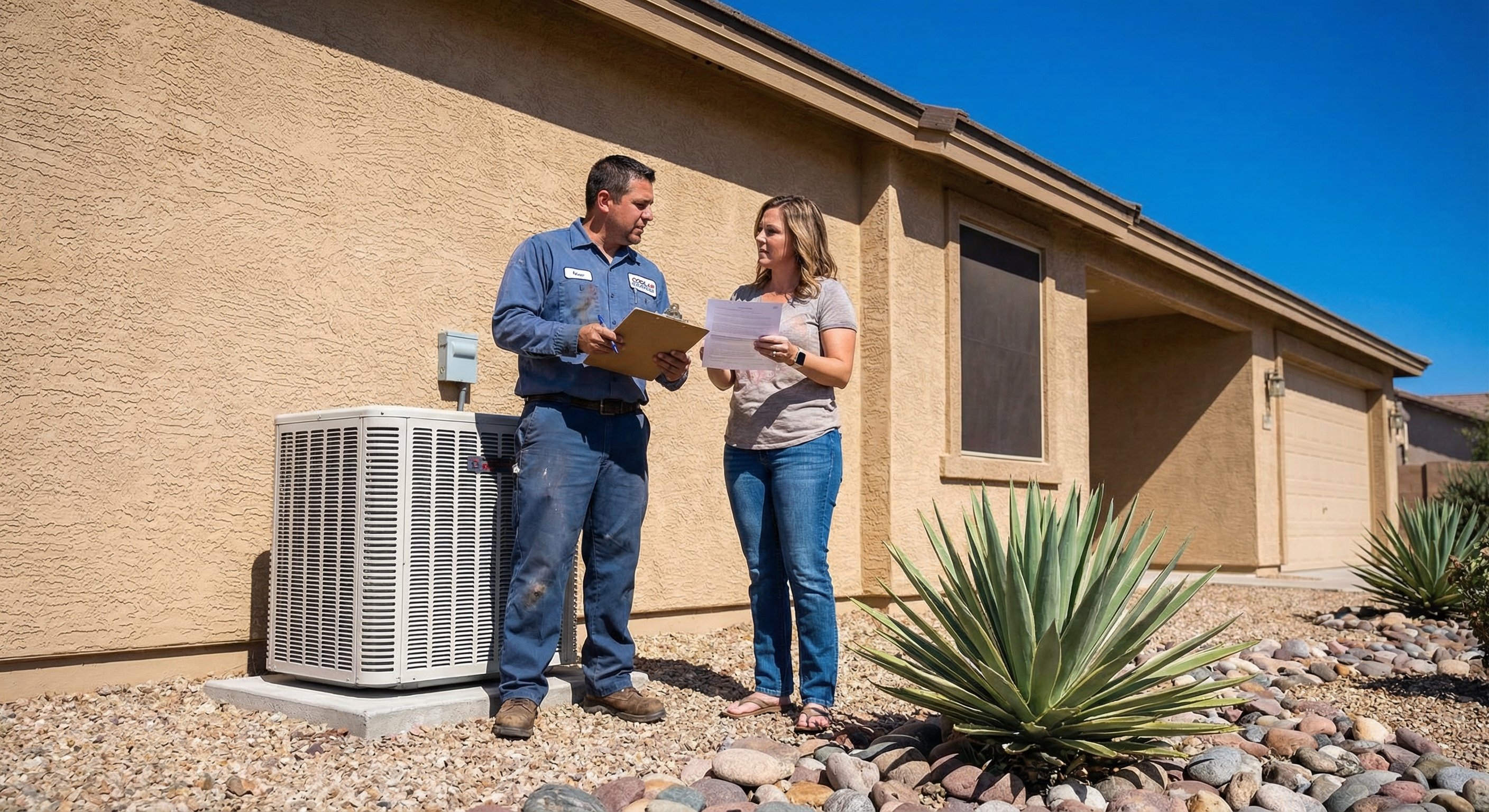
Skip the dealer markup
See What a New AC Actually Costs in Phoenix Metro, AZ
AC Rebel shows you the real equipment price — no sales pitch, no inflated quote. Get matched with a licensed installer and keep $3,000–$5,000 in your pocket.
Get My Direct Price →The Three-Quote Rule (and How to Actually Compare Them)
Always get at least three quotes. But here's what most homeowners miss: you have to compare apples to apples, and most quotes aren't structured to make that easy.
Before comparing prices, align the quotes:
Same tonnage. If one contractor recommends 3 tons and another recommends 4 tons, understand why. Load calculation is real — a 2,000 sq ft home with poor insulation in Gilbert can genuinely need 4 tons. But it's also an easy upsell.
Same SEER rating. A 16 SEER system and a 20 SEER system have legitimately different costs. Make sure you're comparing equivalent efficiency tiers.
Same brand tier. Goodman and Trane are both fine equipment — but they're different price points. A $6,500 Goodman install isn't the same as a $10,000 Trane install.
Ask each contractor: what is the unit model number? With a model number, you can look up the wholesale cost online. The spread between that and what you're quoted is the markup. Some markup is fair. 3x markup is not.
Verify permits are included in every quote before comparing totals.
Once you've aligned on these five factors, comparing prices becomes straightforward.
How to Use AC Rebel to Benchmark Before You Call Anyone
Here's a move most Phoenix homeowners don't know about: before you call a single contractor, check what the unit actually costs direct.
AC Rebel shows you the price of the AC unit itself — what you'd pay if you bypassed the dealer markup entirely. That number becomes your anchor. When a contractor quotes you $14,000 for an installed system and you can see the unit costs $3,800 direct, you now know you're being asked to pay $10,200 for what amounts to a day's labor plus overhead.
That's not necessarily wrong — but it's information you should have. Most homeowners sign quotes without it.
The quote wizard takes about two minutes. You enter your home details, see the direct unit price in one of three tiers (Good, Better, Best), and then compare that against what contractors are quoting you for the full installed package. Even if you ultimately go through a traditional contractor, knowing the unit cost changes the conversation.
Red Flags That a Quote Is Inflated
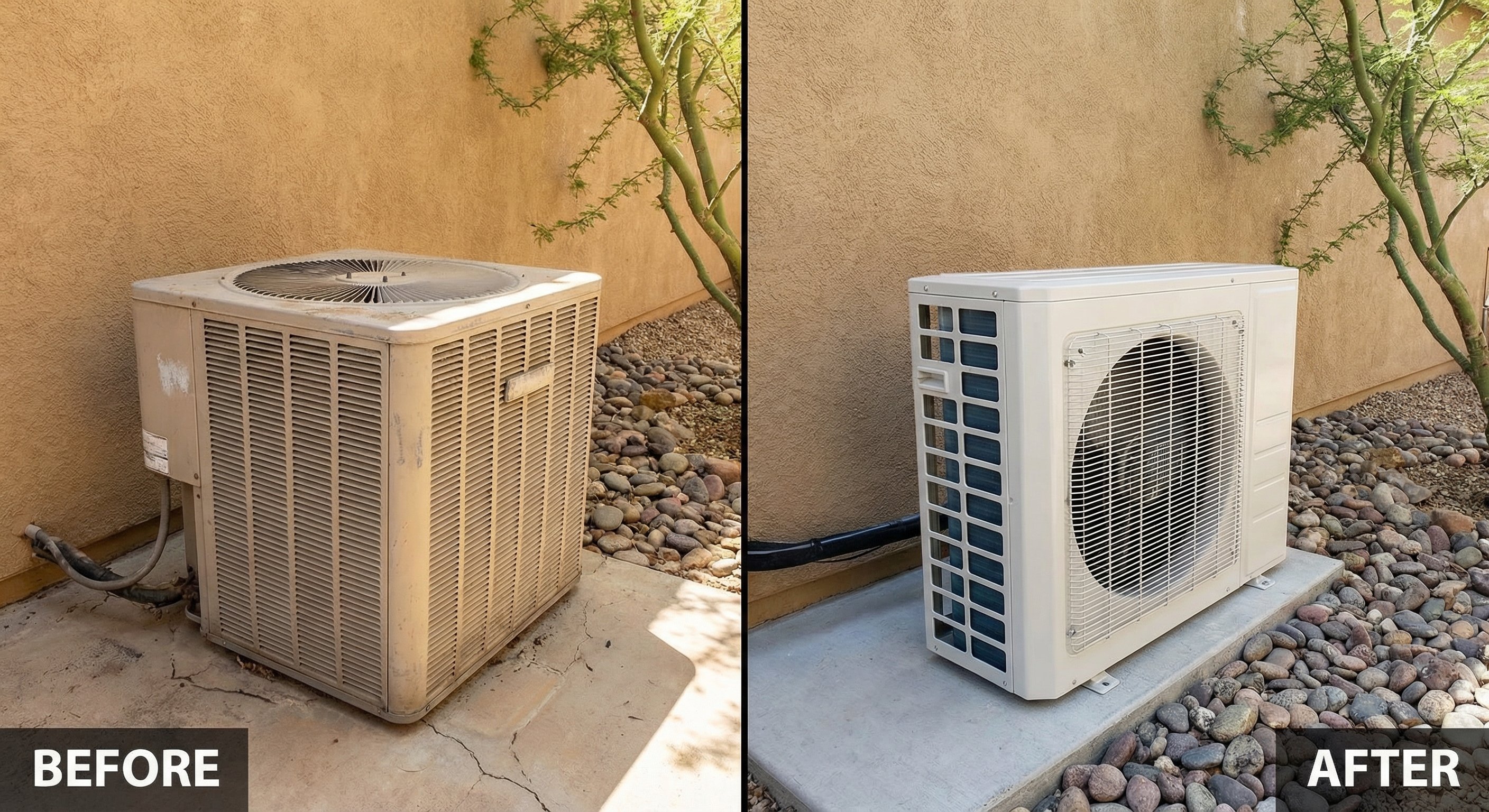
A quick checklist before you sign anything:
- No equipment line item. If they won't break out what the unit costs separately, that's a negotiation tactic.
- "Today only" pricing. Legitimate contractors don't do pressure sales. This is a $10,000 decision — you're entitled to 24 hours to think.
- No permit line item. See above.
- Vague add-ons. "System optimization" and "air quality package" with no explanation of what they actually are.
- Dramatic variation from other quotes. If three quotes range from $8,000 to $11,000 and one comes in at $16,000, the outlier needs a very specific justification.
- Heavily discounted from a "list price" you've never seen. The "list price" of $22,000 crossed out to show you $14,800 is a retail tactic, not a deal.
The Bottom Line
The Phoenix HVAC market has some fantastic contractors and some who rely on homeowners not knowing what fair pricing looks like. Most of the difference between a $9,000 quote and a $16,000 quote isn't quality — it's how much a company spends on sales commissions and advertising, and how much they expect to get because they know you're desperate and hot.
Get three quotes. Align them on the same specs. Ask for the unit cost as a separate line item. Look up the model number if they provide one. And use direct pricing as a benchmark before you start calling.
When you know what the unit actually costs, the rest of the quote makes a lot more sense.
Ready to see what direct pricing looks like? Check your quote on AC Rebel — it takes 2 minutes and shows you the unit cost before any dealer markup is added.
Frequently Asked Questions
Q: How much should a 3-ton AC replacement cost in Phoenix in 2026?
A fair installed price for a 3-ton AC replacement in the Phoenix metro (including unit, labor, and permits) runs $7,500–$10,500 for quality mid-range equipment like Carrier, Lennox, Trane, or Rheem. Variable-speed high-efficiency systems run higher. Quotes above $13,000–$14,000 for a standard 3-ton install in a typical home deserve scrutiny.
Q: What's the biggest source of markup in an AC quote?
The equipment cost is where the most markup lives. In a traditional contractor quote, the AC unit itself — which might wholesale for $2,500–$4,000 — can be marked up 40–100% before labor is even added. Asking for the unit cost as a separate line item and looking up the model number online is the fastest way to see where you stand.
Q: Should I get multiple AC quotes in Phoenix?
Yes — always get at least three. But getting three quotes is only useful if you compare them on the same terms: same tonnage, same SEER rating, same brand tier, and with permits explicitly included in every quote. Comparing a 16 SEER Goodman at $7,500 against a 20 SEER Trane at $11,500 isn't the same comparison.
Q: Is it okay to negotiate an AC quote?
Yes, and it's common in Phoenix's competitive HVAC market, especially outside peak summer months. Equipment cost is harder to negotiate, but labor, add-ons, and service contracts often have room. If a contractor used pressure tactics ("today only" pricing), that's actually a sign they expect pushback — and have room to move.
Q: What happens if I skip the permit on an AC installation?
Skipping a mechanical permit is risky in Maricopa County. You can run into problems when selling your home (permit records are pulled in title searches), your homeowner's insurance may not cover equipment damage from an unpermitted installation, and some manufacturer warranties require permitted installs. Permit fees are minor ($75–$250) — any contractor trying to skip them to hit a price point is cutting a corner you'll eventually pay for.
Q: Why do Phoenix AC quotes vary so much?
Several legitimate factors affect price: system size, brand tier, efficiency rating, and whether ductwork or electrical work is needed. But a significant portion of variation is also business model — a company with TV commercials, commissioned sales reps, and a large call center has higher overhead than a smaller local installer. That overhead ends up in your quote.
Ready to stop overpaying?
See Your Direct AC Price in 2 Minutes
Skip the dealer. Buy your AC unit at direct pricing and pay a vetted local installer only for the installation. No sales calls. No hidden markup. Most homeowners save $3,000–$5,000+ compared to a traditional quote.
Get My Direct Price — No Credit Card2-minute quote · Licensed installers · 10-year warranty options