
Best AC Brands for Arizona's Extreme Heat (2026 Rankings)

Best AC Brands for Arizona's Extreme Heat (2026 Rankings)
TL;DR: In Arizona, AC brand choice matters more than almost anywhere else in the country. Your unit will run 3,000+ hours a year in temperatures that reach 115°F — about double what most HVAC equipment was designed to endure. The top performers for Arizona homes are Trane (most durable under sustained load), Carrier (best mid-range balance of efficiency and price), and Lennox (top efficiency ratings for SRP/APS bill savings). Rheem and Goodman offer solid value for budget-conscious buyers, with Goodman carrying the best warranty in its class. Avoid the lowest-tier no-name units entirely — they're designed for moderate climates and fail fast in the desert.
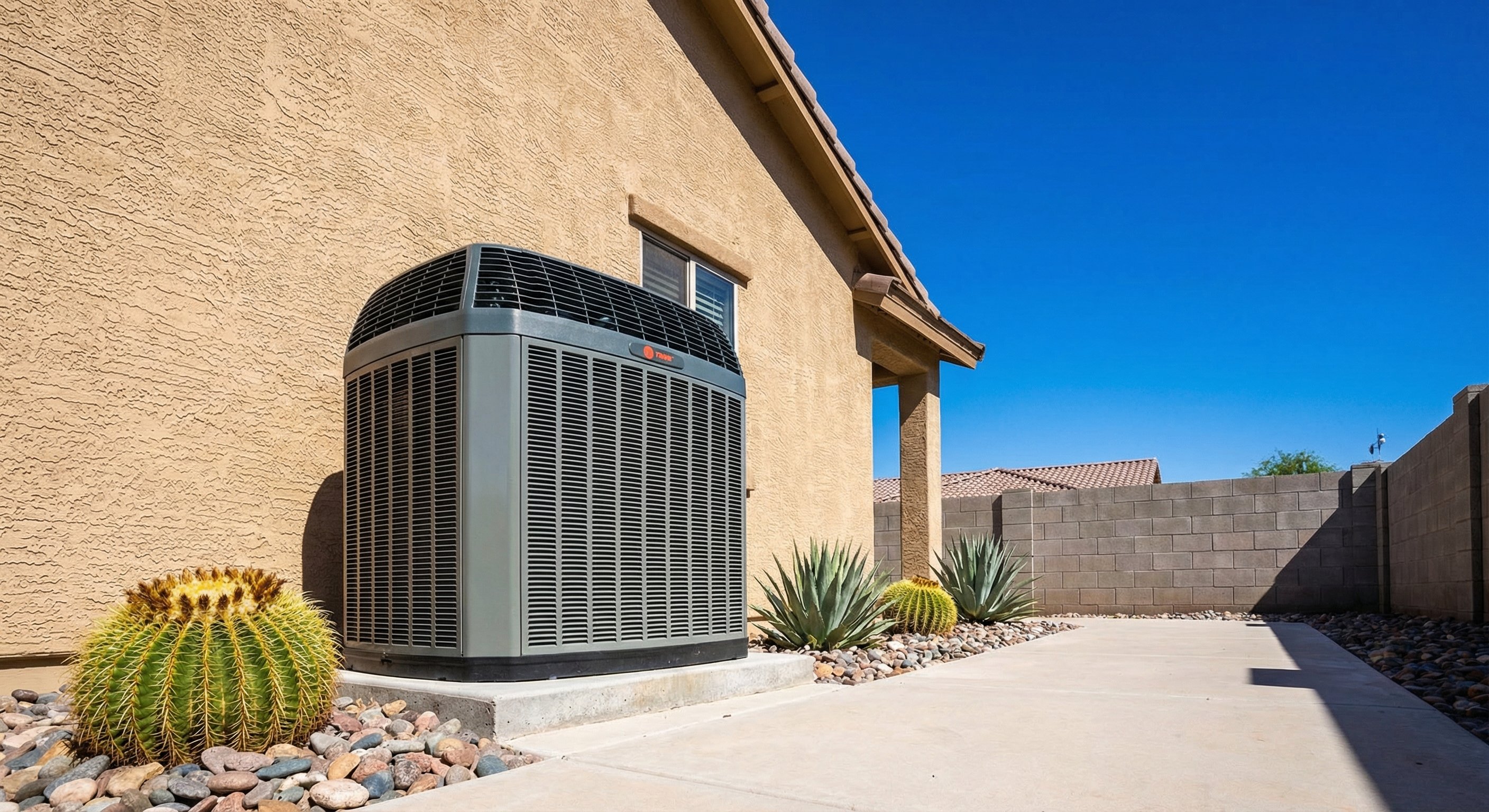
Arizona isn't a normal AC market. The national average household runs their air conditioner about 750 hours per year. In Phoenix? Try 3,000+ hours. Your unit doesn't get June through September off — it runs continuously, fighting outdoor temps that regularly hit 115°F, monsoon humidity that spikes in July and August, and desert dust that clogs coils faster than any climate in the country.
That changes everything about which brands hold up and which ones fall apart.
This guide is specifically for Arizona homeowners — not a recycled national ranking. We'll tell you which brands actually perform in the desert, what specs actually matter here, and where the real quality gaps are.
Why Brand Choice Is Different in Arizona
Before we rank anyone, you need to understand what makes the Arizona environment brutal on HVAC equipment:
Sustained high-load operation. Most compressors are engineered around 2,000-3,500 operating hours per year. In Phoenix, you're pushing 3,000-4,000 hours annually. Manufacturers design their warranties around average use — your use is not average.
Ambient temperatures at or above rated limits. Most residential AC units are rated for operation up to 115°F outdoor ambient temperature. In Maricopa County, we're routinely AT that limit. Cheap units with lower operational ratings (some are only rated to 105°F) will trip high-pressure cutoffs and short-cycle, wearing out faster.
Hard water and coil scaling. Arizona's water is notoriously hard. This leads to scale buildup on evaporator coils over time, reducing efficiency and eventually causing refrigerant leaks. Brands with thicker coil construction and better corrosion treatment handle this better.
Dust and particulates. Phoenix sits in a desert basin. Monsoon season brings massive dust storms. That dust gets into condenser coils, filters, and capacitors. Units with tighter tolerances and better filtration paths perform better longer.
Flat roofs. A significant percentage of older Arizona homes (pre-1990s, particularly in Phoenix, Mesa, and Glendale) use rooftop package units rather than split systems. Brand selection for rooftop units has different dynamics — fewer options, different service considerations.
The Rankings: Best AC Brands for Arizona
1. Trane — Best Overall for Arizona Durability
Trane's reputation in the Phoenix market isn't marketing hype — it's contractor consensus built over decades. Their Comfort R spine fin coil design (patented, not licensed) handles Arizona's dust and hard water conditions better than most alternatives. The fin pattern resists clogging, and the coil material is thicker than standard.
What Arizona homeowners report: Trane units consistently hit 12-15 year lifespans in Phoenix — the high end of what's realistic here. Their XV20i and XR series are the workhorses you'll see most often in Scottsdale and Gilbert.
Best for: Homeowners who want to install it once and forget about it for 12-15 years. Higher upfront cost ($4,000-$6,500 for the unit), but lower long-term service costs.
Key specs for AZ:
- XV20i: 22 SEER2, rated to 125°F ambient (highest in class)
- XR16: 17 SEER2, single-stage, solid entry-level option
- 10-year parts warranty (register within 60 days)
Honest caveat: Trane parts can run 20-30% more expensive than competitors when you need them. And in Phoenix's contractor market, Trane can sometimes get bundled with higher installation quotes. Separate the equipment cost from the labor cost when evaluating.
2. Carrier — Best Mid-Range Balance
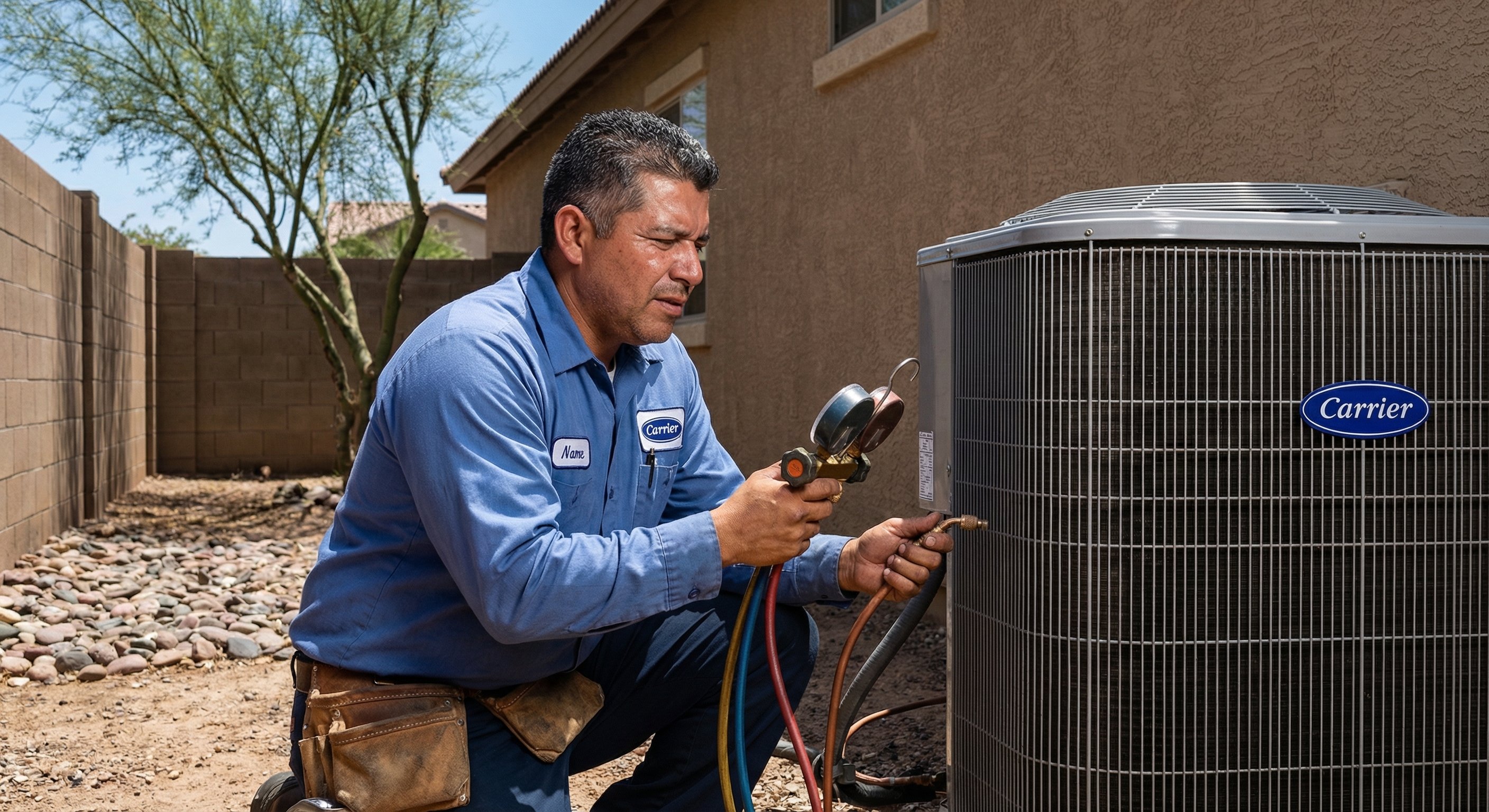
Carrier is the other name Arizona HVAC techs consistently recommend without hesitation. Their WeatherMaker and Infinity series are engineered with Arizona conditions in mind — the Infinity 24ANB1 is specifically designed for high-ambient-temperature operation.
The Carrier Infinity system with its variable-speed compressor handles Arizona's "runs constantly all day" operating pattern better than single-stage systems. Instead of cycling on at 100% and off repeatedly, it modulates down to 40-50% capacity during cooler morning hours and ramps up as the day heats up. This dramatically reduces compressor wear.
Best for: Homeowners who want excellent long-term efficiency combined with reliability, particularly in 1,800-2,800 sq ft homes where variable speed really pays off on the SRP or APS bill.
Key specs for AZ:
- Infinity 24ANB1: 21 SEER2, variable-speed, ideal for extended Arizona operation
- Performance 17: 18 SEER2, good mid-range option
- 10-year parts warranty
Honest caveat: Carrier's contractor network in Phoenix is large, which is a double-edged sword. Plenty of certified techs, but also more variance in installation quality. Vet your installer regardless of brand.
3. Lennox — Best Efficiency If SRP/APS Bills Are Your Main Concern
If your primary goal is minimizing your summer electricity bill, Lennox wins on paper. Their XC25 reaches 28 SEER2 — the highest efficiency rating of any major residential AC brand. For an APS customer running AC heavily from May through September, the efficiency premium pays back faster than you'd expect when bills are hitting $350-500/month.
The tradeoff: Lennox equipment is built with tighter tolerances, which means it's slightly more sensitive to installation quality and maintenance. A Lennox unit installed by a certified Lennox dealer in Chandler or Tempe will run beautifully. The same unit installed carelessly won't reach its rated efficiency.
Best for: Energy-focused homeowners, larger homes (2,500+ sq ft), people planning to stay in the home 10+ years where the efficiency savings compound.
Key specs for AZ:
- XC25: 28 SEER2, variable-speed (highest efficiency available)
- XC21: 21 SEER2, good balance point
- ML14XC1: 15 SEER2, budget-friendly entry
- 10-year warranty (parts and compressor)
4. Rheem — Best Value Mid-Tier
Rheem doesn't get the same industry prestige as Trane or Carrier, but Arizona installers respect it for a reason: it holds up. Rheem's Classic Plus and Prestige series are well-suited to Arizona's conditions, competitively priced, and have some of the most widely available replacement parts in the market.
When your capacitor fails on a 112°F July Saturday (and eventually it will — capacitors are the most common failure point in Arizona), Rheem parts are available at most HVAC supply houses. That matters for repair turnaround.
Best for: Budget-conscious homeowners who don't want to sacrifice reliability. Also strong for rental property owners — Rheem's price/performance ratio makes sense when managing multiple properties.
Key specs for AZ:
- Prestige RA20: 20 SEER2, variable-speed
- Classic Plus RA17: 17 SEER2, solid performer
- 10-year limited parts warranty
Honest caveat: Rheem's contractor support documentation and technical resources lag behind Trane and Carrier. If you need a highly specialized repair, it can take longer to find a tech who knows the unit cold. In Phoenix's competitive service market, this matters less than in rural Arizona.
5. Goodman — Best Budget Option With Solid Warranty
Goodman is the brand HVAC contractors love to upsell from — but that doesn't mean it's bad. In fact, Goodman (owned by Daikin, one of the world's largest HVAC manufacturers) offers something few brands can match at its price point: a lifetime compressor warranty on select models.
Let that sink in. Most brands give you 10 years on the compressor. Goodman says it'll replace it for life, as long as you register within 60 days.
The real question with Goodman: Installation quality matters MORE with budget equipment. A well-installed Goodman in a well-maintained home will serve you. A poorly-installed Goodman in a home where filters haven't been changed in two years is a money pit.
Best for: Budget-focused buyers who commit to maintenance. Or homeowners with older ductwork who don't want to sink a premium unit into an aging system.
Key specs for AZ:
- GSXV9: 19 SEER2, variable-speed
- GSXH5: 16 SEER2, single-stage
- Lifetime compressor warranty (registered units)
What Specs Actually Matter in Arizona (vs. What Doesn't)
MATTERS: SEER2 Rating (But With Context)
SEER2 measures efficiency. Arizona's summer electricity costs make efficiency one of the most financially significant factors in your AC purchase — more so than in moderate climates. Each SEER2 point matters when you're running 10-12 hours a day for 5 months straight.
That said: going from 15 SEER2 to 25 SEER2 costs $1,500-2,500 more upfront. The payback calculation depends on your square footage, your current system's efficiency, and how long you plan to stay in the home. For a 2,000 sq ft home staying 8+ years, the high-efficiency unit pays back. For a home you're selling in 3 years, it probably doesn't.
MATTERS: High Ambient Temperature Rating
Look for units rated to 115°F or higher outdoor ambient temperature. Most major brands rate their standard units to 115°F, but entry-level budget units from smaller manufacturers sometimes cap out at 105°F or 110°F. In Phoenix, this will cause nuisance shutdowns on the hottest days.
MATTERS: Variable-Speed vs. Single-Stage Compressor
Single-stage: full blast or off. Variable-speed: can modulate between 40-100% capacity. For Arizona's extended operation, variable-speed significantly reduces compressor wear and improves dehumidification during monsoon season (single-stage units that cycle rapidly can't remove humidity as effectively).
Variable-speed units cost $1,000-2,000 more upfront. In Arizona's climate, it's usually worth it.
MATTERS: Coil Material and Design
Copper coils resist corrosion better than aluminum-only coils in Arizona's environment. Some brands use aluminum coils with coatings — that's acceptable. Pure aluminum coils without protective treatment corrode faster in the desert. Ask your installer about coil construction.
DOESN'T MATTER AS MUCH: Brand-Specific Smart Home Features
Trane's ComfortLink, Carrier's Infinity Control, Lennox's iComfort — they're all solid smart thermostats. But the honest reality is that a well-installed Google Nest or Ecobee works just as well for most homeowners. Don't pay a brand premium primarily for the smart thermostat.
Skip the dealer markup
See What a New AC Actually Costs in Phoenix Metro, AZ
AC Rebel shows you the real equipment price — no sales pitch, no inflated quote. Get matched with a licensed installer and keep $3,000–$5,000 in your pocket.
Get My Direct Price →The $3,000 Markup Problem Nobody Talks About
Here's the thing nobody in the traditional HVAC industry wants you to know: the brand of your AC unit matters less than the markup your contractor applies to it.
The same Carrier 3-ton unit costs roughly $1,800-2,200 wholesale. By the time it goes through the traditional distribution chain — distributor, supplier, contractor markup — it hits $4,500-6,000 on your invoice before a single wrench turns. That 2-3x markup is the industry standard, and it's been that way for decades.
This is why two homeowners in Peoria can both buy a "Trane 3-ton" and one pays $8,500 while the other pays $11,000 — the unit is nearly identical, the markup isn't.
AC Rebel was built specifically to cut that chain. We source equipment at near-wholesale pricing, you buy the unit directly, and a vetted local contractor handles installation only. The quality of the Trane, Carrier, or Lennox equipment you get is identical — you're just not paying for it three times over.
Most of our customers save $3,000-$5,000+ compared to traditional dealer quotes. That's not a rounding error — that's a significant chunk of the total cost of ownership.
See unit pricing on AC Rebel — transparent, real numbers, no markup games
Quick Reference: Brand Comparison for Arizona
| Brand | Best For | Arizona Durability | Efficiency | Warranty | Price Range (Unit Only) |
|---|---|---|---|---|---|
| Trane | Long-term durability | ⭐⭐⭐⭐⭐ | ⭐⭐⭐⭐ | 10 yr parts | $3,800–$6,500 |
| Carrier | Balanced reliability + efficiency | ⭐⭐⭐⭐⭐ | ⭐⭐⭐⭐ | 10 yr parts | $3,200–$5,800 |
| Lennox | Maximum efficiency / bill savings | ⭐⭐⭐⭐ | ⭐⭐⭐⭐⭐ | 10 yr parts+compressor | $3,500–$6,200 |
| Rheem | Value mid-tier | ⭐⭐⭐⭐ | ⭐⭐⭐ | 10 yr limited | $2,600–$4,800 |
| Goodman | Budget + warranty coverage | ⭐⭐⭐ | ⭐⭐⭐ | Lifetime compressor | $1,800–$3,500 |
Price ranges are equipment-only estimates. Installation labor in the Phoenix metro typically runs $1,500–$2,500 depending on complexity, access, and whether ductwork modifications are needed.
Bottom Line: What Would We Do?
If it were our house in Phoenix:
- 2,000 sq ft or less, budget-conscious: Carrier Performance 17 or Rheem Prestige RA17 — solid reliability, reasonable cost, parts widely available.
- 2,000–3,000 sq ft, planning to stay 8+ years: Carrier Infinity 24ANB1 or Trane XV20i — the variable-speed efficiency payback is real at this size over that timeframe.
- 3,000+ sq ft, high SRP/APS bills: Lennox XC21 or XC25 — the efficiency premium pays back faster at this scale.
- Rental property or tight budget: Goodman GSXH5 with the lifetime compressor warranty, well-installed, maintained quarterly.
Avoid the urge to let a contractor upsell you on features you don't need — and equally, don't go so cheap that you're replacing it in 7 years. Arizona is the worst place in the country to make either mistake.

Frequently Asked Questions
What is the most reliable AC brand in Arizona?
Trane and Carrier consistently rank as the most reliable in Arizona's desert climate, based on contractor feedback and industry repair data. Both are engineered for sustained high-load operation, have high ambient temperature ratings (115°F+), and have large service networks in the Phoenix metro. Trane is typically cited first for durability; Carrier for the best balance of durability and efficiency.
Does AC brand matter in Arizona more than other states?
Yes, meaningfully so. Arizona AC units run 3,000-4,000 hours per year compared to 750-1,500 hours in moderate climates. That accelerated wear means quality differences between brands compound faster. A brand that might last 20 years in Minnesota lasts 10-12 in Phoenix — and a lower-quality unit might last only 6-8.
Is Goodman a reliable AC brand for Phoenix homes?
Goodman is a legitimate option — especially with its lifetime compressor warranty on registered units. It's made by Daikin, one of the world's largest HVAC manufacturers. The honest caveat is that budget equipment has less margin for error: installation quality and maintenance frequency matter more. Properly installed and maintained, a Goodman performs well in Arizona. Neglected, it fails faster than premium brands.
What SEER rating should I get for Arizona?
In Arizona, we recommend a minimum of 16 SEER2 for new installations, with 18-21 SEER2 being the sweet spot for most homeowners. The efficiency math works out differently here than in moderate climates — your unit runs so many more hours per year that high-efficiency equipment pays back faster. Going above 21 SEER2 (into Lennox XC25 territory) makes financial sense primarily for larger homes (3,000+ sq ft) with high utility bills.
How much does a new AC unit cost in Arizona (brand comparison)?
Equipment-only costs for a standard 3-ton residential AC unit in Arizona:
- Trane XR16 (3-ton): ~$2,800–3,800
- Carrier Performance 17 (3-ton): ~$2,600–3,500
- Lennox XC21 (3-ton): ~$3,000–4,000
- Rheem Prestige (3-ton): ~$2,200–3,200
- Goodman GSXH5 (3-ton): ~$1,600–2,500
Through traditional HVAC dealers, add 2-3x for distribution and contractor markup. Total installed quotes typically run $7,000–$12,000 depending on brand and complexity.
Trane vs. Carrier: which is better for Arizona heat?
Both are excellent — this is the most common debate in the Phoenix HVAC market and contractors genuinely use both with confidence. Trane's edge is in raw durability and its Comfort R coil design, which handles Arizona dust better. Carrier's edge is in variable-speed efficiency and the breadth of its certified dealer network. If you're optimizing purely for longevity, lean Trane. If you're optimizing for efficiency + reliability balance, lean Carrier. Either way, the installer matters as much as the brand.
Ready to stop overpaying?
See Your Direct AC Price in 2 Minutes
Skip the dealer. Buy your AC unit at direct pricing and pay a vetted local installer only for the installation. No sales calls. No hidden markup. Most homeowners save $3,000–$5,000+ compared to a traditional quote.
Get My Direct Price — No Credit Card2-minute quote · Licensed installers · 10-year warranty options