
Attic Insulation in Phoenix: The Secret to Lower Bills and a Stronger AC

Attic Insulation in Phoenix: The Secret to Lower Bills and a Stronger AC
TL;DR: Phoenix attics regularly hit 140 to 150 degrees in summer, and the wrong insulation lets that heat bleed straight into your living spaces. Upgrading from R-19 to R-49 attic insulation in a typical 2,000-square-foot Phoenix home costs $1,200 to $2,500 installed, and most homeowners see 15 to 30 percent lower cooling bills within the first summer. The biggest gains come from air sealing before you add insulation, and from making sure your ductwork is not running through an unconditioned attic. Start with a hand-calculation or thermal camera audit if your home is over 15 years old.

It is 108 degrees outside and your thermostat is set to 76. Your AC has been running since 9 a.m. and it is only noon. You are not alone. Every summer, Phoenix homeowners blame their air conditioner for failing to keep up, and in some cases they are right. But in a shocking number of homes, the AC is actually working fine. The problem is in the attic.
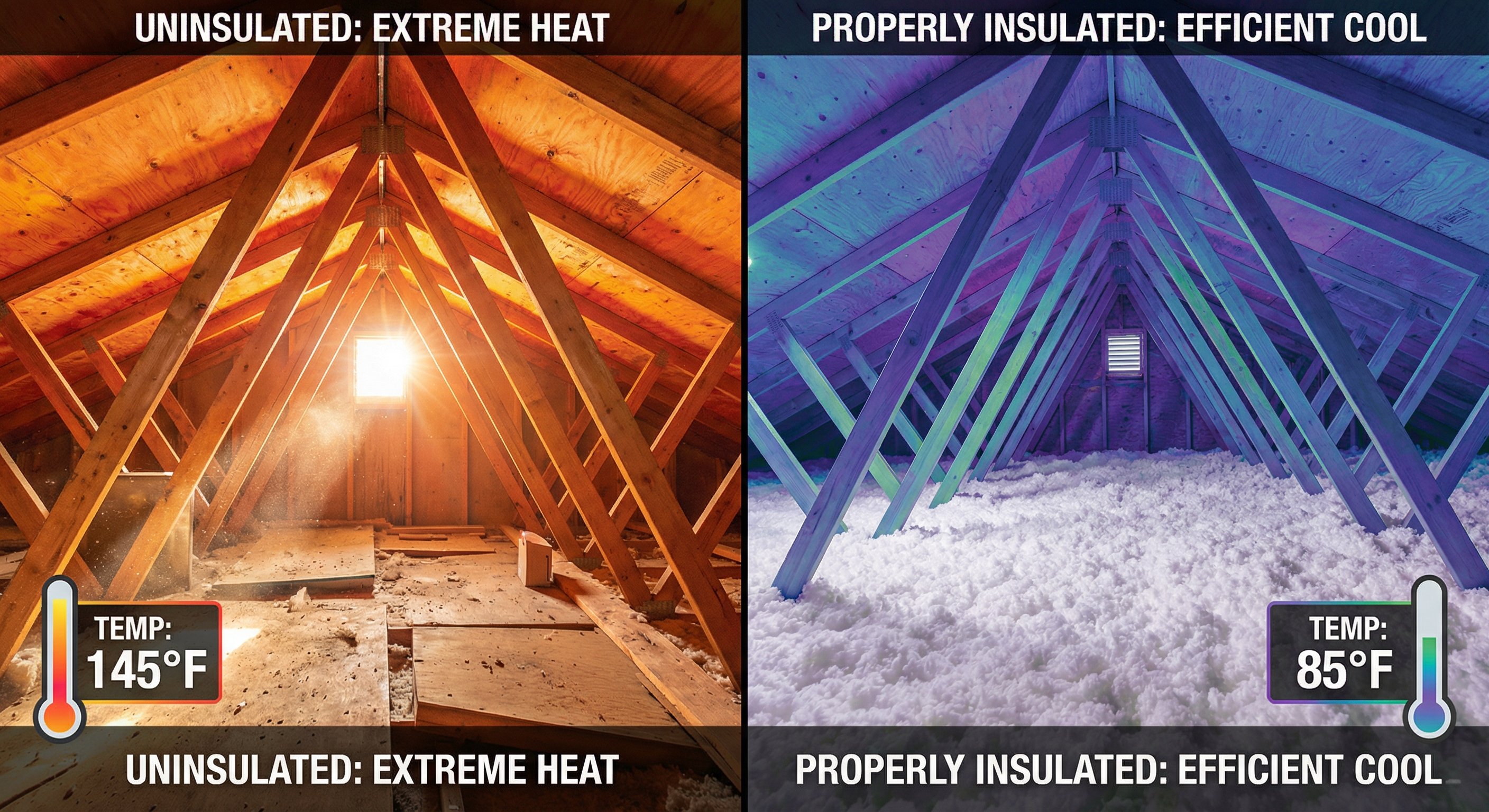
Your attic in Phoenix is not just hot. It is a radiative heat machine. While the sun is up, your roof absorbs every photon that hits it and re-emits that energy as infrared radiation downward, into your attic space. On a clear 108-degree Phoenix afternoon, an uninsulated attic can hit 140 to 150 degrees. That heat does not just sit there politely. It migrates through the ceiling into your living space, and it makes your AC fight a constant uphill battle just to maintain 76.
Most homeowners do not think about attic insulation until something breaks or the electric bill arrives. By then, you have already spent all summer paying for conditioned air you did not need and an AC running at full throttle for no reason.
What R-Value Actually Means for Your Phoenix Home
Insulation is rated by R-value, which measures thermal resistance. Higher R-value means the material resists heat flow more effectively. The Department of Energy classifies most of Arizona as Zone 2, and its recommended minimum attic insulation for Zone 2 is R-49. Many Phoenix homes, particularly those built before 2000, were insulated to R-19 or R-30 at best.
Here is what those numbers mean in practice. R-19 insulation, which is common in older Phoenix homes, provides roughly 5 to 6 inches of fiberglass batting. R-38, which is closer to current code minimums for new construction in the Phoenix area, provides about 10 to 12 inches. R-49, the full recommended level, provides roughly 14 to 16 inches of fiberglass or a comparable depth of blown-in cellulose or fiberglass.
The difference in heat blocking between R-19 and R-49 is not linear. Heat flows faster through thin insulation because the temperature differential between the hot side and the cool side is larger per inch of material. Going from R-19 to R-38 cuts heat flow roughly in half. Going from R-38 to R-49 cuts what is left by another 20 to 25 percent. The first few inches of insulation do the most work, which is why adding any insulation to an uninsulated attic delivers immediate returns, but finishing the job to R-49 delivers the full performance picture.
Why Phoenix Attics Are Different From Attics Anywhere Else
Phoenix has three compounding climate factors that make attic insulation more important here than in almost any other major metro area in the country.
First, the solar intensity. Phoenix receives more than 300 days of sunshine per year, and the high-altitude angle in summer means direct solar radiation hits your roof at near-vertical angles. Your roof absorbs this energy all day long and re-radiates it all night. In a humid climate like Houston, the clouds and rain provide natural cooling periods. Phoenix does not have that.
Second, the monsoon season. July through September brings humidity, which sounds like relief until you realize what it does to your attic. Moisture-laden air hitting a cool surface condenses, and in an attic with inadequate ventilation or existing moisture issues from poor insulation, you end up with damp insulation that loses R-value fast and can lead to mold in the attic or on the ceiling below.
Third, hard water and dust. Phoenix has hard water, and the mineral residue that settles on evaporator coils from the air supply reduces coil efficiency. That same hard water mineral dust, combined with the fine desert dust that gets pulled into attics through soffit vents, coats the top of your ceiling insulation over years, reducing its loft and its R-value. A 10-year-old home in Gilbert that was insulated to code at R-38 is probably reading closer to R-30 effective R-value by now just from dust compaction and settling.
The Air Sealing Step Nobody Talks About
Before you add another inch of insulation, you need to address air sealing. This is the step that most insulation contractors skip or bury in fine print, and it is arguably more important than the insulation itself.
Air sealing means stopping the movement of air between your living spaces and your attic. In a Phoenix home, the pressure differential between a 72-degree interior and a 145-degree attic attic creates a chimney effect. Warm air rises, escapes through every gap it can find in your ceiling, and pulls hot attic air right back in through other gaps. You can have R-60 insulation and still lose 30 percent of your cooling energy if the air is bypassing the insulation entirely through gaps and cracks.
The most common air leakage points in Phoenix homes are around light fixtures that penetrate the ceiling, around supply and return register boots in the attic floor, around the attic access hatch or pull-down stairs, around any plumbing vent stacks, and in homes with dropped ceilings or recessed lighting, around those fixture housings. In older Mesa and west Phoenix homes with older construction, the top plate of interior walls, where the drywall meets the wood framing, is a notorious bypass point.
A proper air sealing job for a 2,000-square-foot Phoenix home typically runs $300 to $800 depending on accessibility and the number of penetration points. It is almost always worth doing before you add insulation, because the insulation will only work as well as the air barrier system behind it.

Skip the dealer markup
See What a New AC Actually Costs
AC Rebel shows you the real equipment price — no sales pitch, no inflated quote. Get matched with a licensed installer and keep $3,000–$5,000 in your pocket.
Get My Direct Price →What Ductwork in an Unconditioned Attic Is Costing You
If your ductwork runs through the attic, and most Phoenix homes built before 2005 have flex duct running through the attic space, you have a second major efficiency problem. Flex duct in an unconditioned attic in Phoenix is one of the most inefficient things you can have in a home cooling system.
The air inside your supply ducts needs to be at roughly 55 degrees when it leaves the evaporator coil to cool your home properly. If that duct runs through a 145-degree attic for 30 feet before it reaches your living room register, by the time the air arrives it has picked up 10 to 15 degrees of heat. Your AC has to produce colder air to compensate, which makes it run longer and harder, and your energy bill reflects every degree of that penalty.
The fix is either to move the ductwork into the conditioned space, which is expensive and disruptive, or to insulate the living daylights out of the existing ductwork. For flex duct, you want duct wrap insulation of at least R-8 on the exterior, and every joint and connection should be sealed with mastic, not duct tape, because duct tape dries out and fails in Phoenix heat within a few years.
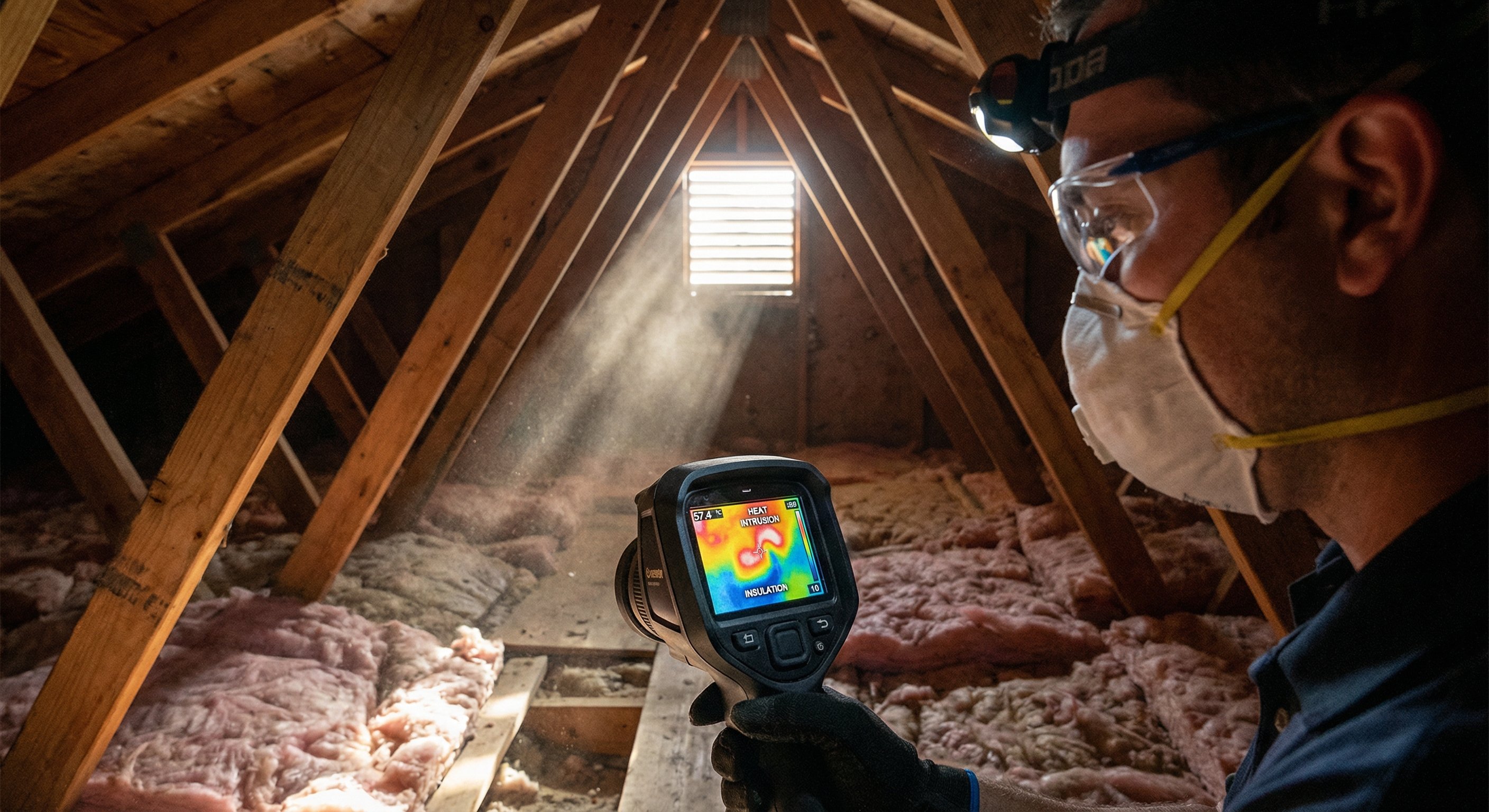
If your ductwork is in the attic, a thermal imaging audit before and after insulating and sealing it is the clearest way to see exactly where the losses are coming from.
Adding Insulation: What It Costs in a Phoenix Home
For a typical 2,000-square-foot Phoenix home with an accessible attic and no major air sealing needed yet, here is what upgrading insulation costs in 2026.
Blown-in fiberglass, the most common approach for retrofits, runs $0.75 to $1.50 per square foot for material and labor. To blow an attic from R-19 to R-49 across 2,000 square feet of ceiling, you are looking at $1,500 to $3,000 total in most Phoenix neighborhoods. Cellulose blown-in insulation runs roughly $1 to $2 per square foot, so $2,000 to $4,000 for the same job. Spray foam, which both insulates and air seals simultaneously, runs $2 to $4 per board foot and would be $6,000 to $12,000 for a full attic, which is overkill for most homeowners unless you are building new or doing a gut renovation.
Most homeowners in the Phoenix market adding blown-in insulation to an accessible attic spend in the $1,200 to $2,500 range for a complete job including air sealing of the major penetration points.
For context on the payoff, the average APS residential customer in Phoenix pays $140 to $220 per month in summer months (June through September) for a 2,000-square-foot home with a 3-ton AC system. A 15 to 25 percent reduction in cooling load from proper attic insulation translates to $20 to $55 per month in summer electric savings. Over a full summer, that is $80 to $220 in savings. Over five years, $400 to $1,100 in savings, which is roughly equivalent to what you spent on the insulation in the first place. But the comfort and AC longevity benefits, which are harder to quantify, are where the real value shows up.
When to Call a Pro Versus Doing It Yourself
Adding blown-in insulation to an accessible attic is a doable DIY project if you are comfortable working in a 140-degree attic in July, renting the blowing machine, and buying the insulation in bags from a Phoenix supply house. The material cost for blown-in fiberglass for a 2,000-square-foot attic is roughly $600 to $900 in bags. Renting the blowing machine is typically $50 to $80 per day from a Phoenix tool rental place.
The DIY route makes sense if your attic is easy to access, you have a helper, and you are confident about the air sealing step. Do not skip the air sealing. The blown-in insulation will cover the gaps and make them invisible, but the air will still leak and you will not have fixed the underlying problem.
Call a pro for attic insulation if your home has limited attic access, if there is existing insulation that needs to be removed, if you have knob-and-tube wiring in the attic, if you suspect asbestos in older insulation, or if you want a full thermal imaging audit done before and after so you have documented proof of what the upgrade actually accomplished.
For a Phoenix homeowner, the combination approach that gives the best results is: air sealing first, then blown-in insulation to R-49, then duct wrap on any exposed ductwork in the attic. That three-step approach, done properly, can cut your summer cooling load by 20 to 30 percent on its own, before you ever touch your AC.
The Connection Between Insulation and Your Next AC Purchase
Here is something most Phoenix homeowners do not think about until they are in the middle of an AC replacement decision. If you are running a new high-efficiency AC, the rated efficiency of that unit is based on it operating under specific conditions. In a Phoenix summer, your AC is already operating outside its optimal temperature range. When it is 115 degrees outside, a SEER 22 unit is not performing at its rated efficiency because the condensing temperature in the outdoor coil is so high that the compressor works harder for every degree the outdoor temperature climbs.
Proper attic insulation lowers the effective load on your AC by reducing the heat gain your system has to overcome. That means your new high-efficiency unit spends more of its capacity actually cooling your home and less of its capacity fighting attic heat. If you are spending $8,000 to $12,000 on a new AC and you have a 145-degree attic, you are effectively negating 15 to 20 percent of the efficiency you paid for by not fixing the envelope first.
The smart sequencing, if you are planning a replacement in the next two to three years, is to insulate and air seal the attic first, then buy the AC. You will buy a smaller, less expensive unit than you thought you needed, and it will perform better than a larger unit would in an under-insulated home.
Frequently Asked Questions
Q: How do I know if my Phoenix home needs more attic insulation?
The easiest check is to look in your attic. If you can see the top of your ceiling joists, you probably have R-19 or less, which is inadequate. If the insulation is level with or below the top of the joists, you need more. If you can see the subfloor or the drywall of your ceiling through the insulation, you definitely need more. For a more precise answer, hire a home energy auditor with a thermal camera in Phoenix. Most charge $200 to $400 for a whole-home audit and will give you a written report with heat map images showing exactly where your insulation is failing.
Q: Does adding attic insulation in Phoenix really lower my electric bill?
Yes, measurably. The Department of Energy estimates that sealing and insulating attics in hot climates like Phoenix can reduce cooling costs by 15 to 30 percent. The exact number depends on how under-insulated your home was to begin with, how well the air sealing was done, and how your ducts are configured. A home with R-19 insulation in a Gilbert 2,000-square-foot home might see $25 to $50 per month in summer savings after upgrading to R-49 with proper air sealing.
Q: Is blown-in fiberglass or cellulose better for Phoenix attics?
Both work. Blown-in fiberglass is the most common and least expensive. Cellulose has a slightly higher R-value per inch and performs marginally better in hot climates because it is denser and has less air circulation through the material. For most Phoenix homeowners, the choice comes down to cost and availability. If your attic has existing insulation that is uneven or compressed, blown-in over the top of it works well with either material.
Q: Should I ventilate my attic or seal it completely in Phoenix?
This is one of the most debated questions in Phoenix HVAC. The traditional approach has been to ventilate attics with soffit and ridge vents to let hot air escape. The newer approach, particularly for sealed attics where the insulation is on the attic floor and the attic space is not conditioned, is that ventilation matters less than air sealing between the living space and the attic. For most Phoenix homes with insulation on the attic floor, maintaining existing ventilation is fine. If you are spray-foaming the underside of your roof deck, that is a different construction approach that requires specific ventilation design.
Q: Can I add attic insulation over existing insulation?
Yes, and in most cases that is exactly what you should do. You can blow fiberglass or cellulose directly over existing batt insulation. The key is to make sure the existing insulation is not wet, moldy, or heavily infested with pests. If there is a moisture problem in the attic, fix that before adding insulation, because trapping moisture under new insulation creates conditions for mold and wood rot.
Q: How long does attic insulation last in Phoenix?
Properly installed fiberglass or cellulose insulation in a Phoenix attic will last 20 to 30 years or longer. The enemy is not age but damage: compression from foot traffic, water damage from roof leaks, and dust accumulation that reduces loft over time. If your home is over 20 years old and has never had additional insulation added, assume your effective R-value is lower than what was originally installed.
Q: What is the best time of year to add attic insulation in Phoenix?
Late winter through early spring, from February through April, is the ideal window. The attic is accessible and comfortable to work in, you can feel the difference immediately when you turn your AC on for the first 100-degree day, and you capture the full benefit of the summer cooling season. That said, attic insulation can be added any time of year. The work is done in the attic, not the living space, so your home is not disrupted.
Your AC in Phoenix works harder than almost any other climate in the country. The least you can do is give it a fighting chance. If your attic is under-insulated, every month you wait is money going directly to APS or SRP that you do not have to spend. Get a free quote for a new AC unit at acrebel.com, and while you are evaluating your cooling options, check your attic. A $1,500 insulation upgrade might mean you need a smaller, less expensive AC system than you thought.
Ready to stop overpaying?
See Your Direct AC Price in 2 Minutes
Skip the dealer. Buy your AC unit at direct pricing and pay a vetted local installer only for the installation. No sales calls. No hidden markup. Most homeowners save $3,000–$5,000+ compared to a traditional quote.
Get My Direct Price — No Credit Card2-minute quote · Licensed installers · 10-year warranty options