
Do UV Air Cleaners Actually Work in Phoenix AC Systems? Here's What the Research Says

Do UV Air Cleaners Actually Work in Phoenix AC Systems? Here's What the Research Says
TL;DR: UV air cleaners do work for specific problems in Phoenix AC systems, but not for everything sales pitches claim. They are most effective at keeping evaporator coils free of biological growth and eliminating odor sources from dirty coils and drain line backups. They do not filter dust, dander, or wildfire smoke. For Phoenix homeowners, the strongest case for UV is coil maintenance in systems running constant cooling under extreme heat, not general air quality improvement. Installation costs run $300-$800, with lamp replacements every 1-2 years at $50-$150 each.
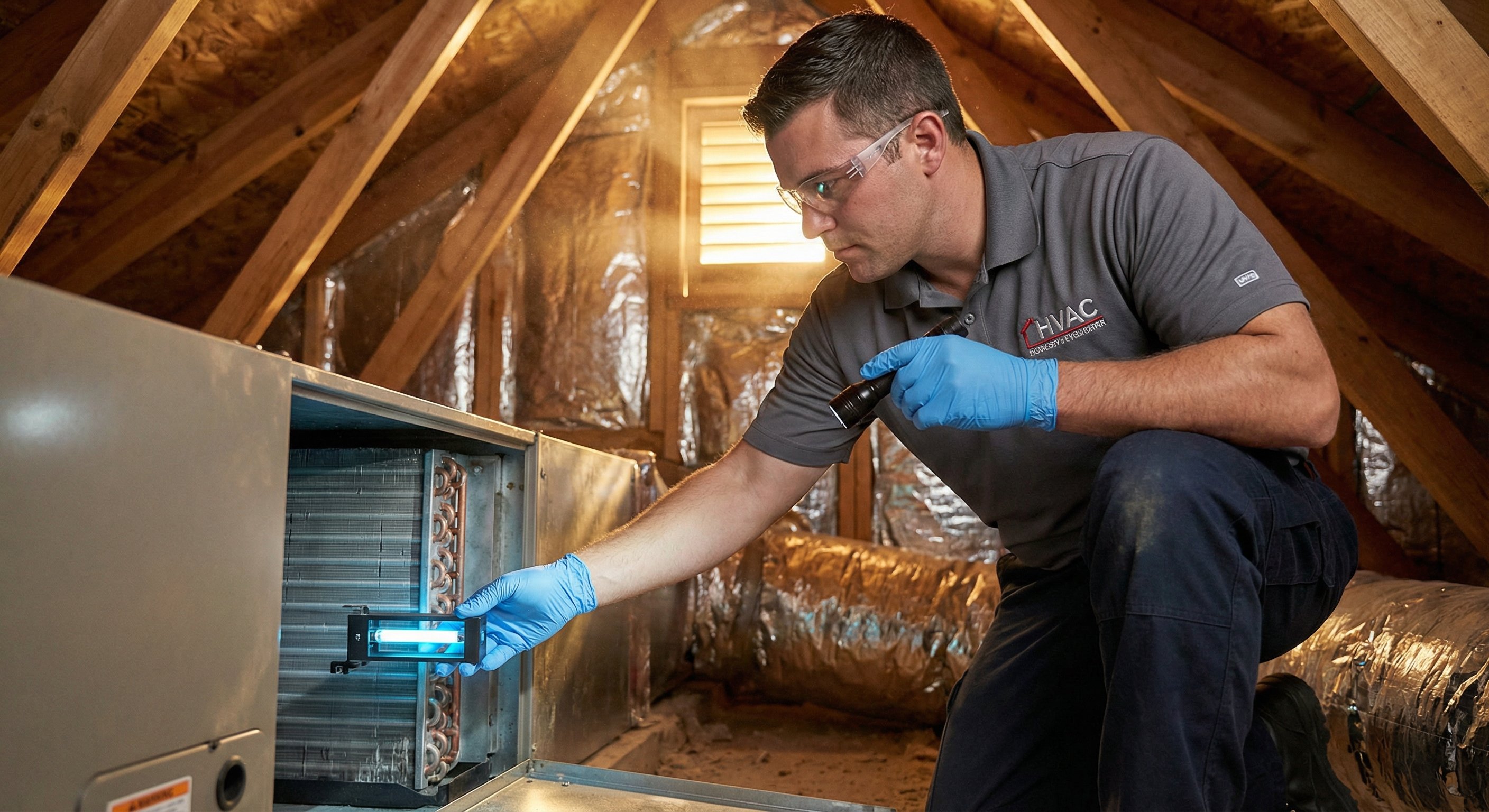
Walk into any Phoenix HVAC supply house and a salesperson will eventually steer you toward UV air cleaners. The pitch usually sounds something like this: kills 99.9% of germs, stops mold, purifies your air, protects your family. Some of that is true. Most of it is exaggerated. Here is what actually holds up under scrutiny.
What UV Air Cleaners Actually Are
A UV air cleaner for an AC system is a low-wattage ultraviolet lamp, typically UV-C wavelength (254 nanometers), mounted inside the ductwork or near the evaporator coil. The light runs continuously whenever the blower fan is on. It does not move air, filter particles, or change airflow. It only irradiates whatever passes through or sits in front of the light.
There are two common placements. Mounting near the evaporator coil is the most effective for system maintenance. Mounting in the supply or return ductwork is less effective because air moves too quickly through the light zone to get meaningful exposure.
The technology itself is not new. UV germicidal irradiation has been used in hospitals, water treatment, and food processing for decades. The question is not whether UV kills microorganisms. It does. The question is whether the residential UV setups marketed to Phoenix homeowners actually deliver the benefits claimed, and whether those benefits justify the cost.
Why Phoenix Conditions Are Different
Every HVAC contractor who works in the Phoenix metro knows this market is categorically different from the rest of the country in summer. Your system does not get to rest. When the thermostat reads 108°F outside and your home is 74°F inside, that evaporator coil is running condensing moisture from indoor air almost continuously from May through October. That is six months of constant latent heat removal in one of the most biologically active environments for AC systems.
Here is what that means in plain terms. Evaporator coils remove moisture from air. That moisture condenses on the coil fins and drips into the drain pan. In a Phoenix summer, the coil is wet most of the time. Warm, wet, dark conditions are exactly what biological growth likes. Algae, mold, and bacteria colonize coil surfaces, clog drain lines, produce musty odors, and reduce heat transfer efficiency.
The other Phoenix-specific factor is dust. Desert dust carries organic material, pollen, fungal spores, and biological particles into your system. Phoenix dust storms in June and July pull particulate levels well into unhealthy ranges. That dust coats your coil, your filter, and your ductwork. It feeds biological growth and reduces system efficiency simultaneously.
This is where UV lights have the strongest case in Arizona. Not because they clean the air, but because they suppress biological growth on the coil itself.
What UV Lights Actually Fix
After looking at the research and talking to contractors who have installed hundreds of these systems in Phoenix homes, here is an honest accounting of what UV actually does.
Evaporator coil cleaning and maintenance. This is the strongest use case. UV-C light at sufficient intensity prevents biological growth on coil fins. A 2012 study published in the International Journal of Refrigeration found that UV systems reduced microbial growth on evaporator coils by 75-90% compared to untreated coils in comparable conditions. In Phoenix, where coils stay wet for months under extreme heat, this directly translates to cleaner coils, better heat transfer, and reduced odor risk. The coil efficiency gain from biological-free fins is modest but measurable, roughly 2-5% in typical residential setups.
Drain line backups and biological odors. Mold and algae growing in the condensate drain line is one of the most common sources of musty AC odor in Phoenix homes. UV light near the coil reduces biological load enough that drain line backups become less frequent. If your AC smells bad every August, biological growth in the drain line is a likely cause, and UV addresses it directly.
Supply duct biological contamination. In older Phoenix homes with central return systems, supply ductwork can harbor biological growth, especially in the summer. UV installed in the supply duct near the air handler helps suppress this, though air velocity limits how much exposure individual particles get.
Allergen and particulate reduction. This is where the marketing gets aggressive and the evidence gets thin. UV does not filter particles. It does not capture dust, pollen, pet dander, or smoke particulate. If a contractor tells you UV will help with your allergies or your wildfire smoke problem, ask them to show you the mechanism. There is none. For particulate control, you need mechanical filtration, ideally a MERV 13 or higher filter and proper duct sealing.
Skip the dealer markup
See What a New AC Actually Costs
AC Rebel shows you the real equipment price — no sales pitch, no inflated quote. Get matched with a licensed installer and keep $3,000–$5,000 in your pocket.
Get My Direct Price →What UV Lights Do Not Do
This section matters because it is where most of the overselling happens.
UV does not purify air in any meaningful sense for general air quality. The light zone in a residential duct is too small and air velocity is too high for significant microbial kill rates in passing air. You would need停留 time measured in seconds for UV to inactivate the average airborne particle, and residential systems do not provide that.
UV does not stop viruses from spreading through your home. There are no published studies demonstrating meaningful viral load reduction in residential forced-air systems using consumer-grade UV lamps. The EPA, CDC, and ASHRAE have all declined to endorse UV as a primary viral control strategy in residential HVAC.
UV does not replace filtration. This is the critical point. Mechanical filtration (MERV 13 or better) and proper filter maintenance do more for indoor air quality in a Phoenix home than any UV system. If you are choosing between UV and upgrading your filter strategy, upgrade the filter first.
UV does not eliminate existing biological growth in your ductwork. UV prevents new growth. If you already have a musty smell problem caused by existing mold in your ducts, installing UV will not fix it. You need duct cleaning first.
How Much UV Air Cleaners Cost in Phoenix
Here is where it gets real. Residential UV air cleaner installation in the Phoenix metro typically runs $300-$800 for the equipment and labor, depending on system size and accessibility.
The lamp itself costs $50-$150 and needs replacement every 1-2 years, depending on usage. Some premium systems quote up to $1,500 installed, which, frankly, is markup-heavy for what the equipment actually costs. A basic single-lamp UV system from a reputable manufacturer (such as Aeroseptic, Fresh-Aire UV, or Honeywell) runs $120-$250 for the kit. Licensed installation typically adds $200-$400 in labor.
If a Phoenix contractor quotes you more than $1,200 for a basic residential UV air cleaner installation, get a second opinion. That equipment-to-labor ratio is not justified for a two-hour installation.
Here is a rough cost breakdown you can use as a reference:
| Component | Typical Phoenix Cost |
|---|---|
| UV lamp kit (single coil mount) | $120-$250 |
| UV lamp kit (dual lamp + duct) | $200-$400 |
| Professional installation labor | $200-$400 |
| Annual lamp replacement | $50-$150 |
| Full system cost (coil mount, installed) | $300-$800 |
The ongoing maintenance cost is real. Unlike a filter change, UV lamp replacement is easy to skip, which means many systems go years without fresh lamps. A UV light that has lost intensity due to aging bulbs does not clean coils effectively, but it keeps running and looking like it is working. If you install UV, put a calendar reminder for annual lamp replacement.
Should You Install UV in Your Phoenix AC?
Most Phoenix homeowners do not need UV. Here is how to know if you are the exception rather than the rule.
You should consider UV if: your AC has recurring musty or sulfur odors in summer that come back after duct cleaning. You live in an older central Phoenix home (pre-2000) with known biological buildup risk in the ductwork. You have an immunocompromised household member and want every reasonable layer of biological suppression in your system. You have documented biological growth problems (recurring drain line backups, algae in the drain pan).
You probably do not need UV if: you are mainly concerned about dust, allergies, or particulate air quality. A MERV 13 filter and a well-sealed duct system will do more for you at lower cost. You are installing UV because a contractor suggested it as a general air quality upgrade. That is overselling, not a bad product in the wrong application.
You should skip it if: you already have a standalone air purifier (HEPA) in your main living areas. UV and HEPA overlap in purpose without either doing their job better. The money is better spent on duct sealing and filter upgrades.
The Honest Verdict on UV for Phoenix AC Systems
UV air cleaners are not snake oil. The germicidal mechanism is real and well-documented. What is misleading is the sales framing. UV in a Phoenix AC system is a coil maintenance tool, not an air purification system. It helps your equipment run cleaner and reduces biological odor sources. It does not meaningfully improve the air you breathe in terms of particulate, allergen, or viral control.
If you are a Phoenix homeowner who has dealt with recurring drain line backups, musty AC smell in August, or biological growth on your evaporator coil, UV is a reasonable investment. If you are buying it because a contractor told you it will clean your air, push back on that claim and ask them to explain the mechanism. A good contractor will give you a straight answer. If they cannot, find one who will.
For most homeowners in the Phoenix metro, the better investment is a quality pleated filter (MERV 11 minimum, MERV 13 if your system can handle it), a seasonal duct inspection, and a smart thermostat that gives you filter change reminders. Those three steps do more for your system and your air quality than a UV lamp alone.
If you are ready to look at your options for a full system upgrade, including coil maintenance add-ons and financing, get a free quote at acrebel.com. No dealer markup. Direct pricing.
Frequently Asked Questions
Q: Does UV light in an AC system help with allergies in Phoenix?
UV light does not capture or remove common allergens like pollen, dust, pet dander, or mold spores. Those particles are too large and too fast-moving through ductwork for UV to inactivate them meaningfully. For allergy control, a MERV 13 or higher pleated filter and a standalone HEPA unit in bedrooms do far more than UV. If a contractor sells you UV for allergies, get a second opinion.
Q: How often do UV lamps in AC systems need to be replaced?
Most residential UV lamps lose effective output after 9,000 to 14,000 hours of use, which typically means 1-2 years in a Phoenix home running AC six or more months per year. Replace lamps annually before the cooling season starts. Some systems have indicator lights or smartphone alerts for lamp end-of-life. Check your specific model.
Q: Can UV lights damage my AC system?
UV-C lamps at residential intensity do not damage metal components, wiring, or refrigerant lines. The only material at risk is certain plastics and rubber components if they are in direct, prolonged exposure path of the light. Professional installers position lamps to avoid this. If you are considering a DIY installation, research the placement carefully.
Q: Does UV help with Phoenix dust and sand storms?
UV does not capture particulate. Desert dust, sand, and smoke particles pass through UV light unaffected. For dust and particulate control from Phoenix dust storms, focus on filter quality (MERV 13+), regular filter changes during high-dust seasons, and duct sealing. UV addresses biological growth on coils, not dust accumulation.
Q: Are there any health risks from UV lights in an AC system?
Professionally installed residential UV-C systems do not present meaningful health risk to occupants when properly positioned. The light is contained within the ductwork and does not emit into living spaces. The primary safety concern is electrical (moisture near electrical components) and UV exposure during maintenance. Always shut off the AC and the UV lamp before servicing the air handler.
Ready to stop overpaying?
See Your Direct AC Price in 2 Minutes
Skip the dealer. Buy your AC unit at direct pricing and pay a vetted local installer only for the installation. No sales calls. No hidden markup. Most homeowners save $3,000–$5,000+ compared to a traditional quote.
Get My Direct Price — No Credit Card2-minute quote · Licensed installers · 10-year warranty options