
Portable AC Units for Phoenix Homes: When They Actually Work (and When to Skip Them)
Portable AC Units for Phoenix Homes: When They Actually Work (and When to Skip Them)
TL;DR: Portable AC units work best in Phoenix as temporary or supplemental cooling for single rooms, renters who cannot modify their home, or as a bridge while waiting for central AC installation. They are not a substitute for a proper central system in Arizona summer heat. A 12,000 BTU portable unit struggles in rooms larger than 400 square feet once outdoor temperatures hit 105°F or higher. If you own your Phoenix home and face regular cooling bills over $300 per month in summer, a new central AC system will almost always be cheaper over a five-year window, even before accounting for utility rebates from SRP or APS. Skip the portable unit if your goal is whole-home cooling during June through August.
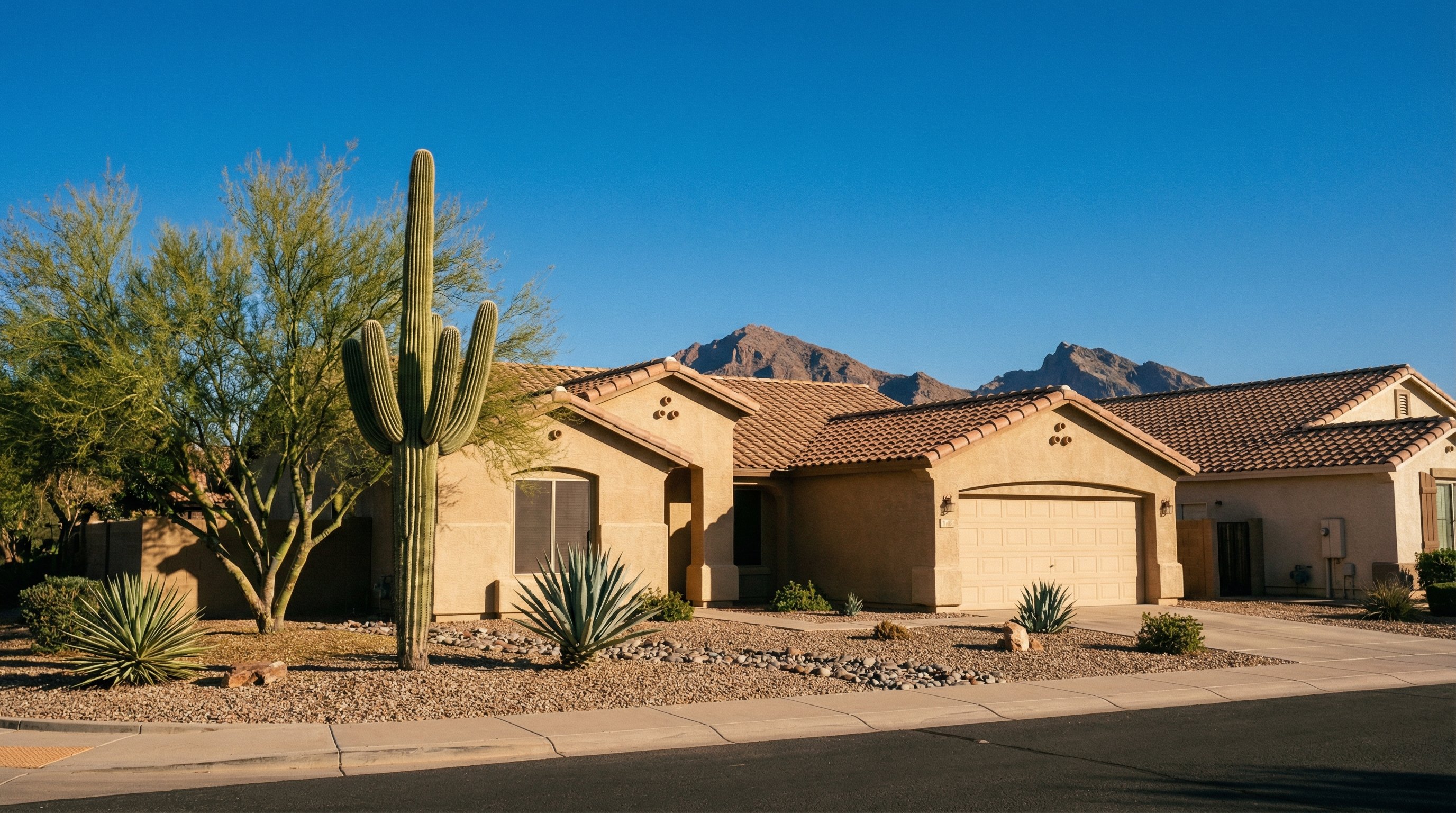
You moved into a 1970s ranch home in south Chandler. The ductwork was rerouted during a 1990s addition and now reaches only half the rooms. Your daughter's bedroom sits on the back of the house with zero airflow, and a contractor quote to extend the ducts came back at $4,200. A friend suggests a portable AC unit. You see them at Home Depot for $299. It seems like an easy fix.
Here is what nobody at the store will tell you about running a portable AC unit in Phoenix.
When Portable AC Units Fall Short in Arizona
The problem is not the unit. It is the physics of trying to move heat from inside to outside when the outside temperature is 108°F.
Portable AC units cool by pulling hot air from your room, running it across refrigerated coils, and exhausting the heat through a hose vented outdoors. That works fine in Houston or Miami where summer highs sit in the high 80s and low 90s. In Phoenix, the math shifts. A unit designed to create a 20-degree temperature drop inside your home has to fight a 30-to-40-degree gradient for five months straight.
The other problem is specific to single-hose units, which make up the majority of what you will find at retail. A single-hose portable AC vents hot air outside, but it creates negative pressure inside your home in the process. Your conditioned air gets pushed out the vent, and hot outside air gets pulled in through every gap it can find: window frames, door seals, even the bathroom vent. You are cooling your neighborhood as much as your living room.
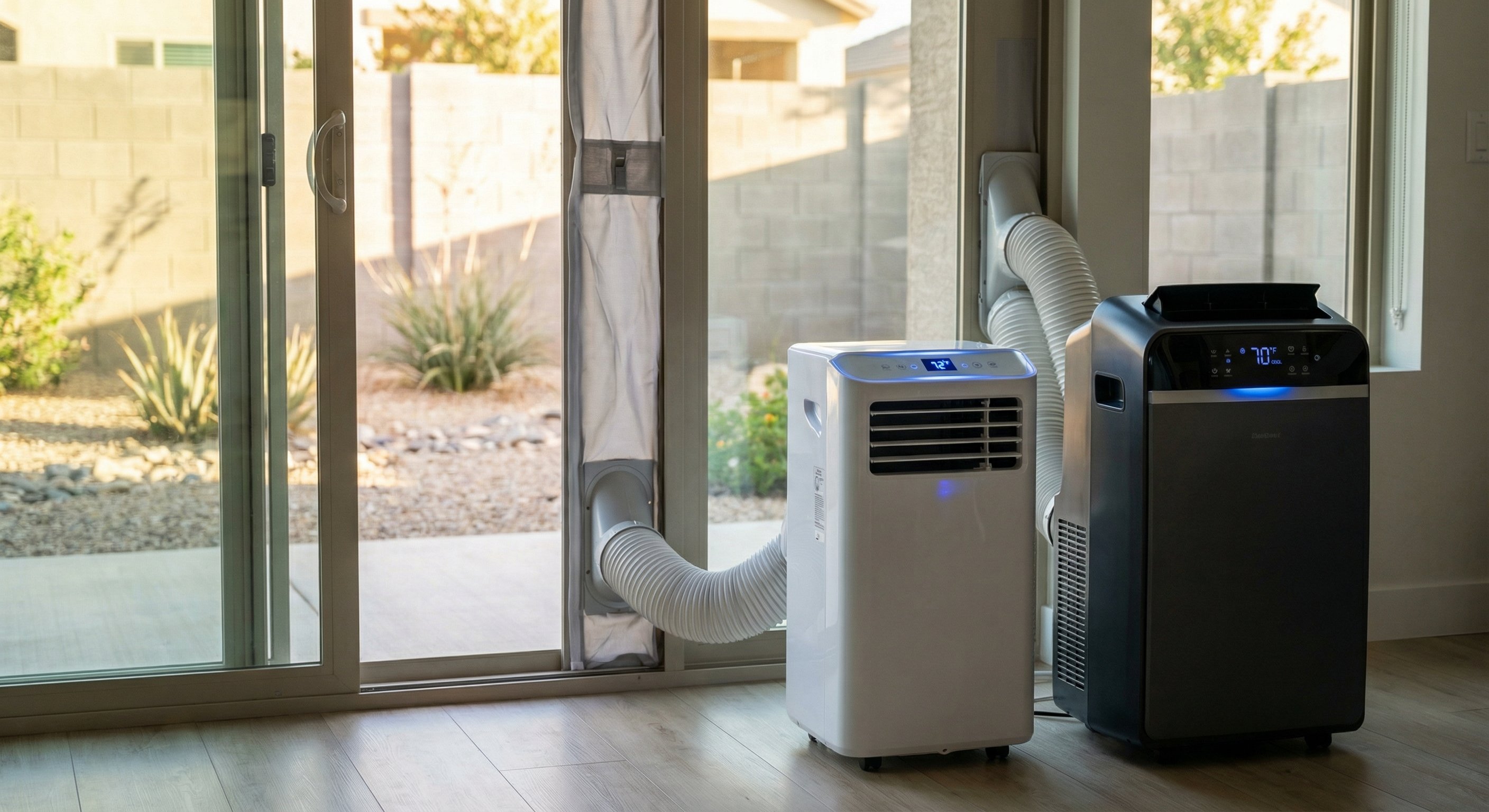
Dual-hose units solve the pressure problem by using one hose to draw outside air for the condenser and a separate hose to exhaust heat. They perform noticeably better in extreme heat, but they cost more and the improvement still has limits.
What Portable AC Units Actually Cost in Phoenix
The sticker price is only the start.
A basic 8,000-to-10,000 BTU single-hose unit runs $200 to $500 at retail. A solid dual-hose unit in the 12,000-to-14,000 BTU range typically costs $600 to $900. Commercial-grade models above 14,000 BTU run $1,000 to $2,000.
Installation adds another $50 to $200 if you buy a window seal kit and do it yourself, or $150 to $400 if you hire someone to set it up properly.
The ongoing cost that surprises most people is electricity. A 12,000 BTU portable unit running eight hours a day in Phoenix summer heat will add $75 to $130 per month to your electric bill, according to SRP and APS rate calculators. Run two of them for a larger home and you are looking at $150 to $250 per month in cooling costs, almost the same as running a central AC system.
Compare that to a modern 16-to-18 SEER central air conditioner, which costs $200 to $350 per month to cool a 2,000 square foot home, covers every room, and adds value to your home. The portable unit that seemed cheaper upfront is matching or exceeding your monthly cooling costs by June.
Sizing a Portable AC Unit for Phoenix Rooms
The standard sizing formula is 20 BTU per square foot of living space. Most people stop there.
For Phoenix, you need to add a 10-to-15 percent fudge factor for extreme heat. A room that needs 8,000 BTU under normal conditions needs closer to 9,500 to 10,000 BTU to actually feel cool in August. This is especially true for rooms with western exposure, where afternoon sun blasts through windows from 2 p.m. until sunset.
Here is what that means in practice:
A 400 square foot master bedroom needs a 12,000 BTU unit in Phoenix, not the 8,000 BTU the formula suggests.
A 600 square foot open living area needs 16,000 to 18,000 BTU. At that point you are looking at a commercial-grade portable unit that runs $1,200 to $1,800 and still has the hose vent problem.
A 1,000 square foot apartment or small home would need two portable units at a combined cost of $1,200 to $2,000 in equipment plus $150 to $250 per month in electricity. At that price point, you are halfway to a proper central AC installation.
Skip the dealer markup
See What a New AC Actually Costs
AC Rebel shows you the real equipment price — no sales pitch, no inflated quote. Get matched with a licensed installer and keep $3,000–$5,000 in your pocket.
Get My Direct Price →The Installation Reality Nobody Talks About
Portable AC units need to vent hot air outside through an exhaust hose. Getting that hose installed properly is the part most homeowners underestimate.
The hose that comes with most units is 5 to 7 feet long. The longer and more kinked the hose, the harder your unit works to push hot air out. A kinked or overly long hose can reduce cooling efficiency by 20 to 30 percent.
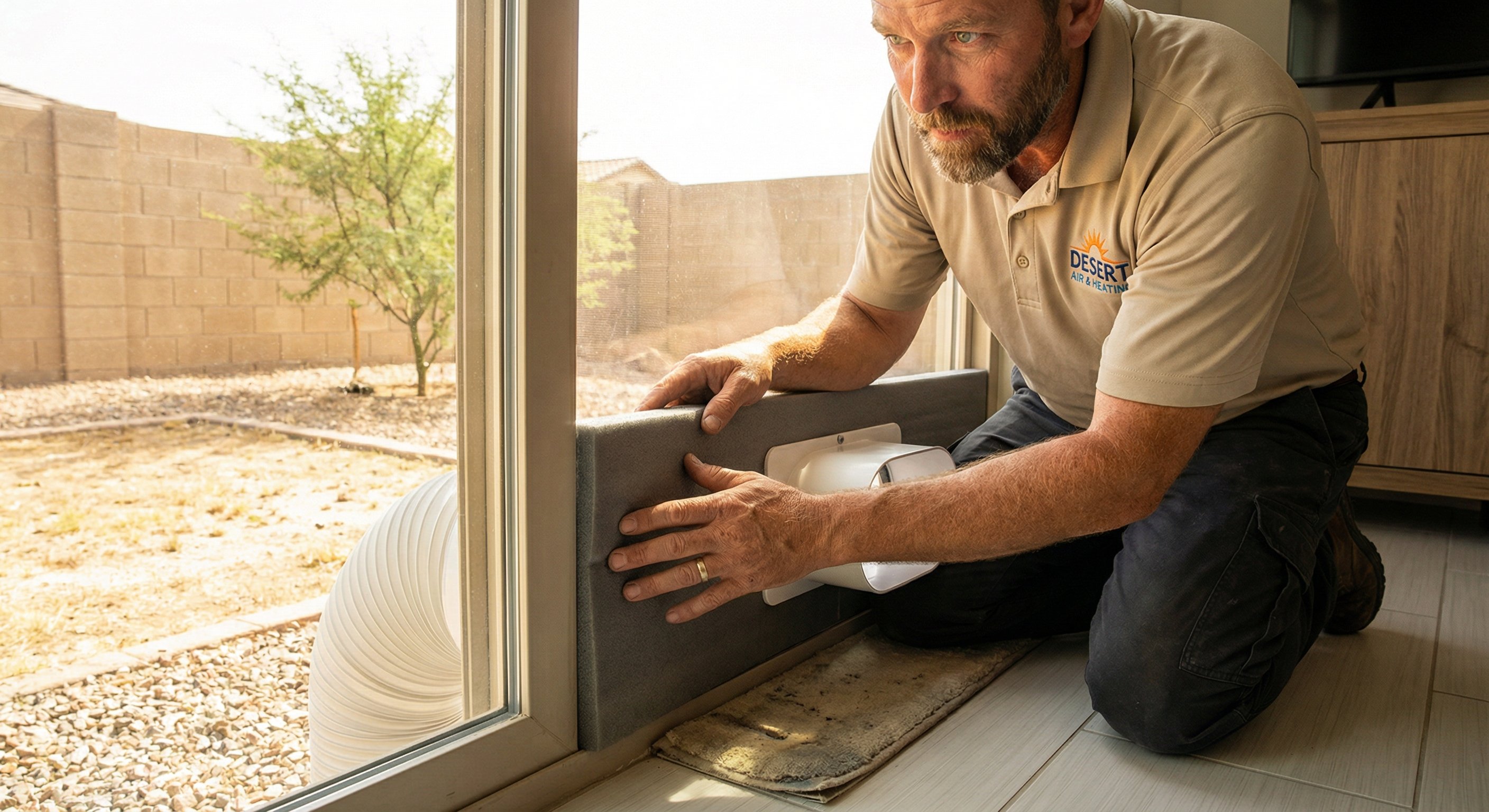
The most common setup is a sliding glass door seal kit. You close the door around a foam panel with a circular cutout for the hose, run the hose outside, and seal around the hose entry point. It works, but it is ugly and it means you cannot close that door properly, which is a security and weather seal issue in a neighborhood with kids.
Window kits exist for standard double-hung windows, but they require the window to stay partially open around the hose, creating the same seal problem.
The other issue nobody warns you about is condensate. Portable AC units produce water as a byproduct of cooling. Small units under 10,000 BTU mostly evaporate this through the exhaust hose in Phoenix dry heat. Larger units produce enough water that you either drain a tank every 8 to 12 hours manually or set up a small condensate pump to route it outside. During monsoon season in July and August, when outdoor humidity climbs, the condensate problem gets worse.
What Monsoon Season Changes for Portable AC Performance
Phoenix summers split into two distinct cooling challenges. May through mid-June is dry heat, where portable units perform closest to their rated capacity. July through September is monsoon season, when moisture from the Gulf of California pushes humidity levels up into the 40 to 70 percent range.
During monsoon season, your portable AC is fighting two battles at once. It is removing heat from your indoor air and it is pulling moisture out of humid indoor air at the same time. The unit is doing two jobs, and it was designed primarily for the first one.
This is when you start to feel the limits of portable cooling. The thermostat says 76 degrees but the house feels muggy. The unit is running constantly and the room still does not feel cool. That is not a broken unit. That is monsoon physics working against you.
A central air conditioning system handles both sensible and latent cooling as a single integrated system. This is why Phoenix homeowners who run their AC heavily in July and August almost universally report better satisfaction with central AC than with portable units, even when the portable units are correctly sized.
When a Portable AC Unit Makes Sense in Phoenix
Despite the limitations, there are genuine use cases where a portable AC unit earns its place.
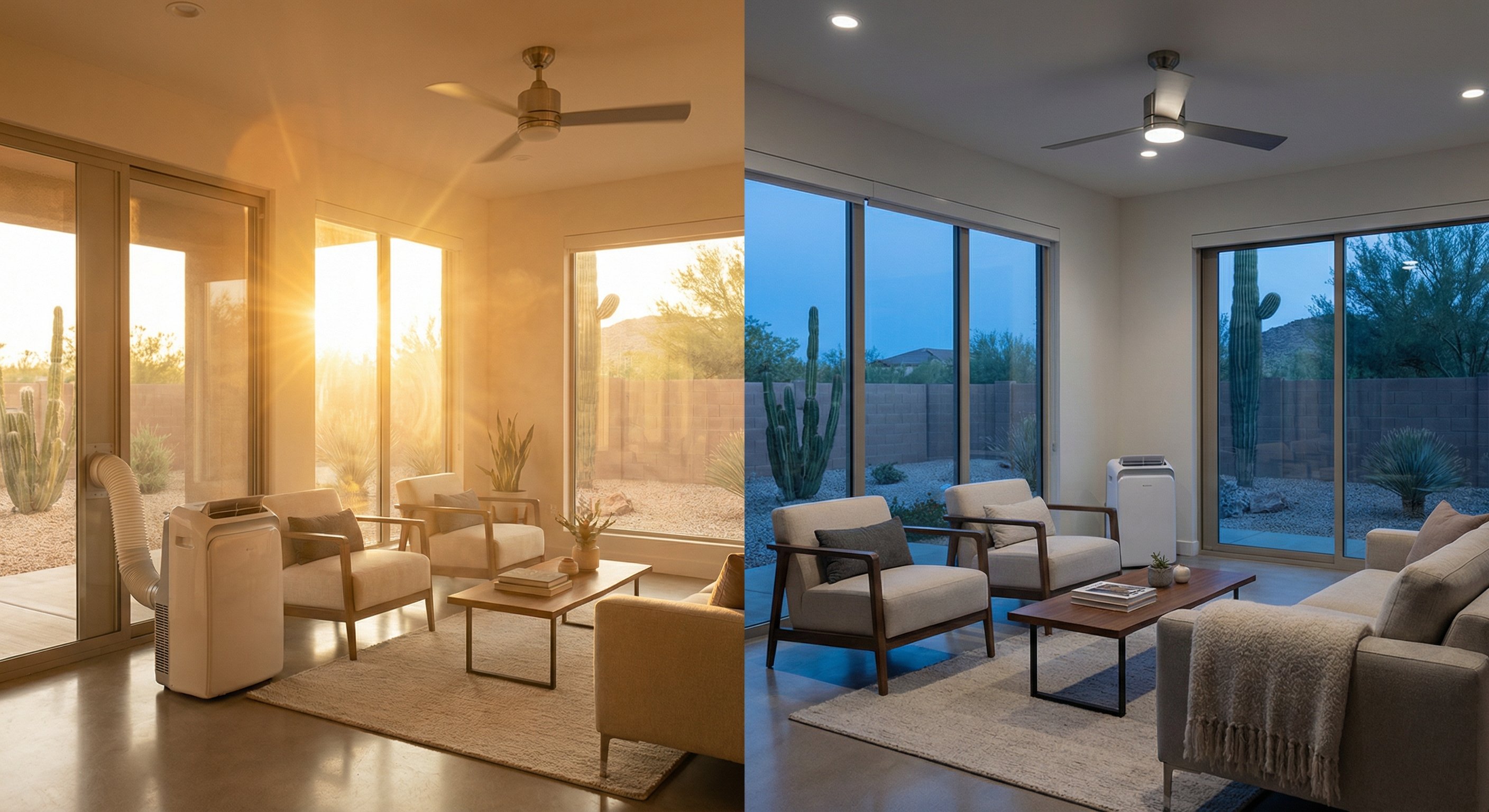
If you rent your home and your lease forbids permanent modifications, a portable unit is often your only legal cooling option. Vent it through a sliding door, keep the receipt, and take it with you when you move.
If you have a home office or workshop in a converted garage with no ductwork, a portable unit can keep that space bearable without running new HVAC lines. A 12,000 BTU unit in a 300 square foot garage office works well, especially in a north-facing garage that does not get direct sun.
If you are between homes and staying in a short-term rental while your new system is being installed, a portable unit bridges the gap. Most HVAC contractors in Phoenix have a 2-to-4 week lead time for new central AC installations during peak season, and a good dual-hose portable unit makes that wait survivable.
If you cool one specific room for four hours or less per day, such as a home gym or a nursery, a smaller portable unit can handle the load without running your central AC for a handful of rooms.
What to Look for If You Buy a Portable AC in Phoenix
If your situation fits one of the scenarios above, here is what actually matters when you are shopping.
Buy a dual-hose unit. The 20-to-30 percent efficiency improvement over single-hose models in extreme heat is worth the $100 to $200 price premium. The math pays back within the first summer.
Size up by one level. If the room calls for 10,000 BTU, buy 12,000. In Phoenix July heat, you want headroom.
Look for an EER of 9 or above. Energy Efficiency Ratio measures real-world energy use at peak conditions, not lab conditions. Higher is better.
Check the hose length and diameter against your window or door setup before you buy. Most units come with a 5-foot hose that may not reach your installation point without an extension, and extensions reduce performance.
Budget for a condensate pump at $40 to $80. During monsoon season you will be grateful for it.
The Better Long-Term Call for Most Phoenix Homeowners
If you own your home, cool more than one room regularly, and face summer electric bills over $300 per month with an aging central AC system, the portable unit is almost never the right long-term answer.
A new 16 SEER central AC system for an average Phoenix home costs $8,000 to $11,000 installed through a traditional contractor. That sounds like a lot until you consider that AC Rebel sells the same quality unit at direct pricing, cutting out the distributor and supplier markups that add $3,000 to $5,000 to every traditional quote. On AC Rebel, a 3-ton 16 SEER unit runs $3,800, and you choose your own licensed installer from a vetted contractor network.
Over a 10-year window, the central system costs less to run, adds value to your home, and actually keeps every room cool during the months when you need it most.
Get a free instant quote at acrebel.com to see what a new central AC system actually costs for your specific home, with no markup and no pressure.
Key Takeaways
Portable AC units are best suited as temporary or supplemental cooling in Phoenix. They work for renters, single-room applications, and bridge situations while waiting for a permanent install.
Single-hose portable units lose efficiency fast in extreme heat because they create negative pressure in your home, pulling hot air in from outside. Dual-hose units perform noticeably better in the Phoenix summer.
Sizing matters more here than in other climates. Size up by 10 to 15 percent compared to the standard BTU formula, and buy a dual-hose model for anything over 10,000 BTU.
Monsoon season changes the performance calculus. If your comfort priority is keeping humidity under control in July and August, a central AC system handles latent and sensible cooling together in a way portable units cannot match.
The electricity cost of running portable units during peak Phoenix summer is often comparable to running a central system. If you are running more than one portable unit regularly, you are probably better off investing in central AC.
For homeowners who want to see exactly what a proper central AC system costs for their specific home without sitting through a contractor sales appointment, AC Rebel shows unit pricing upfront and connects you with vetted local installers.
Frequently Asked Questions
How many BTU do I need for a portable AC in Phoenix?
For Phoenix, calculate 20 BTU per square foot and then add 10 to 15 percent for extreme heat. A 400 square foot room needs roughly 11,000 to 12,000 BTU, not the 8,000 the basic formula suggests. Western-facing rooms and top-floor spaces need an additional bump.
Can I use a portable AC as my only cooling system in Phoenix?
You can, but you will struggle during peak summer months once temperatures exceed 105°F. Portable units are designed for moderate climates, and Phoenix summers push their limits, especially during monsoon season when humidity arrives in July. If you cool more than one room regularly, a portable unit will cost you more in electricity than a central system over a five-year window.
How do I vent a portable AC in Phoenix without a window?
The most common setup in Phoenix homes is a sliding glass door seal kit, which holds a foam panel against the door with a circular opening for the exhaust hose. Standard window kits work for double-hung windows. You can also vent through a wall if you install a proper wall vent kit, though that requires a minor modification to your home.
What is the difference between single-hose and dual-hose portable AC units?
A single-hose unit vents hot air outside but creates negative pressure inside your home, which pulls hot outdoor air in through every gap it can find. A dual-hose unit uses one hose for intake air to cool the condenser and a separate hose for exhaust, eliminating the pressure problem. In Phoenix heat above 105°F, dual-hose units are measurably more effective and are worth the additional cost.
Are portable AC units cheaper than central AC in Phoenix?
Portable units have a lower upfront cost, ranging from $200 to $2,000 depending on capacity. A central AC system costs $8,000 to $11,000 installed traditionally, or around $3,800 to $5,200 for the unit alone through direct pricing retailers like AC Rebel, plus installation. However, running one or two portable units through a Phoenix summer costs $75 to $250 per month in added electricity, which approaches or matches central AC operating costs. Over a five-year window, most Phoenix homeowners come out ahead with a properly sized central system.
Ready to stop overpaying?
See Your Direct AC Price in 2 Minutes
Skip the dealer. Buy your AC unit at direct pricing and pay a vetted local installer only for the installation. No sales calls. No hidden markup. Most homeowners save $3,000–$5,000+ compared to a traditional quote.
Get My Direct Price — No Credit Card2-minute quote · Licensed installers · 10-year warranty options