
Smart Thermostats for Phoenix Homes: The Complete 2026 Buying Guide

Smart Thermostats for Phoenix Homes: The Complete 2026 Buying Guide
TL;DR: A smart thermostat in Phoenix costs $130 to $250 for the device plus $100 to $200 for professional installation if you lack a C-wire. Most homeowners save 15 to 23 percent on annual cooling costs with payback in under 12 months. The top pick for Phoenix homes is the Ecobee SmartThermostat Premium for its room sensor, followed by the Google Nest Learning Thermostat 4th Gen and the budget-friendly Honeywell Home T6 Pro.
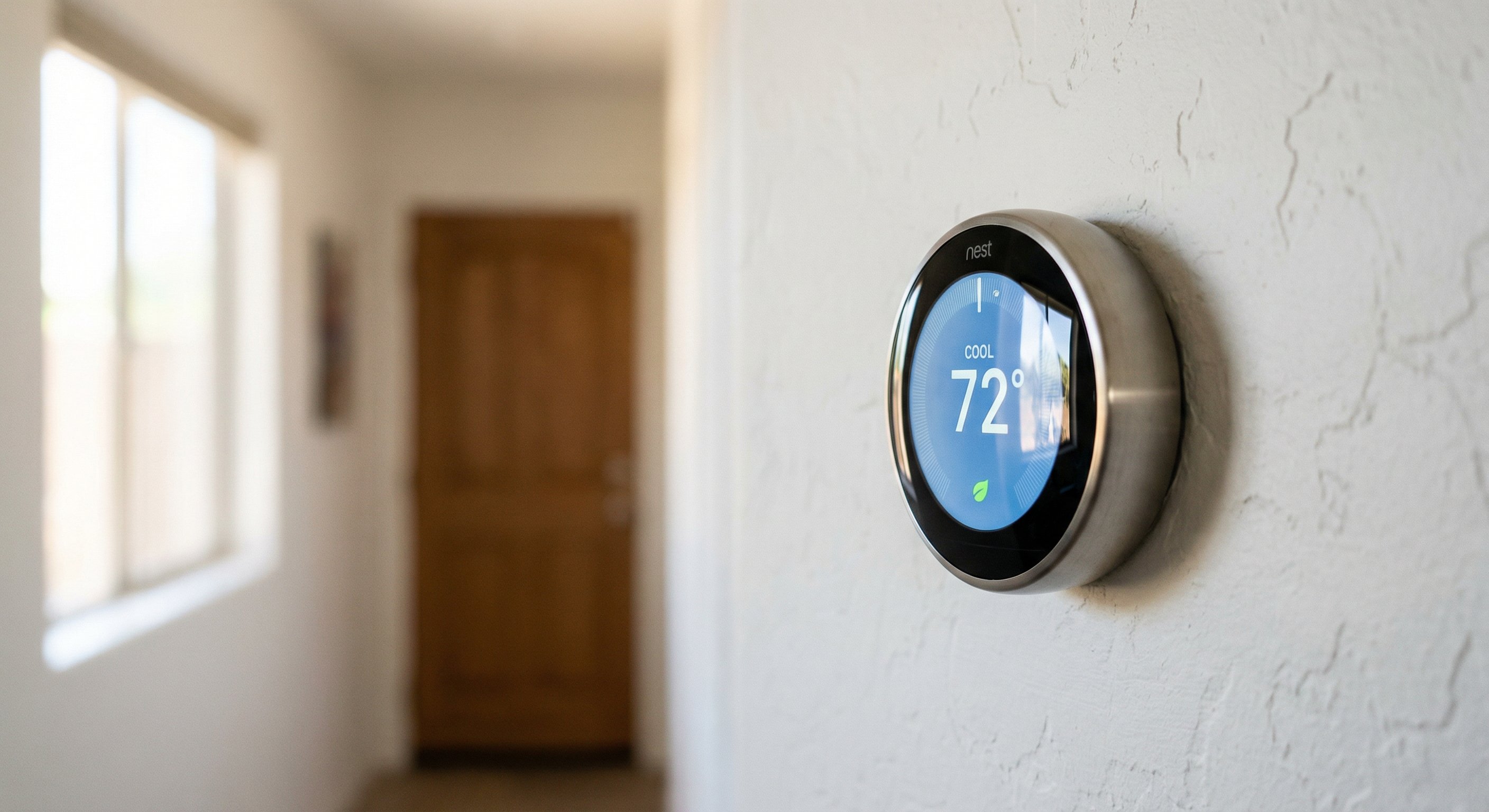
Your APS bill is $380 in July. You set your thermostat to 76 and forget about it until you get home to 84 degrees because someone bumped the dial. This is the default state of most Phoenix households, and it is an expensive one.
A smart thermostat fixes this. Not vaguely. With data from Phoenix homeowners on APS and SRP plans, a properly configured smart thermostat cuts cooling costs by 15 to 23 percent while keeping your home at the same comfort level. On a $2,400 annual cooling bill, that is $360 to $550 per year in savings. The device pays for itself inside 12 months.
Why Standard Programmable Thermostats Fall Short in Phoenix Heat
A standard programmable thermostat sets a schedule. A smart thermostat responds to the actual state of your home. That difference matters more in Phoenix than almost anywhere else in the country.
Standard programmables cannot detect that it is 108 degrees and pre-cool your home before peak demand pricing. They cannot detect that you are home on a day your schedule says you should be at work. They cannot automatically respond to APS or SRP peak pricing signals that push electricity costs to $0.22 to $0.28 per kilowatt-hour between 3 p.m. and 7 p.m. in summer. They cannot tell you your AC has been running continuously for three hours and something might be wrong.
For Phoenix homeowners, occupancy detection is the biggest practical win. If you work from home on a Wednesday and your spouse leaves early, a smart thermostat knows you are both still there and adjusts accordingly.
The Best Smart Thermostats for Phoenix in 2026
Ecobee SmartThermostat Premium
The Ecobee Premium is the best smart thermostat for Phoenix because of one feature no competitor matches: a remote room sensor included in the box that measures temperature and occupancy in a separate room. In a Phoenix home with a second story that runs 8 to 10 degrees hotter than the ground floor, that sensor changes how your AC actually cools your house.
You can set the Ecobee to average temperature across your whole home instead of just cooling the room where the main thermostat is mounted. For two-story Phoenix homes, which describes most homes built in Gilbert, Chandler, and Queen Creek after 2000, this is the feature that makes the upstairs livable in August.
The Ecobee also integrates natively with APS and SRP demand response programs, has built-in Alexa voice control, and works with solar panel systems to align cooling with peak generation hours. It retails for around $250. APS offers up to $75 in instant rebates on qualifying models through their cooling rewards program, and SRP has comparable incentives.
The app is functional but not as polished as Google Home. You will adapt in a day.
Google Nest Learning Thermostat (4th Gen)
The Nest is the most popular smart thermostat for a reason. The 4th generation has a sharper display, better HVAC compatibility, and the most intuitive learning algorithm on the market. Within a week it has your schedule figured out.
For Phoenix homeowners who live in the Google ecosystem, the Nest slots in cleanly with Google Home voice control and works with Nest room sensors for temperature averaging. The sensors are sold separately at $40 each, which adds up if you want coverage in more than two rooms. It retails for around $250.
If you prefer Apple HomeKit, skip the Nest and go Ecobee.
Honeywell Home T6 Pro
The T6 Pro is the value play. No built-in voice assistant, no auto-learning. What it has is geofencing, solid scheduling, and integration with both APS and SRP utility programs through the Resideo app. It sells for $130 to $150.
For a Phoenix homeowner who wants real energy savings without paying a premium for features you will not use, the T6 Pro delivers 80 percent of the benefit at roughly half the price of the Ecobee or Nest. The geofencing alone, which sets your home to away mode when the last person leaves and starts pre-cooling when the first person is within 5 miles, handles the forgotten adjustment that wastes the most energy in most households.
What You Actually Save in Phoenix
APS customers on standard residential pricing pay $0.12 to $0.16 per kilowatt-hour. On time-of-use plans, the 3 p.m. to 7 p.m. peak period runs $0.22 to $0.28 per kilowatt-hour in summer. A smart thermostat set to pre-cool to 72 degrees by 2:30 p.m. and allow it to drift to 78 between 3 p.m. and 7 p.m. meaningfully reduces peak-hour usage.
SRP serves the East Valley and uses a demand pricing structure where your highest one-hour usage during peak months determines a separate demand charge. A smart thermostat that reduces peak draw by even 0.5 to 1 kilowatt meaningfully lowers your SRP bill because demand charges can represent 30 to 40 percent of your total summer bill.
ENERGY STAR certification requires at least 8 percent energy savings in controlled testing. Phoenix-specific data from utility program evaluations shows 12 to 23 percent savings for homeowners who actively use scheduling and geofencing. Passively using your smart thermostat yields closer to 5 to 8 percent.
Payback on device cost: 12 to 18 months for most Phoenix homeowners before any utility rebates.
Skip the dealer markup
See What a New AC Actually Costs
AC Rebel shows you the real equipment price — no sales pitch, no inflated quote. Get matched with a licensed installer and keep $3,000–$5,000 in your pocket.
Get My Direct Price →Installation in Phoenix: DIY or Pro
The biggest variable in smart thermostat installation is whether you have a C-wire.
Every smart thermostat needs constant 24-volt power to run its display and Wi-Fi radio. Standard thermostats only need power when heating or cooling is actively running, so many older Phoenix homes only have 4 wires at the thermostat. A C-wire (common wire) provides that constant power, and without it, most smart thermostats will not work properly.
You Have a C-Wire
If your thermostat terminal shows 5 or more wires including one labeled C, you can install any of the three thermostats in this guide yourself. Remove your old thermostat, connect the matching wires to the new thermostat terminals, mount it, and follow the app setup. Budget 45 minutes to 1.5 hours.
You Do Not Have a C-Wire
If you have 4 wires and no C-wire, you need to run one from your air handler to your thermostat location. This typically means fishing wire through the attic or inside a wall. If you are comfortable in an attic in 115-degree heat and experienced with low-voltage wiring, buy 18-gauge thermostat wire at Home Depot for $40 and budget 3 to 4 hours.
If this is not you, call an HVAC technician. C-wire retrofit installation runs $100 to $200 in the Phoenix market. Do not pay more than $250 for this job specifically, it takes a licensed tech under an hour.
When to Always Call a Pro
If your air handler is in the garage and your thermostat wire runs through an exterior stucco wall, call someone. Stucco wire routing without experience leaves visible holes and can crack the finish. Also call a pro if you have a multi-stage AC system or a heat pump, which require more complex wiring.
Phoenix-Specific Issues That Actually Matter
Thermostat Location in Two-Story Homes
Most Phoenix homes built before 2010 have the main thermostat on a ground-floor hallway wall. In a two-story home, this means your AC spends all summer cooling the downstairs to 74 degrees while the second story stays at 84 to 88 degrees because heat rises and west-facing second-floor windows get direct summer sun all afternoon.
The correct fix is not to move the thermostat, which requires running new wire. The correct fix is to buy a smart thermostat with remote room sensors and set it to average temperature across your whole home. That is why the Ecobee Premium with its included remote sensor is the top recommendation for two-story Phoenix homes specifically.
APS and SRP Demand Response Programs
Both APS and SRP offer demand response programs where they pay you to let your thermostat briefly cycle your AC during extreme grid stress events. The Ecobee and Nest both support these programs automatically once you opt in through your utility account.
Opting in typically earns $25 to $50 per qualifying event, with 5 to 10 events per summer. That is $125 to $500 in annual bill credits for doing nothing beyond keeping your smart thermostat connected to Wi-Fi.
Monsoon Humidity
During Phoenix monsoon season, indoor humidity can climb to 50 to 60 percent even in typically dry Phoenix homes. If your home feels muggy in August despite your AC running, the problem is humidity, not temperature. Your AC removes humidity as a byproduct of cooling, but if you set your thermostat to 80 degrees to save energy during peak pricing, it runs less and your home stays humid.
Most smart thermostats let you set a minimum run time or use a dehumidify mode if your system supports it.
Frequently Asked Questions
Q: Does a smart thermostat actually work with APS and SRP in Phoenix?
Yes. The Ecobee and Nest both integrate with APS and SRP demand response programs, automatically adjusting cooling during peak grid events in exchange for $25 to $50 in bill credits per event. You opt in through your utility account and the thermostat app, and it runs automatically after that.
Q: Can I install a smart thermostat myself in Phoenix?
If your current thermostat has 5 or more wires including a C-wire, you can install one yourself in under 2 hours. If you have only 4 wires, you need to run a new C-wire, which requires either DIY experience with low-voltage wiring or a licensed HVAC technician at $100 to $200. Many Phoenix homes built before 2005 do not have pre-run C-wires.
Q: Which smart thermostat is best for a two-story Phoenix home?
The Ecobee SmartThermostat Premium is the best choice for two-story Phoenix homes because it includes a remote room sensor that averages temperature across multiple rooms instead of just cooling the downstairs where the main thermostat is mounted. Second floors in Phoenix two-story homes typically run 8 to 10 degrees hotter than ground floor, and a single thermostat sensor cannot fix that imbalance without additional temperature data from remote sensors.
Q: How much does a smart thermostat save in Phoenix summer?
Phoenix homeowners who actively use scheduling, geofencing, and demand response features save 15 to 23 percent on annual cooling costs, based on APS and SRP program data. For a household spending $2,400 per year on cooling, that is $360 to $550 in annual savings before any device rebates from your utility company.
Q: Do smart thermostats work with all AC systems in Phoenix?
Most work with conventional single-stage and two-stage AC systems, which cover the majority of Phoenix metro residential systems. If you have a heat pump, a multi-stage system, or a communicating HVAC system, verify compatibility on the Ecobee or Nest website before buying by entering your current thermostat model and wiring setup.
Q: What is the best smart thermostat for someone on SRP in Mesa or Gilbert?
The Ecobee SmartThermostat Premium is the top recommendation for SRP customers in the East Valley because SRP's demand charge structure rewards reducing peak draw, and the Ecobee's room sensor and demand response integration both lower peak demand. The Google Nest is a close second if you prefer the Google Home ecosystem.

The Bottom Line
A smart thermostat is not optional in Phoenix anymore. At current APS and SRP pricing, it is one of the highest-payback home upgrades available, with most homeowners recovering the cost inside 12 months through lower bills.
The Ecobee SmartThermostat Premium is the right default choice for most Phoenix homeowners, particularly those with two-story homes or irregular schedules. The Google Nest Learning Thermostat 4th Gen is the best option if you live in the Google ecosystem and want the most intuitive auto-learning experience. The Honeywell Home T6 Pro is the smart buy if you want solid functionality without paying for features you will not use.
Before you buy any of them, check what APS and SRP are offering in rebates this month. Both utilities run seasonal instant-rebate programs that can cut the effective cost of a $250 thermostat by $50 to $75 before you account for a single dollar of energy savings.
Get a free instant quote at acrebel.com to see how much you would save on a new AC system with a smart thermostat included in your installation.
Ready to stop overpaying?
See Your Direct AC Price in 2 Minutes
Skip the dealer. Buy your AC unit at direct pricing and pay a vetted local installer only for the installation. No sales calls. No hidden markup. Most homeowners save $3,000–$5,000+ compared to a traditional quote.
Get My Direct Price — No Credit Card2-minute quote · Licensed installers · 10-year warranty options