
AC Repair vs. Replace in Arizona: How to Make the Right Call

AC Repair vs. Replace in Arizona: How to Make the Right Call
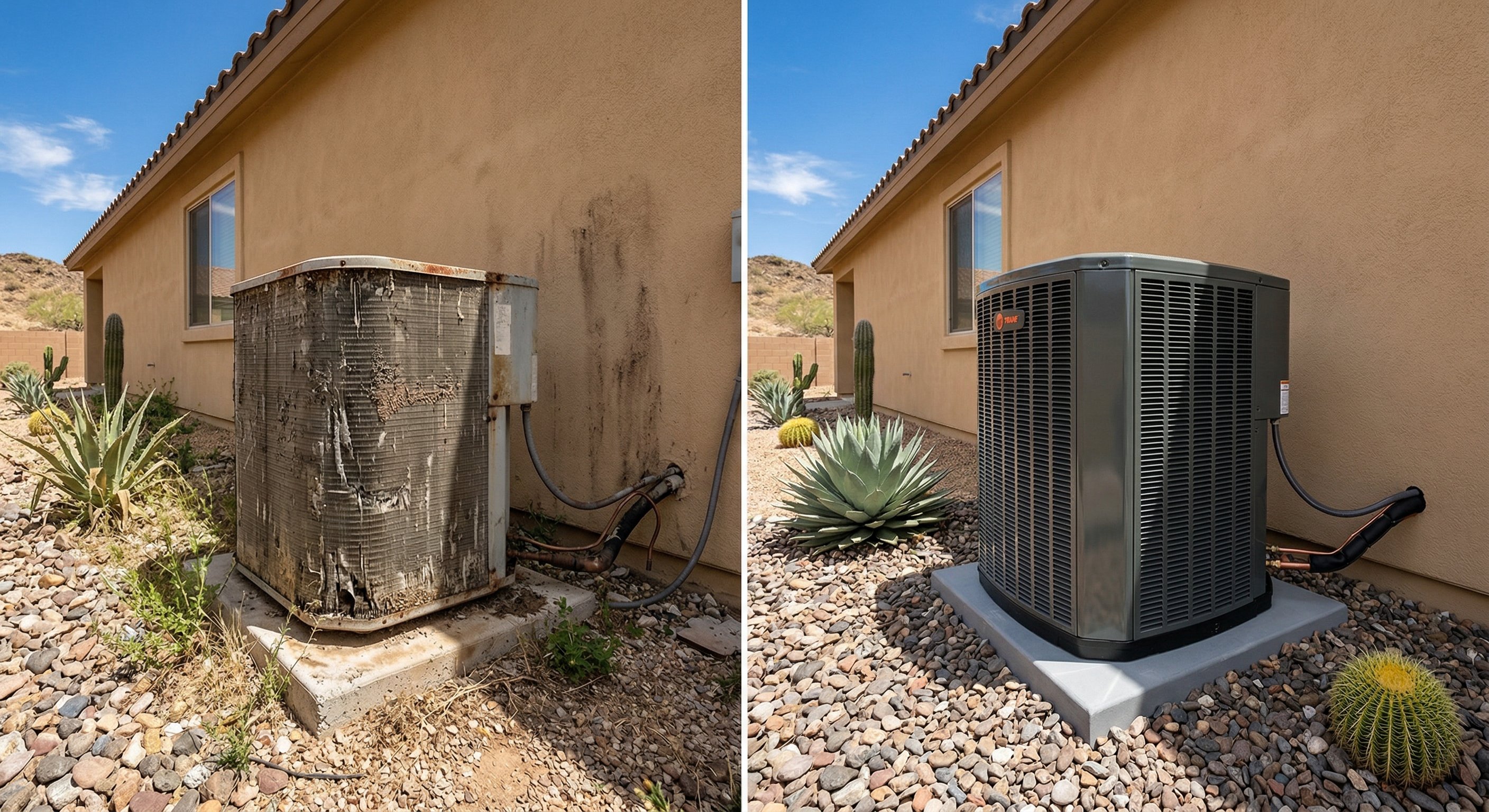
TL;DR: In Arizona, replace if your unit is 10+ years old and the repair costs more than $1,000. The national "50% rule" breaks down here — our heat ages units faster, and you'll pay that repair again within two seasons. A new 3-ton system runs $7,200–$9,800 installed through AC Rebel's direct pricing, compared to $10,000–$14,000+ the traditional dealer route. If your system is under 8 years and the fix is under $600, repair it. Everything in between deserves a five-minute cost comparison before you commit.
Your AC is broken. It's March — which sounds fine until you remember that Phoenix routinely hits 100°F by late April, and you have exactly zero buffer to make this decision slowly.
Here's what nobody tells you: the repair-vs-replace math is genuinely different in Arizona than anywhere else. National HVAC guides quote the 5,000 rule (multiply repair cost by system age — if that number exceeds $5,000, replace it). It's not wrong. But it was calibrated for a climate where your AC runs 4 months a year, not 8. In the Valley of the Sun, a 10-year-old unit has lived a 16-year life anywhere else. That changes everything.
Why Arizona Breaks the National Math
The average AC lifespan nationally is 15–20 years. In Phoenix, Mesa, Chandler, and the rest of the metro? Realistically 10–12 years if you've kept up on maintenance. Eight to ten if you haven't.
Why? Four compounding factors that most national HVAC content glosses over:
Runtime. Phoenix ACs run 8–10 months a year. A 10-year-old Phoenix unit has accumulated the equivalent operating hours of a 15-year-old unit in Chicago.
Desert dust. Monsoon season (July–September) sends particulate matter through coils and filters at a rate that would horrify anyone from a temperate climate. Clogged coils make compressors work harder, age faster.
Hard water scale. APS and SRP service areas sit on some of the hardest water in the country. Evaporator coils build mineral scale that quietly kills efficiency — and repair bills don't fix that.
Peak load stress. When it's 115°F outside, your unit isn't just running — it's running at maximum capacity for 6+ hours a day. That's sustained stress that accelerates every mechanical failure mode.
The result: that repair you just got quoted may feel like the cheaper option today. But if the unit is already showing age, you're buying yourself 12–18 more months before the next expensive breakdown — in the middle of June, when HVAC techs are booked three weeks out.
The Arizona Repair-or-Replace Decision Tree
Use this to cut through the noise:
Step 1: How old is your unit?
Under 8 years: Lean toward repair unless the fix is major (compressor replacement, refrigerant coil). Equipment this young has years of efficient life left if you fix the problem.
8–12 years: The gray zone. Run the cost calculation below before deciding. Arizona units in this range can go either way.
12+ years: Almost always replace. You're past the useful life curve for Phoenix climate. Every dollar you spend on repair is borrowed time with interest.
Step 2: What does the repair cost?
Pull out the quote and run this check:
- Under $400: Repair it. Capacitors, contactors, basic electrical components — these are cheap and common. Any unit can fail these parts at any age.
- $400–$800: Borderline. Compare to monthly operating cost (see below).
- $800–$1,500: Serious warning sign on any unit over 8 years. You're approaching the cost of a new unit's down payment on GreenSky financing.
- Over $1,500: Unless your unit is under 6 years old and otherwise in great shape, replace.
Step 3: Apply the Modified 5,000 Rule
The standard formula: Repair cost × Unit age — if the number exceeds 5,000, replace.
Example: A $900 repair on a 9-year-old unit = 8,100. Replace. A $300 repair on a 6-year-old unit = 1,800. Repair.
For Arizona, drop that threshold to 4,000, not 5,000. The accelerated wear profile means you hit replacement economics faster.
The Real Cost Comparison: Repair vs. Replace in Phoenix Metro
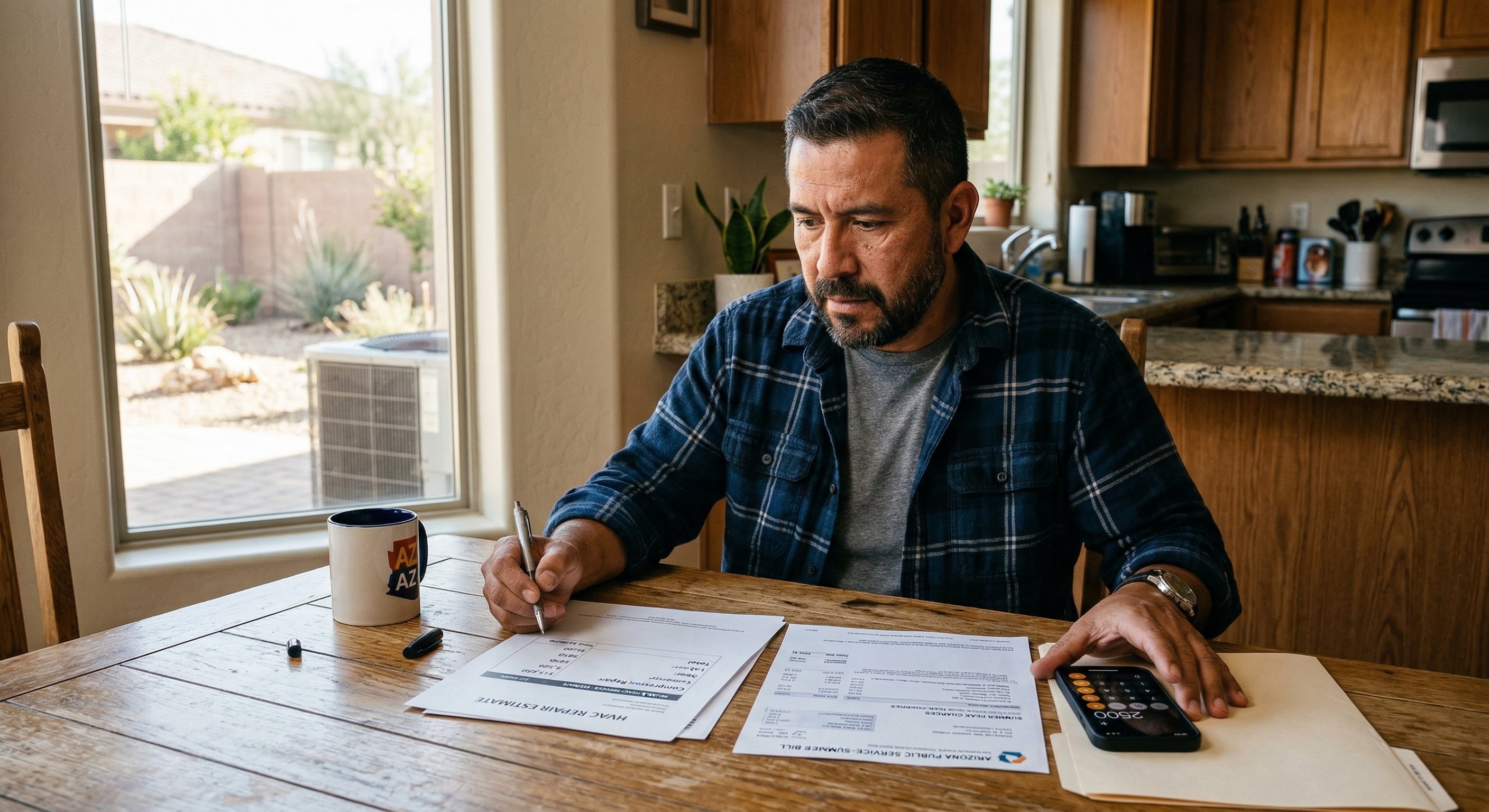
Here's what this actually looks like with real numbers:
Scenario A: Repair route
- Compressor repair quote: $1,800
- Unit age: 11 years
- Current monthly SRP bill (summer avg): $390
- Projected monthly SRP bill after repair: $340 (same aging unit, marginal improvement)
- Estimated remaining lifespan: 1–3 years
Scenario B: Replace route (via AC Rebel direct pricing)
- New 3-ton 16 SEER system: $7,800 installed
- GreenSky financing: ~$87/month (0% for 12 months, then low-APR)
- New monthly SRP bill: $220–$240 (modern efficiency vs. 11-year-old unit)
- Monthly energy savings: ~$150/month
- Payback period: 4.3 years on energy savings alone — before factoring in avoided future repairs
The $1,800 repair looks cheaper today. But $1,800 + $390/month in bills + next summer's breakdown = the wrong answer for most Phoenix homeowners in that scenario.
That said, if the same homeowner had a 4-year-old unit and a $600 capacitor replacement, the math flips completely. Repair it. That's a healthy unit doing its job.
Skip the dealer markup
See What a New AC Actually Costs in Phoenix Metro, AZ
AC Rebel shows you the real equipment price — no sales pitch, no inflated quote. Get matched with a licensed installer and keep $3,000–$5,000 in your pocket.
Get My Direct Price →The Parts That Signal Replace (Not Repair)
Some components, when they fail, are less a repair and more a verdict on the whole system:
Compressor failure. This is the heart of your AC. A compressor replacement runs $1,200–$2,500 in parts and labor in Phoenix. On a unit under 6 years old with a parts warranty still in effect, it may make sense. On a 9-year-old unit? The compressor dying usually means the rest of the system is tired too. Replace the system, not just the compressor.
Refrigerant coil leak. If your evaporator coil is leaking, you're looking at $900–$1,800 for repair and recharge. Combined with an aging unit, this is often the catalyst to replace.
R-22 refrigerant. If your system still runs on R-22 (Freon) — common in anything installed before 2010 — R-22 now costs $80–$150 per pound due to the federal phase-out. A recharge that used to cost $200 now costs $800+. And you'll need it again. The EPA outlawed R-22 production in 2020. If your system needs R-22, replace the system — full stop.
Ductwork failure. If the technician finds major duct deterioration, that's a separate cost on top of the system repair. At that point, a full system replacement that includes duct sealing starts to look very reasonable.
What Arizona Techs Won't Always Tell You
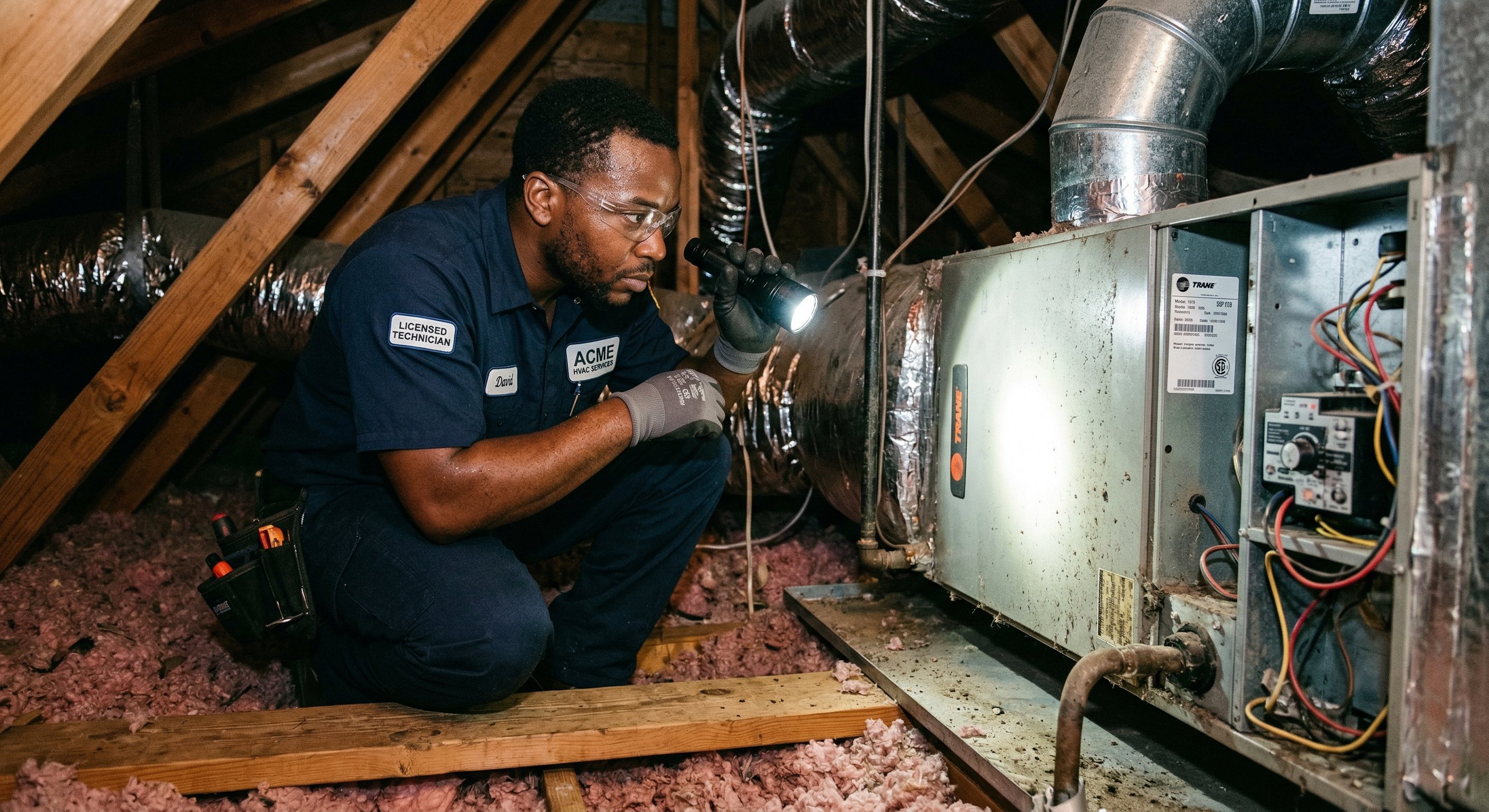
When you call a traditional HVAC contractor, they're going to quote you a repair. That's how they make money. They'll also quote you a replacement — but they're buying the equipment from a distributor at markup, and their incentive is to sell you the most expensive system with the highest margin.
A few things worth knowing before you commit:
Second opinion is always worth it. A $150 diagnostic call from another contractor can save you from a $1,800 unnecessary repair or a replacement you didn't need yet. In the Phoenix market, diagnostic fees run $75–$150.
The emergency markup is real. If your AC dies in July and you call for same-day service, you'll pay 20–40% more than you would scheduling the same work in March. Right now, in early spring, is genuinely the best time to make this decision calmly.
Ask about efficiency grades. Old units are often 8–10 SEER. New systems start at 14 SEER and go up to 20+. At APS rates, the difference between a 10 SEER and a 16 SEER unit is $100–$150 per month in summer. Over 10 years, that's $12,000–$18,000 in energy savings. That's not hypothetical — that's math on published rate tables.
When to Repair (The Cases for Staying)
It's not always replace. Here's when repair genuinely wins:
- Unit is under 7 years old and you've kept up on maintenance (filters changed, annual tune-up)
- Repair cost is under $500 for a standard component failure (capacitor, contactor, thermostat, refrigerant recharge on a modern system)
- The unit is R-410A (modern refrigerant) with documented prior service history
- You're planning to sell the house in 6–12 months — a working unit beats a half-installed new system in terms of showing, and the buyer can negotiate on age
- It's a warranty repair — if the failure is covered, obviously take the warranty
The clearest case for repair: a 5-year-old unit with a $350 capacitor failure. Fix it. Don't let anyone convince you otherwise.
The Replace Case: What It Actually Costs in Phoenix Metro
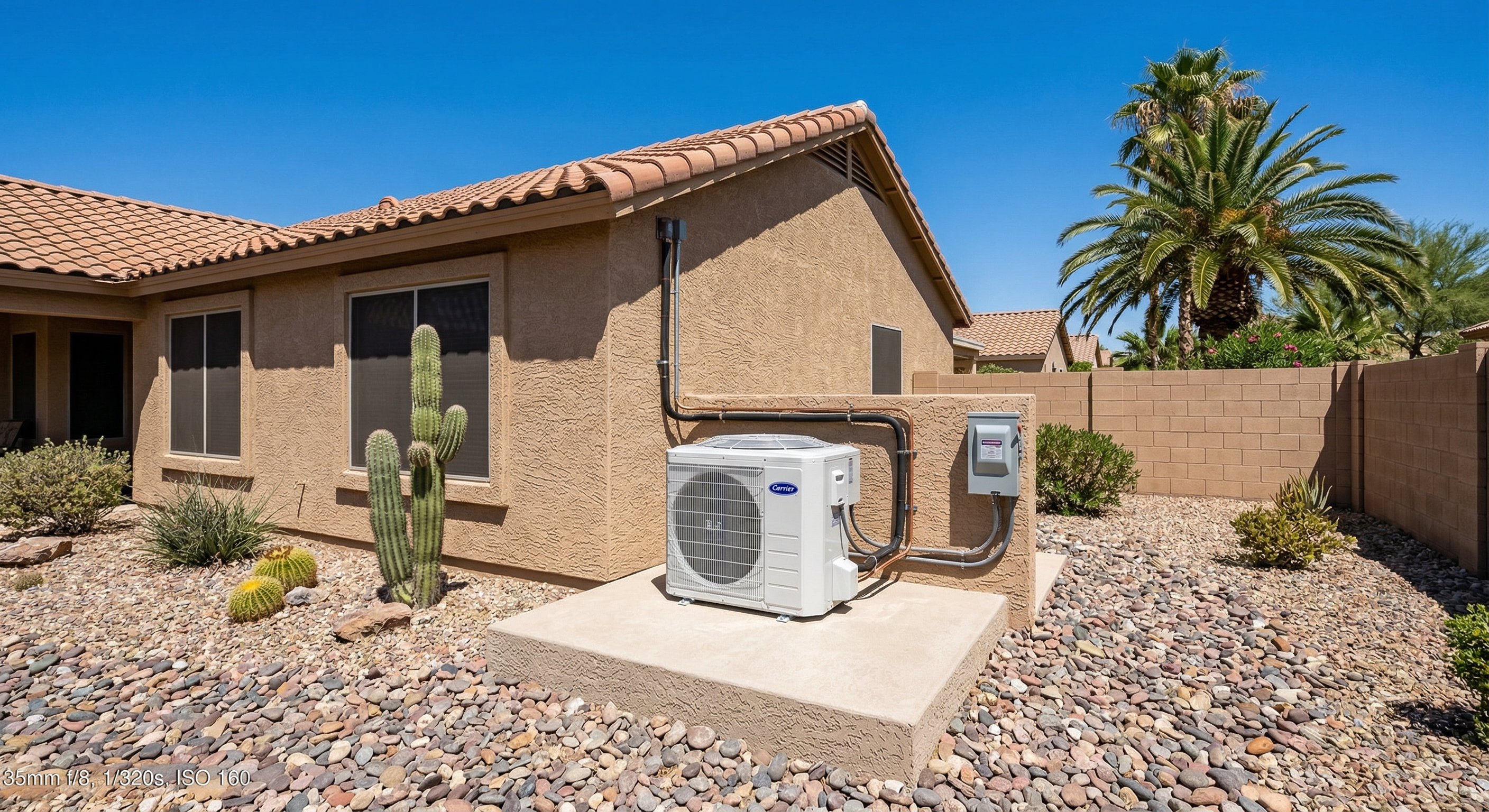
If you're going to replace, here are the real installed costs in the Phoenix market for 2026 (labor + equipment + permits, standard replacement no duct work):
| System Size | 14 SEER (Good) | 16 SEER (Better) | 18–20 SEER (Best) |
|---|---|---|---|
| 2-ton (under 1,200 sq ft) | $6,200–$7,200 | $7,500–$8,800 | $9,500–$11,500 |
| 3-ton (1,200–2,000 sq ft) | $7,200–$8,500 | $8,800–$10,200 | $11,000–$13,500 |
| 4-ton (2,000–2,800 sq ft) | $8,200–$9,800 | $9,800–$11,500 | $12,500–$15,000 |
| 5-ton (2,800+ sq ft) | $9,500–$11,500 | $11,500–$13,500 | $14,000–$17,000 |
The numbers on the right (traditional dealer route) are what you'll get from most HVAC contractors quoting through the normal supply chain. Equipment markups of 40–60% are standard practice.
The alternative: buying the unit direct — at near-wholesale pricing — and paying a vetted installer only for labor. That's exactly what AC Rebel does. Most homeowners save $3,000–$5,000 on a standard replacement by cutting out the middleman markup on the equipment itself.
If you're already looking at a repair bill over $1,000, it's worth running a quick side-by-side to see what replacement actually costs you.
Making the Decision When You're Under Pressure
The worst time to make this call is when you've been without AC for 48 hours in July and a sweating contractor is standing in your living room telling you what you should do.
The best time is right now — in March, before the heat arrives. You have time to get two quotes. You have time to shop equipment pricing. You have time to think clearly.
If you're reading this in summer with no AC, here's the condensed version: If the unit is over 10 years old and the repair is over $800, replace it. The short-term cost is higher, but you're buying reliability through the rest of a Phoenix summer — which is not optional equipment.
If you're doing this proactively in the spring window, take 20 minutes to run the full calculation. Get the diagnostic, get the quote, look at replacement options, and make the call with real numbers in front of you.
Most of what you'll pay for a new AC through a traditional contractor is dealer markup — not the equipment itself. See direct pricing on AC Rebel and run the comparison yourself. GreenSky financing runs as low as $87/month on a standard 3-ton replacement. Sometimes the replace decision is cheaper month-to-month than the repair bill plus the energy costs of keeping an aging system alive.
Frequently Asked Questions
Is it better to repair or replace an AC in Arizona?
In Arizona, replace if your unit is 10+ years old and the repair quote exceeds $800–$1,000. The state's extreme heat accelerates aging — a 10-year-old Phoenix unit has lived the equivalent of a 15-year unit in a milder climate. Run the 4,000 rule: multiply repair cost by system age. Over 4,000? Replace.
How long should an AC last in Arizona?
Most AC systems last 10–12 years with proper maintenance in the Phoenix metro. Without regular maintenance — annual tune-ups, filter changes every 30–60 days — expect 8–10 years. The combination of extreme heat, desert dust, and hard water shortens Arizona AC lifespans significantly compared to the national average of 15–20 years.
What is the average cost of AC repair in Phoenix?
Basic AC repairs in Phoenix run $150–$600 for common components (capacitors, contactors, refrigerant top-offs). Mid-tier repairs (coil cleaning, fan motor, circuit board) run $400–$1,200. Major repairs (compressor, evaporator coil, refrigerant leak) run $1,200–$2,500+. Emergency same-day service adds 20–40% in summer months.
Should I repair an AC that uses R-22 refrigerant?
No. R-22 (Freon) was phased out by the EPA in 2020 and now costs $80–$150 per pound. A recharge that used to cost $200 now costs $800+. Any system that requires R-22 refrigerant should be replaced — the ongoing recharge cost makes repair economically irrational.
When is the best time to replace an AC in Arizona?
February through April is the sweet spot. Demand is low, HVAC contractors have availability, and you're not making a panicked decision in 115°F heat. Replacement quotes in March are typically 10–20% lower than July emergency replacements, and you can take time to compare options rather than accepting the first quote you get.
AC Rebel is a direct-to-consumer HVAC marketplace serving the Phoenix metro. Homeowners buy AC equipment at near-wholesale pricing and connect with vetted local contractors for installation — cutting out the traditional dealer markup that adds $3,000–$5,000+ to standard replacements.
Ready to stop overpaying?
See Your Direct AC Price in 2 Minutes
Skip the dealer. Buy your AC unit at direct pricing and pay a vetted local installer only for the installation. No sales calls. No hidden markup. Most homeowners save $3,000–$5,000+ compared to a traditional quote.
Get My Direct Price — No Credit Card2-minute quote · Licensed installers · 10-year warranty options