
Ductwork Efficiency in Phoenix: Why Your Ducts Might Be Costing You More Than a New AC Unit

Ductwork Efficiency in Phoenix: Why Your Ducts Might Be Costing You More Than a New AC Unit
TL;DR: Leaky, uninsulated, or poorly designed ductwork can waste 20-30% of your AC cooling capacity before the air reaches your rooms. In Phoenix, that means a 4-ton unit performs like a 2.8-ton unit while running harder. Sealing leaks with mastic, insulating attic ducts, and balancing airflow typically costs $800-$2,500 and delivers more practical cooling improvement than replacing the unit itself. If your AC runs constantly and some rooms will not cool, the problem is usually in the ducts.
Your thermostat reads 78°F. You are still sweating.
The contractor you called said the AC unit is fine. He suggested you might need a bigger one. Quote: $11,200.
Here is what he probably did not check: whether the air your AC produces is actually reaching your rooms.
In Phoenix, it often is not. And it is not because of the AC unit.
The Real Math on Duct Losses
When your AC runs, it cools air and pushes it through a network of ducts to every room. If those ducts have leaks or uninsulated sections, a significant portion of that cooled air vanishes before it reaches the supply registers.
The U.S. Department of Energy estimates that typical duct systems lose 20-30% of conditioned air through leaks. In Phoenix, where AC runs five to six months a year and summer utility bills routinely hit $300-$500 per month with older systems, that 20-30% represents real money every single month.
A concrete example: your 3-ton AC unit produces 36,000 BTUs of cooling per hour. If your ductwork is leaking 25% of that air, you are effectively running a 2.25-ton system. On a 110°F Phoenix afternoon, that gap is the difference between holding 76°F and watching the thermostat climb past 80°F.
You do not necessarily need a bigger unit. You need the air you are already paying to produce to actually get where it needs to go.
What Goes Wrong in Phoenix Duct Systems
Phoenix homes have a set of ductwork problems that are more common here than in other climates. Most stem from how Phoenix homes were built, not from AC maintenance failures.
Leaky Rigid Metal Duct Joints
Most Phoenix homes built before 2000 use rigid sheet metal ducts with snap-lock joints and foil tape connections. Those connections dry out and separate over time. Even a 1/4-inch gap at a joint leaks substantial air volume over an entire cooling season.
An attic in Phoenix during July reaches 130-140°F. When cooled air leaks into that space, it is gone. When attic air leaks back into your return ducts, your AC has to recool it. That is double damage from a single leak point.
Missing or Compressed Duct Insulation
Many Phoenix attics have insulation that has been walked on, compressed, or settled over decades. A duct wrapped in 4 inches of insulation that has been compressed to 1 inch provides almost no thermal protection. The cooled air running through that duct picks up heat from the surrounding attic air along its entire length.
Undersized or Misplaced Return Vents
In many Phoenix homes, especially split-level and two-story designs, the return vent is located in only one central location. When a bedroom or bathroom door closes, that room goes slightly negative. Cooled supply air from that room gets pulled back into the return before it circulates properly. The room feels stuffy. The AC runs continuously. The unit wears faster.
Flex Duct Kinks
When older systems are modified, contractors often use flexible ductwork. Flex duct is easy to install but kinks easily, sags over time, and can be routed with too many bends. Each kink adds aerodynamic resistance. A flex duct that sags 6 inches creates the equivalent of a partially closed damper. The AC unit strains against that resistance constantly.
How to Test Your Ducts Without Calling Anyone
A rough duct efficiency check takes 15 minutes and requires nothing but a piece of tissue paper.
The Supply Register Test
Turn your AC on high. Go to a supply register. Hold a piece of tissue paper up to the opening without touching the vent.
The tissue should pull strongly toward the vent and stay held in place. If it barely moves, your ductwork may have significant leaks or blockage upstream.
The Return Register Test
Go to your return air grille. Hold the tissue paper to the opening the same way.
On a properly balanced system, the tissue should pull toward the return with moderate force. If it gets sucked very hard, your return airflow may be too strong, which creates its own set of problems.
The Attic Walk
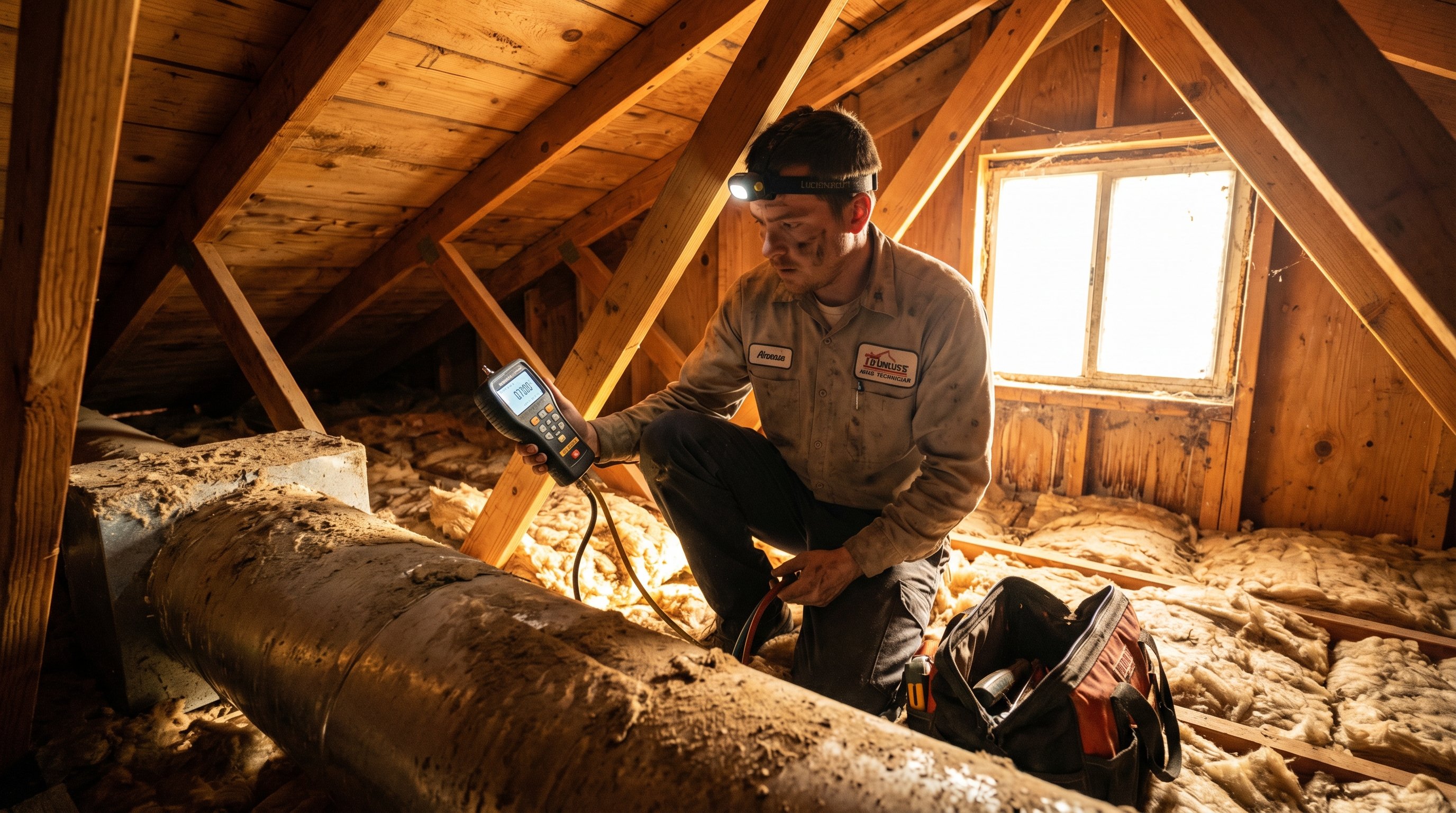
If you have attic access, go up on a hot afternoon with a flashlight. Stay on the joists and avoid walking on insulation.
Look for: foil tape peeling at joints, visible gaps between duct sections, ducts running through unconditioned spaces without insulation, and any section that connects somewhere unexpected. Peeling tape and visible gaps are your highest-priority targets.

Skip the dealer markup
See What a New AC Actually Costs
AC Rebel shows you the real equipment price — no sales pitch, no inflated quote. Get matched with a licensed installer and keep $3,000–$5,000 in your pocket.
Get My Direct Price →What Professionals Actually Do
Duct Blaster Testing
A duct blaster test pressurizes your system using a calibrated fan and measures exactly how much air escapes. The result is a CFM reading that tells you how much air is leaking and at what rate.
For Phoenix homes, anything over 150 CFM of duct leakage for a 3-ton system is worth addressing. Your contractor should give you this number before and after the work.
Aerodynamic Balancing
Once leaks are sealed and insulation is addressed, balancing adjusts dampers at each duct branch so every room receives its designed airflow. This is especially valuable in two-story homes where upstairs consistently runs hotter than downstairs.
What Fixes Cost and What They Actually Fix
Foil Tape to Mastic Sealant
Replacing dried-out foil tape with duct mastic at accessible joints is the highest-ROI fix. Mastic stays flexible and bonds permanently.
Cost: $300-$600 as part of a larger service call, $800-$1,200 as a standalone job. Most Phoenix homeowners see restored full airflow to previously weak supply vents within the first month.
Full Duct Sealing
For systems with significant leakage throughout, some contractors offer full duct sealing using specialized equipment. This seals leaks that are inaccessible from the exterior.
Cost: $1,200-$2,500 depending on system size and accessibility. This delivers the most consistent results for homes with systemic leakage.
Attic Duct Insulation
If ducts run through unconditioned attics without insulation or with compressed insulation, wrapping them with new duct wrap is a straightforward fix.
Cost: $500-$1,500 depending on linear footage and attic accessibility. Even sealed ducts lose cooling capacity if the surrounding attic air is 135°F. This prevents that thermal gain.
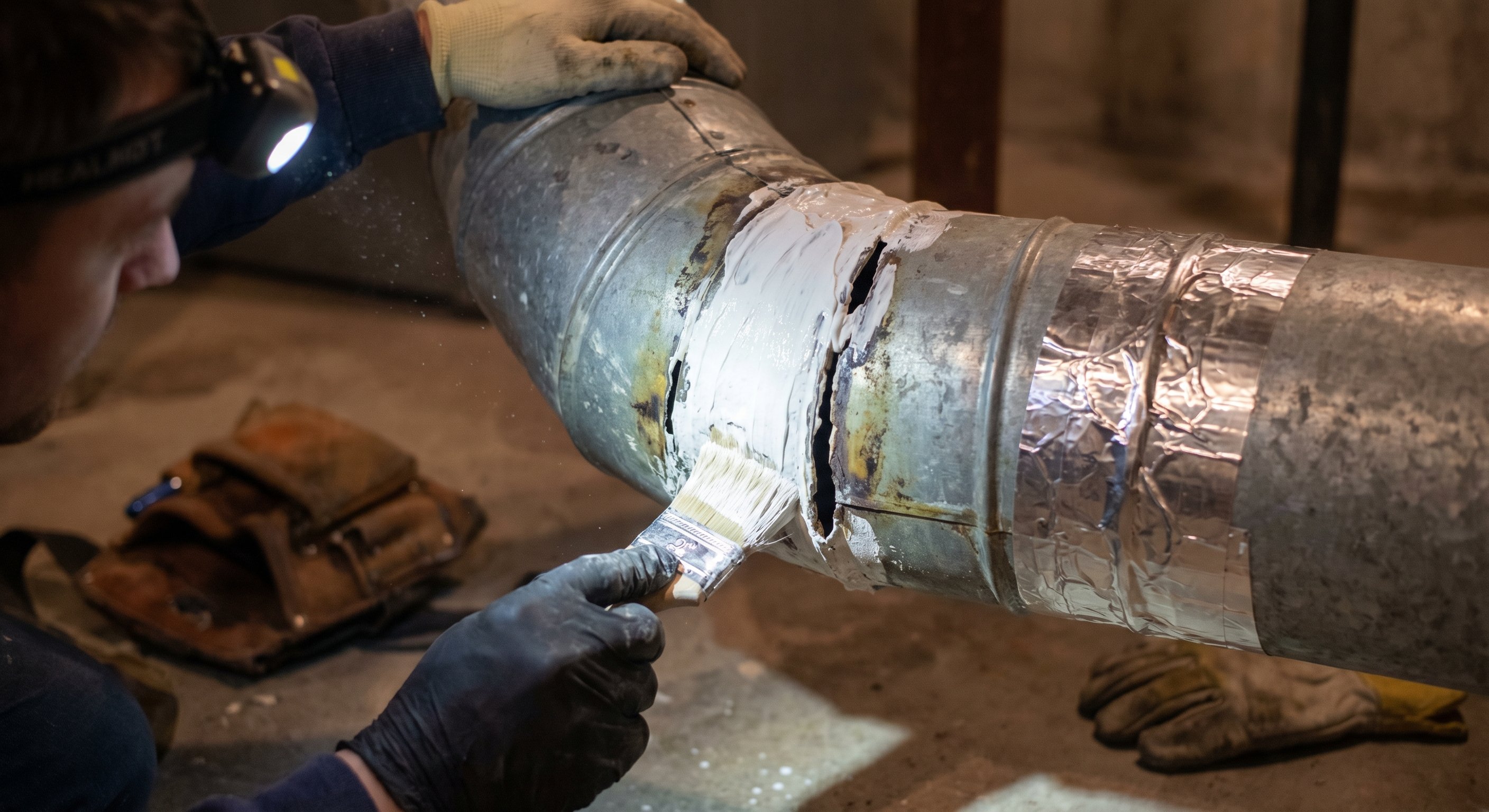
According to ENERGY STAR, homeowners can save up to 20% on heating and cooling costs by properly sealing and insulating their ductwork, which applies directly to Phoenix homes where attics regularly exceed 130°F in summer ENERGY STAR Duct Sealing Guide.
Flex Duct Replacement
Kinked, sagging, or poorly routed flex duct should be replaced with properly sized runs and as few bends as possible.
Cost: $400-$1,200 depending on run length. If supply registers blow weakly and there are no leaks, a kinked flex duct is almost certainly the cause.
Return Vent Addition
If your home has one central return and multiple bedrooms with closed doors, adding a second return vent reduces negative pressure in those rooms.
Cost: $600-$1,800 depending on accessibility. Most common in two-story homes.
Duct Work vs. New AC Unit: When to Choose Each
If your AC unit is relatively new (under 10 years), the compressor is running normally, and your home has difficulty cooling specific rooms, the problem is almost certainly ductwork. Replacing the unit will not fix it. You will have spent $8,000-$12,000 on new equipment and still have the same distribution problem.
If your AC is over 15 years old and the compressor is frequently failing, a new unit may make sense. But ask your contractor to price duct sealing as a separate line item. A new unit installed on leaky, uninsulated ductwork performs like a smaller unit. Sealing the ducts first often means you can buy a smaller, less expensive unit and get better results.
Think of it this way: a new 4-ton AC unit on leaky ductwork performs like a 2.8-3 ton unit. Sealing and insulating what you have may deliver more practical cooling improvement than buying new, for a fraction of the cost.
Why Phoenix Makes This Worse
The summer temperature differential in Phoenix is extreme. A duct carrying 55°F supply air through a 135°F attic has an 80°F temperature gradient to fight. Every uninsulated section loses measurable cooling per linear foot. In more moderate climates, the same uninsulated duct run would barely register.
Monsoon season brings humidity into Phoenix attics, which accelerates corrosion at joint connections and degrades insulation faster. Homes that have been through several monsoon seasons often show accelerated deterioration.
Desert dust gets pulled into return ducts and settles in the air handler coil. Over time this buildup reduces coil efficiency and airflow. If you have not had your ducts cleaned in five or more years, there is likely accumulated dust working against your system.

How Long Does Duct Sealing Last?
Mastic sealant, properly applied, has a service life of 20-25 years. Once sealed, joints do not need to be resealed unless the ductwork is physically disturbed.
Insulation added to existing ducts also lasts 20+ years as long as it is not compressed. Flex duct has a shorter lifespan, typically 10-15 years before sagging and brittleness become issues.
Frequently Asked Questions
Q: How do I know if my ducts are leaking instead of my AC being too small?
If your AC runs constantly and the thermostat never reaches temperature, try this: turn off all supply vents except the living room. If the living room cools quickly with just one vent open, the problem is distribution, not unit capacity. The air is leaking somewhere else, not failing to be produced.
Q: Can I seal duct joints myself?
Accessible joints in a basement or crawlspace can be sealed with aerosol duct sealant kits from home centers. However, applying mastic properly requires cleaning the surface and working it into gaps evenly. Most homeowners get better results from a contractor who does this regularly. For attic work, hiring a professional is strongly recommended: the working conditions are difficult and improper application wastes money.
Q: How much should duct sealing cost for a typical Phoenix home?
For a 1,600-2,200 square foot Phoenix home with a central AC system, expect $800-$1,800 for sealing and insulation upgrades. Full duct sealing runs $1,200-$2,500. Get at least two bids and ask for duct blaster readings before and after so you can verify the work actually reduced leakage.
Q: Does sealing ducts help with indoor air quality?
Indirectly, yes. Leaky return ducts pull air from attics, crawl spaces, and wall cavities into the system. Sealing those leaks means the return pulls conditioned air from inside the home rather than unfiltered air from between walls. This reduces the amount of dust, insulation fiber, and particulates being recirculated.
Q: Should I add insulation to my ducts even if they are not leaking?
Yes. Even sealed ducts in an unconditioned Phoenix attic lose cooling capacity simply from the surrounding 130°F+ air. An uninsulated duct can raise supply air temperature 5-10°F over a 30-foot run. Insulating the ducts prevents this thermal gain and protects against monsoon humidity getting into the duct interior.

If your home is not cooling the way it should and your AC seems to be working harder than it should, check the ducts before you buy a new unit. A duct blaster test and a visual inspection will tell you exactly what you are dealing with before you spend anything. In most cases, the answer is considerably less expensive than a new AC system.
Get a free instant quote at acrebel.com to see what new AC units cost when you are ready, and use our contractor directory to find someone who specializes in duct diagnostics.
Ready to stop overpaying?
See Your Direct AC Price in 2 Minutes
Skip the dealer. Buy your AC unit at direct pricing and pay a vetted local installer only for the installation. No sales calls. No hidden markup. Most homeowners save $3,000–$5,000+ compared to a traditional quote.
Get My Direct Price — No Credit Card2-minute quote · Licensed installers · 10-year warranty options