
How HVAC Contractors Price You Before They Even Quote You

How HVAC Contractors Price You Before They Even Quote You
TL;DR: Before an HVAC contractor gives you a number, they've already researched your home value, scoped out your neighborhood, and decided how much you can afford. That's why quotes for the same equipment can vary by $3,000–$5,000. Here's exactly how they set prices — and how to make sure you're not overpaying.
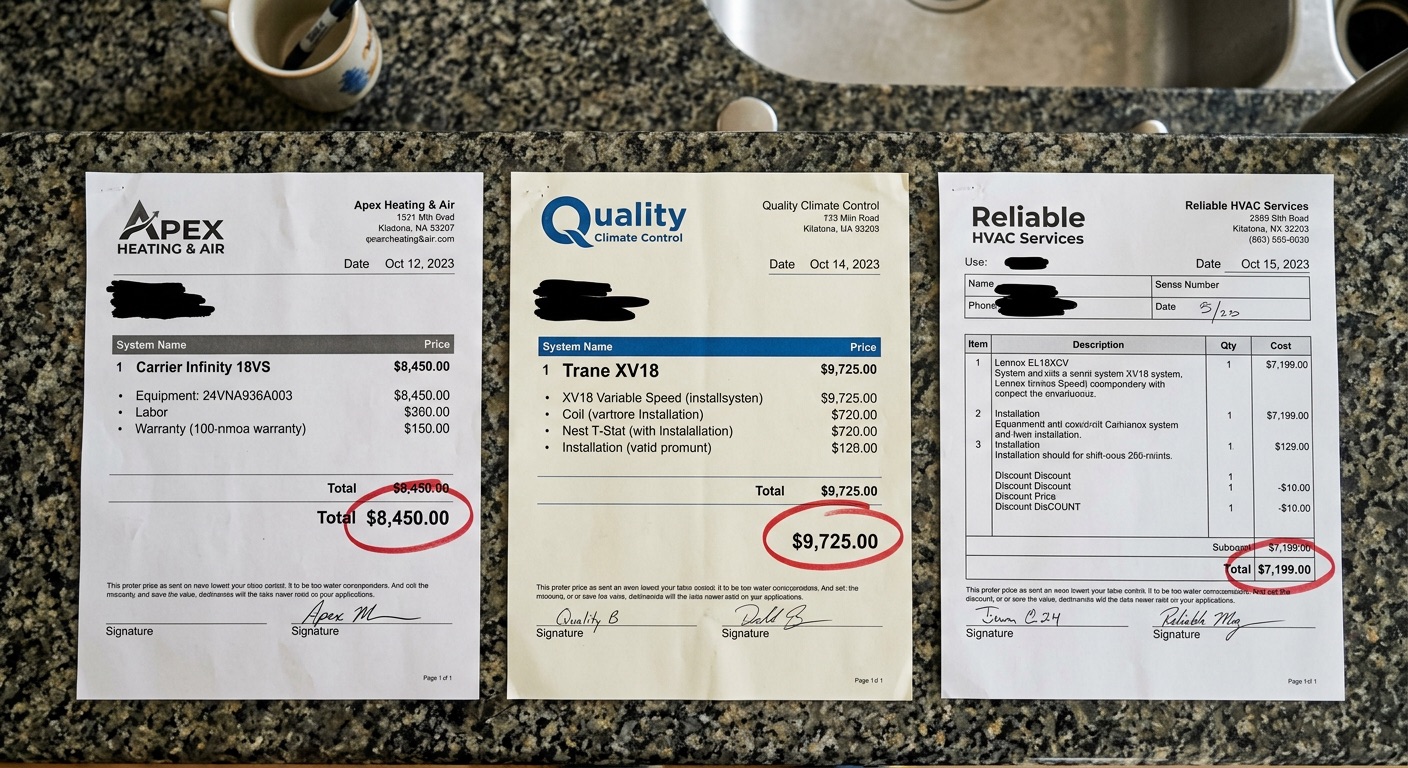
You call three HVAC companies for quotes on a new AC system. Same house. Same square footage. Same brand of equipment. One quotes $8,200. Another says $11,500. The third comes in at $13,800.
How is that possible?
Because HVAC pricing has very little to do with the equipment — and everything to do with you.
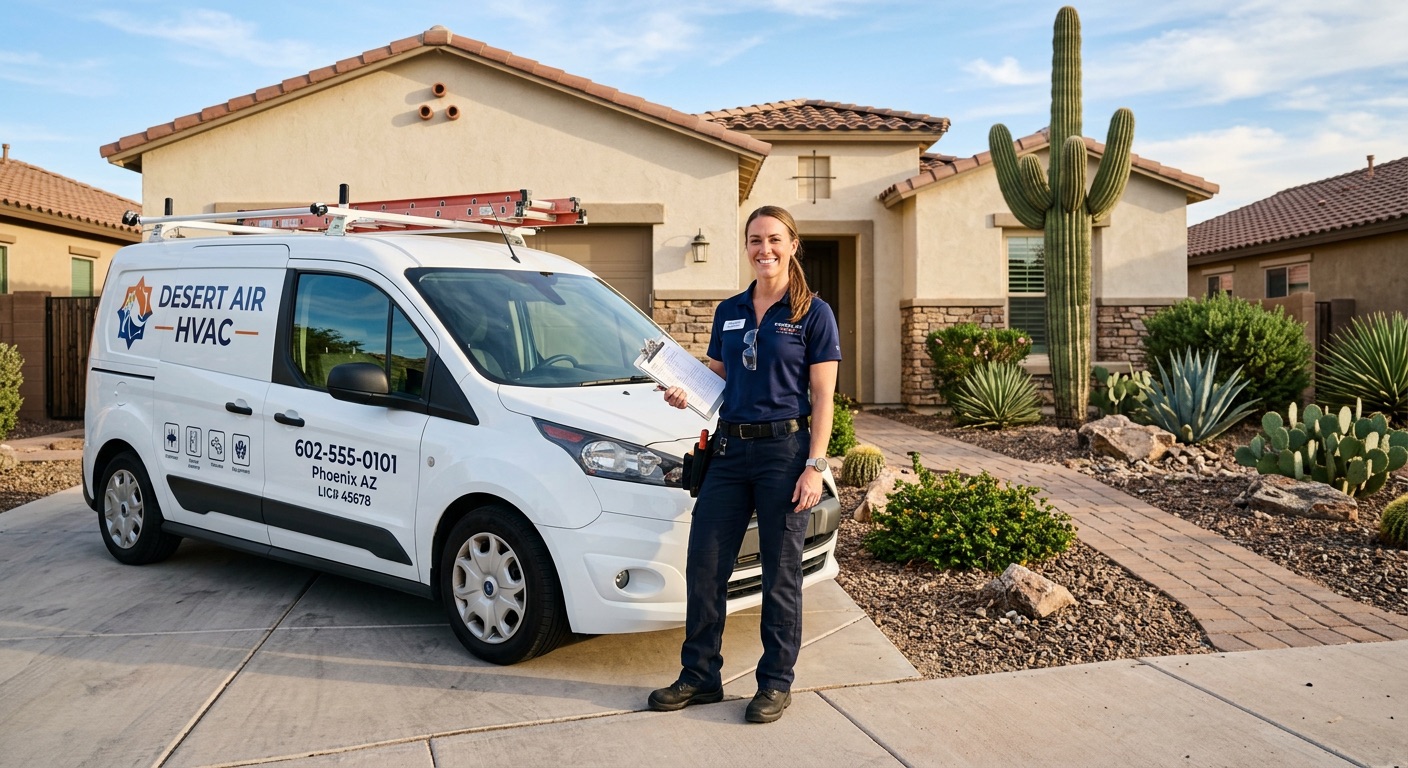
The Address Game: Why They Won't Quote Without Your Address
Ever tried to get a ballpark price over the phone? You probably heard some version of: "We really need to come out and take a look."
There's a reason they want your address before they'll talk numbers — and it's not just about measuring your ductwork.
Here's what happens the moment you give a contractor your address:
Zillow lookup. Within 30 seconds, they know your home's estimated value. A $350,000 home in Maryvale gets a very different quote than a $650,000 home in North Scottsdale — even if both are 2,000 square feet with the same cooling needs.
Google Street View. They're looking at your home's exterior, your landscaping, your cars in the driveway, and the general condition of the property. A well-maintained home with a new truck out front signals a homeowner who's likely to pay more.
Neighborhood income data. Many larger HVAC companies use software that overlays census data and average household income by ZIP code. Your neighborhood's median income directly influences the quote you get.
This isn't a conspiracy theory. It's standard operating procedure at most mid-to-large HVAC companies in Phoenix. The sales reps are trained to do it. The CRM software makes it easy. And most homeowners never realize it's happening.

5 Things They Check Before Quoting You
Let's get specific. Here are the five data points most HVAC sales reps evaluate before they ever give you a price:
1. Your Home Value
This is the biggest factor. Home value is a proxy for what you can afford and — more importantly — what you're willing to pay. A homeowner in a $700,000 home is expected to pay a premium because, in the sales rep's mind, you won't blink at a $12,000 quote the way someone in a $300,000 home might.
The markup isn't subtle. Industry insiders have told us that some companies run two or three different pricing tiers based entirely on home value brackets.
2. The Car in Your Driveway
This sounds ridiculous, but it's real. When a tech pulls up to your home and sees a new BMW or a loaded pickup truck, the mental pricing shifts upward. A 10-year-old sedan? The quote might come in lower — not because the job costs less, but because the rep assumes you'll push back harder.
3. Your Neighborhood
Beyond individual home values, the neighborhood itself matters. Companies know that homeowners in Arcadia, Paradise Valley, or Gilbert's Agritopia will pay more than homeowners in Tolleson or Buckeye — not because the installations are different, but because the market will bear it.
Some companies literally have different price sheets for different ZIP codes.
4. Your Current Equipment's Age
If your current system is 15+ years old and struggling, you're in a weaker negotiating position. The sales rep knows you need a replacement soon, and urgency means you're less likely to shop around or push back on price.
If your system is 8–10 years old and you're just exploring options? They know you can walk away, so the quote tends to be more competitive.
5. Your Desperation Level
This is the one they evaluate in person. Are you calling in July when it's 115°F and your AC just died? Or are you planning ahead in February?
Emergency calls in peak summer carry a premium — sometimes $1,500–$3,000 more than the same job quoted in the off-season. Some of that is legitimate (higher demand, overtime labor). But a lot of it is simply because they know you'll pay whatever it takes to get cool air back.
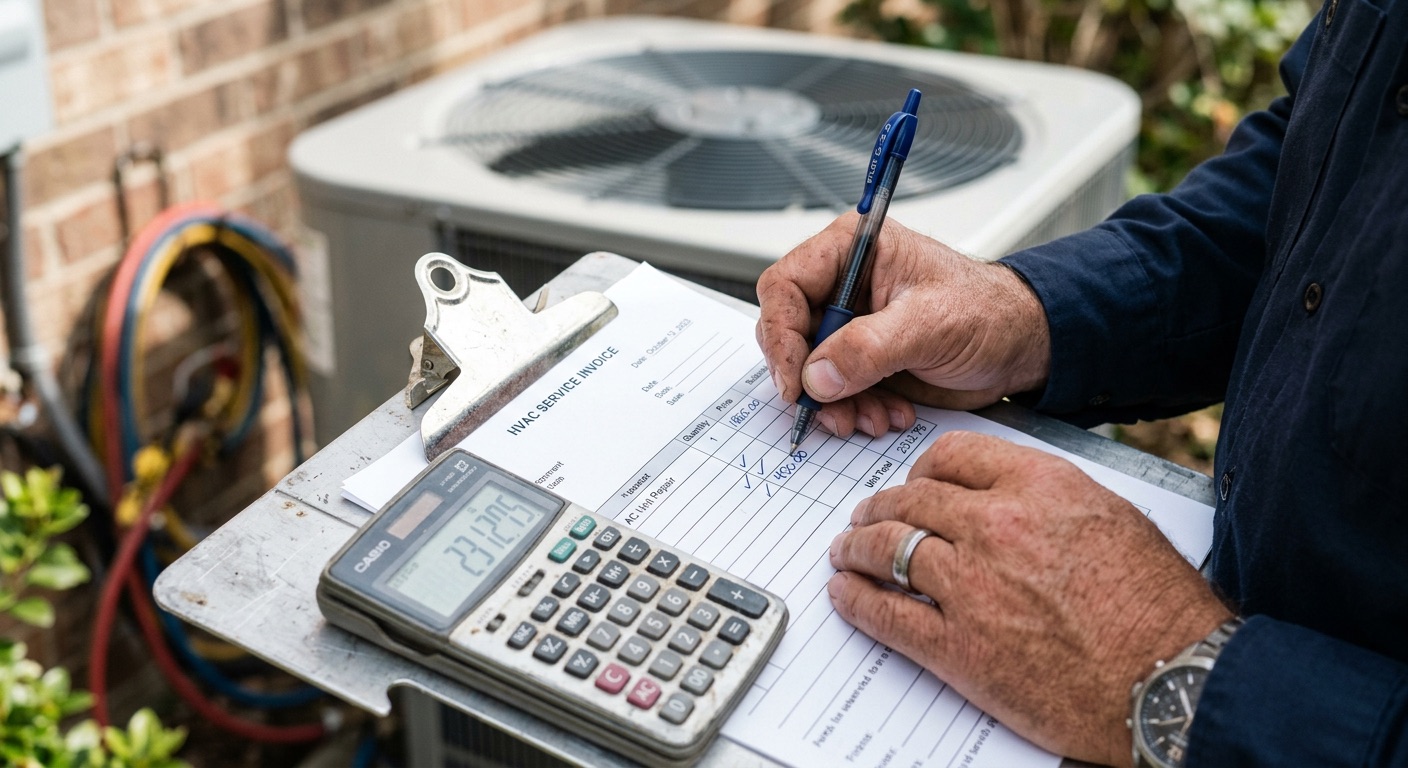
The Diagnostic Fee Trick
Here's a move that's become almost universal in the Phoenix HVAC market: the $89–$150 diagnostic fee.
On the surface, it makes sense. A technician comes out, evaluates your system, tells you what's wrong. Seems fair.
But here's what's really happening during that visit:
- They're inside your home. Now they can see your finishes, your furniture, your kitchen countertops. All of these factor into their pricing decision.
- They're building rapport. A good tech spends 30–45 minutes with you. By the time they present the quote, you feel a personal connection. You're less likely to say "let me get other quotes" to someone you've been chatting with for an hour.
- They're anchoring high. The diagnostic often reveals a "critical" problem — a cracked heat exchanger, a refrigerant leak, a failing compressor. The repair quote comes in at $2,500–$4,000, and suddenly the $12,000 replacement doesn't seem so bad by comparison.
- The fee gets waived if you buy. This is the hook. "If you go with us today, we'll waive the diagnostic fee." It creates a sunk-cost feeling and incentivizes same-day decisions.
The diagnostic fee isn't really about diagnosing your system. It's a sales tool designed to get a trained closer inside your home.
Skip the dealer markup
See What a New AC Actually Costs in Phoenix Metro, AZ
AC Rebel shows you the real equipment price — no sales pitch, no inflated quote. Get matched with a licensed installer and keep $3,000–$5,000 in your pocket.
Get My Direct Price →Why Quotes Vary $3K–$5K for the Same Job
Let's say you need a 3-ton, 16 SEER2 Carrier system installed. The equipment costs roughly the same whether you buy it from Company A or Company B — distributors sell to all licensed contractors at similar wholesale prices.
So why the massive price difference?
Labor is similar. A standard residential installation takes a crew of two about 6–8 hours. Labor costs in Phoenix are roughly $150–$250 per crew member per hour. Total labor: $1,800–$4,000 depending on complexity.
Equipment cost is fixed. That 3-ton Carrier unit costs the contractor roughly $3,000–$4,500 at wholesale, depending on the model.
Materials and permits: $300–$800.
So the hard cost of a standard installation is roughly $5,100–$9,300. Everything above that is margin.
When Company A quotes $8,200 and Company C quotes $13,800 for the same equipment, the difference isn't in what the job costs them. It's in:
- Overhead. Big companies with showrooms, fleets of wrapped vans, TV commercials, and large sales teams have significantly higher overhead. You're paying for their marketing budget.
- Sales commissions. Many companies pay their sales reps 8–12% commission. On a $13,000 sale, that's $1,040–$1,560 going to the person sitting in your living room.
- Address-based markup. As we covered above — your home value, your neighborhood, and your perceived ability to pay.
- Urgency premium. If it's July and you called them, they know you're not shopping around.
The equipment is the same. The installation quality might be identical. You're paying for their business model, their marketing, and their read on your wallet.
How AC Rebel Is Different
We built AC Rebel specifically because this pricing model is broken.
Here's what we don't do:
- No address-based pricing. Your quote is based on your home's cooling needs — square footage, insulation, ductwork condition. Not your home's Zillow estimate.
- No sales reps in your living room. Our quote tool gives you real pricing in minutes, from your phone. No one needs to come inside your house to tell you what a system costs.
- No diagnostic fee games. We're transparent about pricing upfront. You see equipment cost, labor cost, and total price before anyone shows up.
- No commission-driven quotes. Our pricing is direct. There's no 10% commission baked in that changes based on how much the sales rep thinks you'll pay.
We work with top-rated, licensed installers across the Phoenix metro. The difference is that our pricing comes from the job — not from your address.
Check your quote against industry pricing with our Quote Checker, or see our Price Guarantee for how we back it up.
How to Protect Yourself
Whether you use AC Rebel or not, here's how to avoid overpaying for HVAC:
1. Get at Least Three Quotes
This is non-negotiable. The spread between the highest and lowest quote in Phoenix typically ranges from $3,000–$5,000 for the same job. You need comparison points to know where fair pricing falls.
2. Demand Itemized Breakdowns
Any reputable company should be willing to break out:
- Equipment cost (brand, model, SEER2 rating)
- Labor cost
- Materials and permits
- Warranty terms
If a company gives you a single lump-sum number and won't itemize, that's a red flag.
3. Don't Decide on the Spot
The "this price is only good today" tactic is designed to prevent you from shopping around. A legitimate company will honor a quote for at least 30 days. If they won't, ask yourself why.
4. Check the Equipment Price Independently
Look up the wholesale price of the specific unit they're quoting. Websites like?"?"?HVACDirect and online distributors give you a ballpark. If the contractor's equipment line item is 3x the wholesale price, something's off.
5. Use a Quote Checker
Our Quote Checker lets you enter any HVAC quote you've received and see how it compares to fair market pricing in your area. It's free, and you don't need to buy from us to use it.
The Bottom Line
HVAC contractors aren't all dishonest. Many are skilled tradespeople who do excellent work. But the industry's pricing model is built on information asymmetry — they know exactly what the job costs, and most homeowners don't.
The best defense is knowledge. Now you know what they're checking, how they're pricing, and what to look for. Whether you're getting a quote next week or next year, you'll walk into that conversation with your eyes open.
Ready to see what fair pricing actually looks like? Get a quote in 2 minutes — no address lookup, no diagnostic fee, no games.
Ready to stop overpaying?
See Your Direct AC Price in 2 Minutes
Skip the dealer. Buy your AC unit at direct pricing and pay a vetted local installer only for the installation. No sales calls. No hidden markup. Most homeowners save $3,000–$5,000+ compared to a traditional quote.
Get My Direct Price — No Credit Card2-minute quote · Licensed installers · 10-year warranty options