
Which AC Refrigerant Should You Use in Phoenix? (2026 Guide to R-22, R-410A, and R-454B)

Which AC Refrigerant Should You Use in Phoenix? (2026 Guide to R-22, R-410A, and R-454B)
TL;DR: R-410A is the current standard for all new AC systems sold in Arizona. R-454B is the next-generation replacement that will dominate by 2026 and carries a lower global warming penalty. R-22 is obsolete and being phased out. If you are replacing your system in Phoenix today, you are choosing between R-410A and R-454B. R-454B units carry a modest price premium but have a significantly lower environmental impact and meet upcoming EPA requirements ahead of schedule. R-22 systems should be replaced, not repaired.
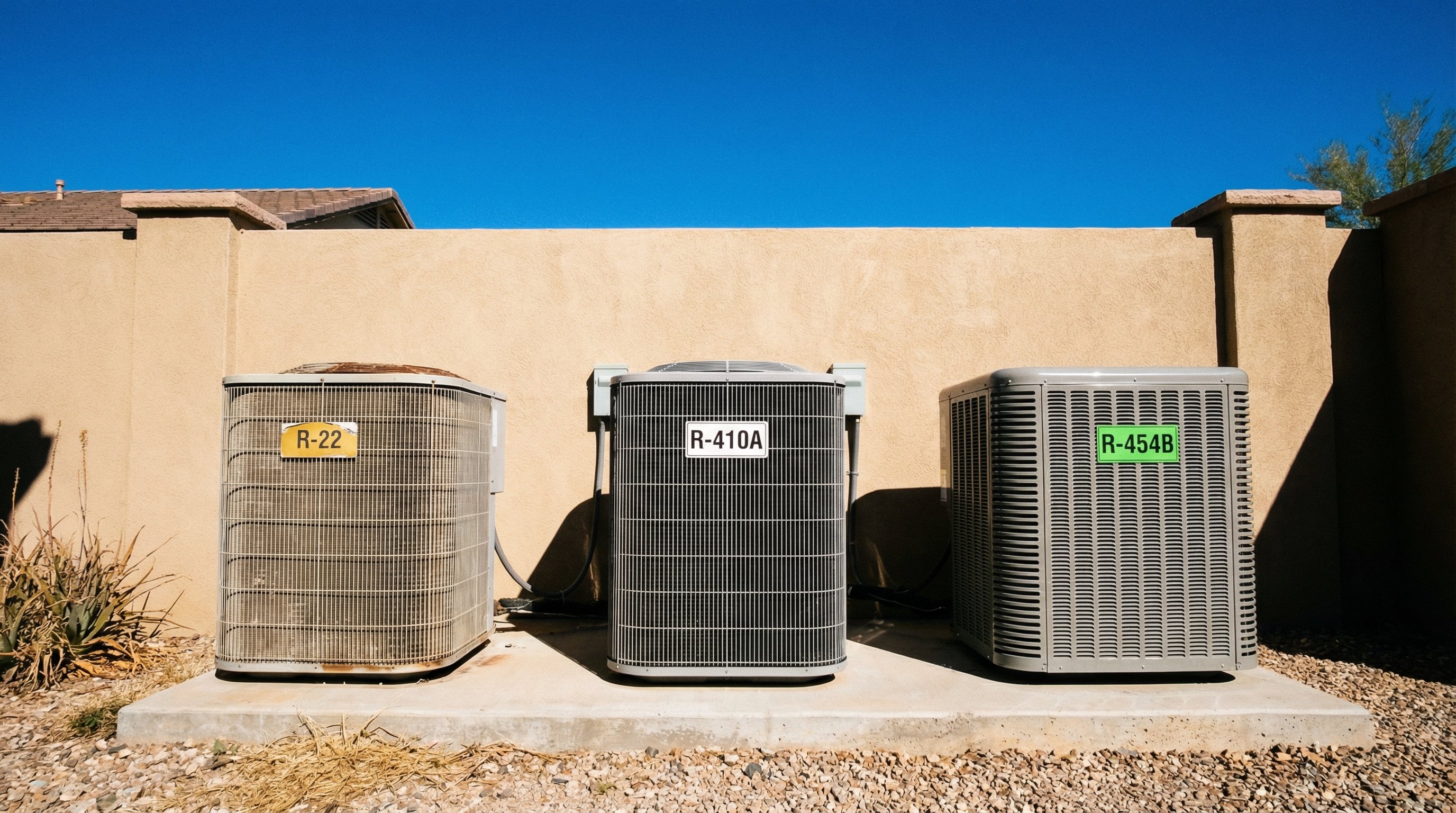
Three refrigerants are currently in play for Phoenix homeowners. Here is how they compare straight up.
R-22: The One You Should Not Be Running
R-22, also called Freon, has been the standard residential refrigerant for decades. It works. The problem is that it is also an ozone-depleting substance, and the EPA has been phasing it out since 2010 under the Montreal Protocol.
Production and import of new R-22 ended in 2020. What that means for you: the R-22 still in your system is the only R-22 that will ever exist. Every pound that gets reclaimed from a dead system is recovered and reused. There is no new R-22 being manufactured anywhere in the world.
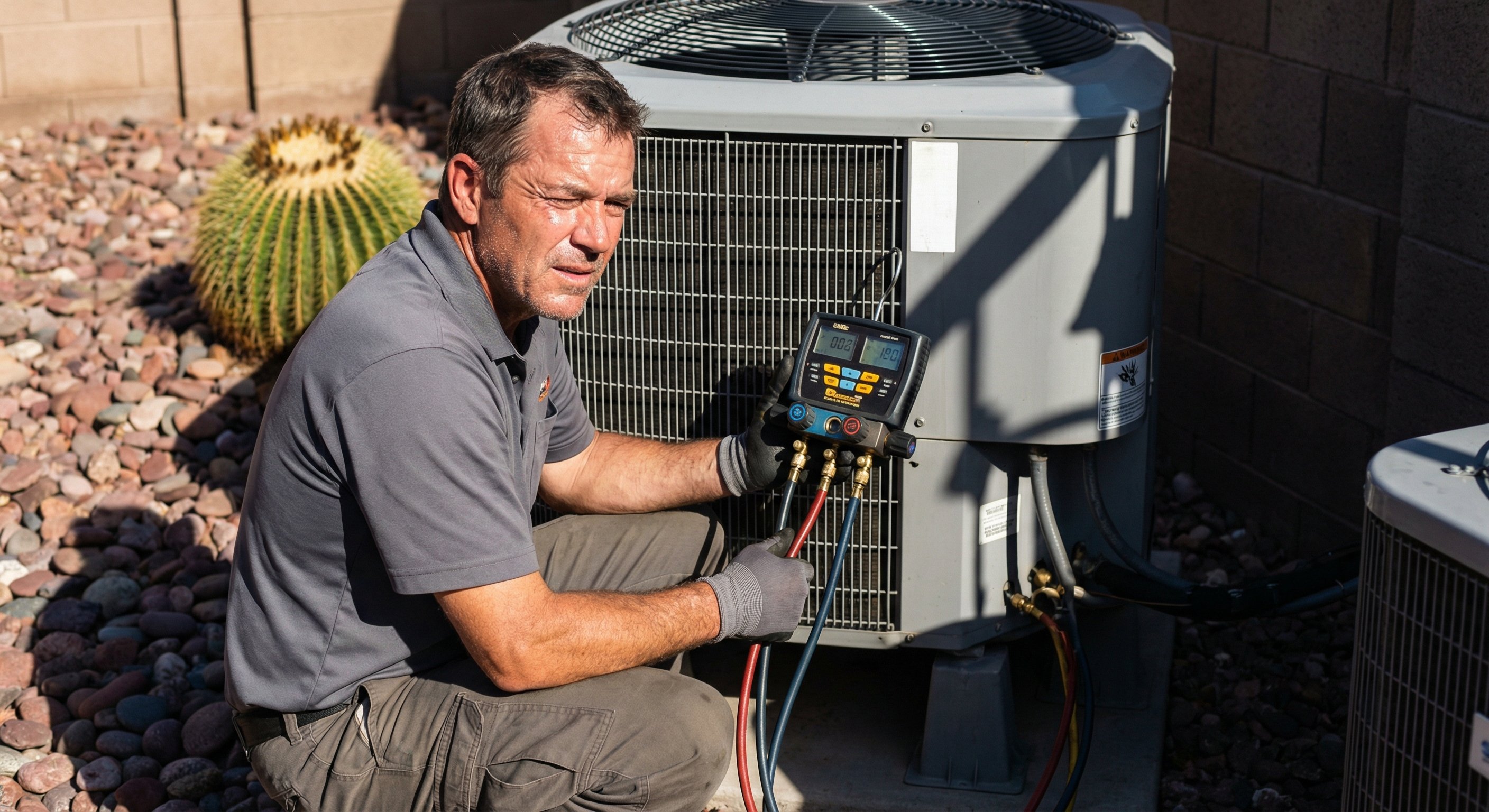
If your Phoenix home still runs an R-22 system, you are sitting on a ticking clock. When your compressor fails, or when you have a major refrigerant leak, you face a choice that is not really a choice. R-22 recharge costs $600 to $1,200 per pound in the Phoenix market, and prices have roughly doubled since 2020. A typical R-22 recharge that required 5 pounds of refrigerant in 2019 now costs $3,000 to $6,000. That is before you pay for the labor.
Contractors who still service R-22 systems will tell you it is fine to keep running it. Technically, that is correct. Practically, you are paying escalating prices for a system that is nearing the end of its serviceable life in a regulatory environment that will not get more lenient.
The honest answer: if your AC uses R-22 and is more than 12 years old, replacement makes more financial sense than another repair investment. That $850 recharge quote you got? It buys you maybe two more summers before the next leak, the next $850, and the same conversation again.
R-410A: The Current Standard and What It Actually Means for You
R-410A is the refrigerant in every new AC system sold in the United States today. It is not ozone-depleting, it is more efficient than R-22 in heat transfer, and it has been the residential HVAC standard since around 2010. If you buy a new system this year in Chandler, Gilbert, or Glendale, it will almost certainly be charged with R-410A.
Here is what R-410A means for your Phoenix home in practical terms.
It is readily available. R-410A is manufactured at scale, relatively inexpensive compared to R-22, and any licensed HVAC contractor in the Phoenix metro has it in stock. Service costs are predictable and competitive.
It operates at higher pressure than R-22. This sounds like a problem but it is actually an advantage. R-410A systems can be engineered to be more compact and more efficient because the refrigerant handles heat transfer more effectively. A properly charged R-410A system running in Phoenix conditions typically achieves higher SEER ratings than the R-22 systems it replaced.
The main limitation of R-410A is its global warming potential. It has a GWP of 2,088, which means releasing 1 pound of R-410A has roughly 2,088 times the warming impact of 1 pound of CO2. The EPA is already restricting high-GWP refrigerants under the American Innovation and Manufacturing Act. R-410A will not disappear, but new systems are shifting toward lower-GWP alternatives, and by the late 2020s it will start to become less common in new residential equipment.
R-454B: The Refrigerant Your Next System Will Probably Use
R-454B is the next generation of residential air conditioning refrigerant, and it is the direction the entire industry is heading. It entered the residential market in 2023 and is being adopted across all major manufacturers including Carrier, Trane, Lennox, and Goodman.
The key difference is environmental profile. R-454B has a GWP of 238, which is roughly 89% lower than R-410A. It meets the EPA's requirements for the AIM Act phase-down schedule well ahead of the 2025 compliance deadline. From an environmental standpoint, it is a meaningful improvement.
For Phoenix homeowners, R-454B has practical advantages beyond the environmental angle.
R-454B systems are required to include leak detection technology that automatically shuts down the system if refrigerant pressure drops below safe levels. That sounds like a compliance burden, but for Phoenix homeowners it is a genuine benefit. Desert conditions accelerate coil degradation. A system losing half an ounce of refrigerant per month runs for years before anyone notices, while your cooling bills climb 10% to 15% higher than they should. Leak detection catches that immediately, before the slow leak becomes a catastrophic failure. R-410A systems do not have this standard protection.
Efficiency ratings on R-454B systems are comparable to or better than equivalent R-410A models. SEER ratings from 16 to 26 are available depending on the model tier. The tradeoff is price: R-454B units carry a 5% to 15% price premium at the distributor level, typically $300 to $600 at the unit cost. On AC Rebel's direct pricing model, that premium is visible in the unit price but is not inflated by the traditional dealer markup that adds $3,000 to $5,000 to every installed system.
Skip the dealer markup
See What a New AC Actually Costs
AC Rebel shows you the real equipment price — no sales pitch, no inflated quote. Get matched with a licensed installer and keep $3,000–$5,000 in your pocket.
Get My Direct Price →The Phase-Down Schedule and What It Means for Your Decision
The EPA's AIM Act established a phase-down schedule for HFC refrigerants, with the first step in 2025 and subsequent cuts through 2036. EPA HFC Phase-Down R-410A production reduces to 10% of baseline levels by 2033. This does not mean your R-410A system becomes worthless. It means new R-410A equipment gets progressively more expensive as manufacturing scales back, and eventually R-410A service carries a specialty premium. Think of it as what happened with R-22, but on a longer timeline. Your existing R-410A system will remain serviceable for its full operational life. If you are replacing in the next 5 years, R-454B is the forward-looking choice. If you are replacing in 10 to 15 years, R-454B will be the established standard.
The Cost Comparison for Phoenix Homeowners
Unit-only costs from distributors, not installed prices: a quality 3-ton, 16 SEER R-410A condensing unit runs $2,200 to $2,800. The equivalent R-454B unit runs $2,500 to $3,200. The premium is $300 to $600 at the unit level.
Now add installation. In the traditional contractor model, that R-410A unit becomes $8,000 to $10,500 installed. The R-454B unit becomes $8,500 to $11,200. The refrigerant premium is a rounding error compared to the installation markup that the traditional supply chain adds. A poorly installed R-454B system is worse than a well-installed R-410A system. When comparing quotes, ask specifically what refrigerant the quoted system uses, what SEER rating it achieves, and whether the contractor is adding a $200 to $500 "specialty refrigerant fee" for R-454B that is really just a markup dressed as a material cost.

How Long Each Will Be Serviceable
R-22 systems are serviceable until the compressor fails or a major leak occurs. R-22 refrigerant will remain available through 2030 minimum under essential use exemptions, but prices will continue climbing. Plan on replacement, not repair, for any R-22 system still running in Phoenix by 2026.
R-410A systems are fully serviceable for their operational life, which in Phoenix averages 10 to 14 years. The refrigerant will be available for existing systems through at least 2040 given the large installed base.
R-454B systems are the new baseline, serviceable for their full life with the advantage of buying into the next generation of refrigerant technology from day one.
What This Means for Your Replacement Decision
If you are replacing in the next 12 to 18 months, ask your contractor specifically about R-454B options. Many major manufacturers have moved their mid-tier and premium lines to R-454B already. The unit-level premium is $300 to $600. If a contractor is quoting you $1,500 to $2,000 more for R-454B, you are getting upcharged on something other than the refrigerant.
If your system uses R-22, the decision is made by economics. Pouring $2,000 into an R-22 recharge on a 14-year-old system defers a replacement you will have to make anyway, probably in the next 3 to 5 years.
If your system uses R-410A and is running fine, there is no reason to replace it proactively. R-410A is proven and reliable. You are not behind the curve.
Frequently Asked Questions
Q: Can I switch my existing R-410A system to R-454B?
No. R-410A and R-454B operate at different pressures and require different system components, including compressor design, heat exchangers, and metering devices. You cannot retrofit an R-410A system to use R-454B. Switching refrigerants requires a complete new condensing unit and matching indoor coil. This is one of the reasons it makes sense to replace both units at once if you are upgrading.
Q: Is R-454B safe to use in my Phoenix home?
Yes. R-454B is classified as an A2L refrigerant, which means it has mild flammability properties under specific laboratory conditions. ASHRAE A2L Safety Standard This classification requires built-in leak detection and automatic shutoff technology in all residential installations, which is a safety benefit. The refrigerant is used in millions of systems across Europe and Asia, and the EPA has approved it for residential use in the United States.
Q: Why is R-22 so expensive to recharge in Phoenix?
R-22 is expensive because it is no longer manufactured. The Montreal Protocol ended new R-22 production in 2010. Remaining supplies are drawn from recovery and recycling. A typical R-22 recharge in Phoenix costs $600 to $1,200 per pound, compared to $35 to $65 per pound for R-410A. Most systems require 3 to 8 pounds, making R-22 recharges a $2,000 to $6,000 proposition that does not fix the underlying leak.
Q: Should I wait for R-454B prices to come down?
R-454B prices have already come down from their 2023 introduction premiums. The price gap between R-454B and R-410A has narrowed to roughly 5% to 15% at the unit level. Waiting for further convergence is unlikely to yield meaningful savings, and every summer you delay replacement on a failing R-22 or end-of-life system costs you money in repair bills and elevated utility usage.
Q: Does the refrigerant type affect my summer cooling bills in Phoenix?
The refrigerant itself has a minor effect on efficiency. The larger drivers of cooling cost are system SEER rating, proper refrigerant charge, coil cleanliness, and ductwork condition. What R-454B provides that R-410A does not is automatic leak detection, which prevents gradual efficiency loss from slow refrigerant leaks that otherwise go undetected for months or years.
The refrigerant question is important, but it is one piece of a larger decision. What matters most is whether your system is the right size for your home, whether it was installed properly, and whether you are paying a fair price for the equipment and installation. The refrigerant you choose is the foundation under those choices.
If you are evaluating a replacement, you can see what direct pricing looks like for both R-410A and R-454B systems on AC Rebel, with full unit specifications and installed cost estimates for your specific home. No markup. No assignment. You choose the system, you choose your contractor.
Get a free instant quote at acrebel.com
Ready to stop overpaying?
See Your Direct AC Price in 2 Minutes
Skip the dealer. Buy your AC unit at direct pricing and pay a vetted local installer only for the installation. No sales calls. No hidden markup. Most homeowners save $3,000–$5,000+ compared to a traditional quote.
Get My Direct Price — No Credit Card2-minute quote · Licensed installers · 10-year warranty options