
AC Replacement Cost in Peoria, AZ (2026 Real Numbers)

AC Replacement Cost in Peoria, AZ (2026 Real Numbers)
TL;DR: In Peoria, AZ, most homeowners pay $7,200–$11,500 for a complete central AC replacement in 2026 — unit plus installation. Smaller homes (under 1,600 sq ft) often land closer to $6,500–$8,500. Homes over 2,500 sq ft or those needing ductwork or electrical upgrades can push $13,000+. The biggest driver of price variation isn't the brand — it's the contractor margin layered on top of the equipment cost. More on how to close that gap below.
Your AC quit on you, or you're smart enough to be planning before the June death spiral starts. Either way, you're in Peoria asking what this is going to cost you — and you're getting conflicting answers from every contractor you've called.
That's not an accident. HVAC pricing in Peoria — and the whole Phoenix metro — is intentionally opaque. Contractors don't want you comparison shopping because the margins are built into the gap between what they paid for the unit and what they're charging you for it.
Here's what you actually need to know.
What Peoria Homeowners Are Paying Right Now
Prices vary a lot based on system size, home age, and what else needs attention (ductwork, electrical panel, etc.). But here are real-world ranges for a straightforward replacement — existing ductwork, no major complications:
| System Size | Home Size | Total Installed Cost (2026) |
|---|---|---|
| 2-ton | Under 1,000 sq ft | $5,800–$7,500 |
| 3-ton | 1,200–1,800 sq ft | $7,000–$9,200 |
| 3.5-ton | 1,800–2,200 sq ft | $7,800–$10,500 |
| 4-ton | 2,200–2,800 sq ft | $8,500–$11,500 |
| 5-ton | 2,800–3,500 sq ft | $10,000–$14,000 |
These numbers reflect the Peoria and northwest Phoenix metro market. They include equipment, labor, refrigerant, and permits. They do NOT include ductwork repairs, panel upgrades, or attic work — those add cost.
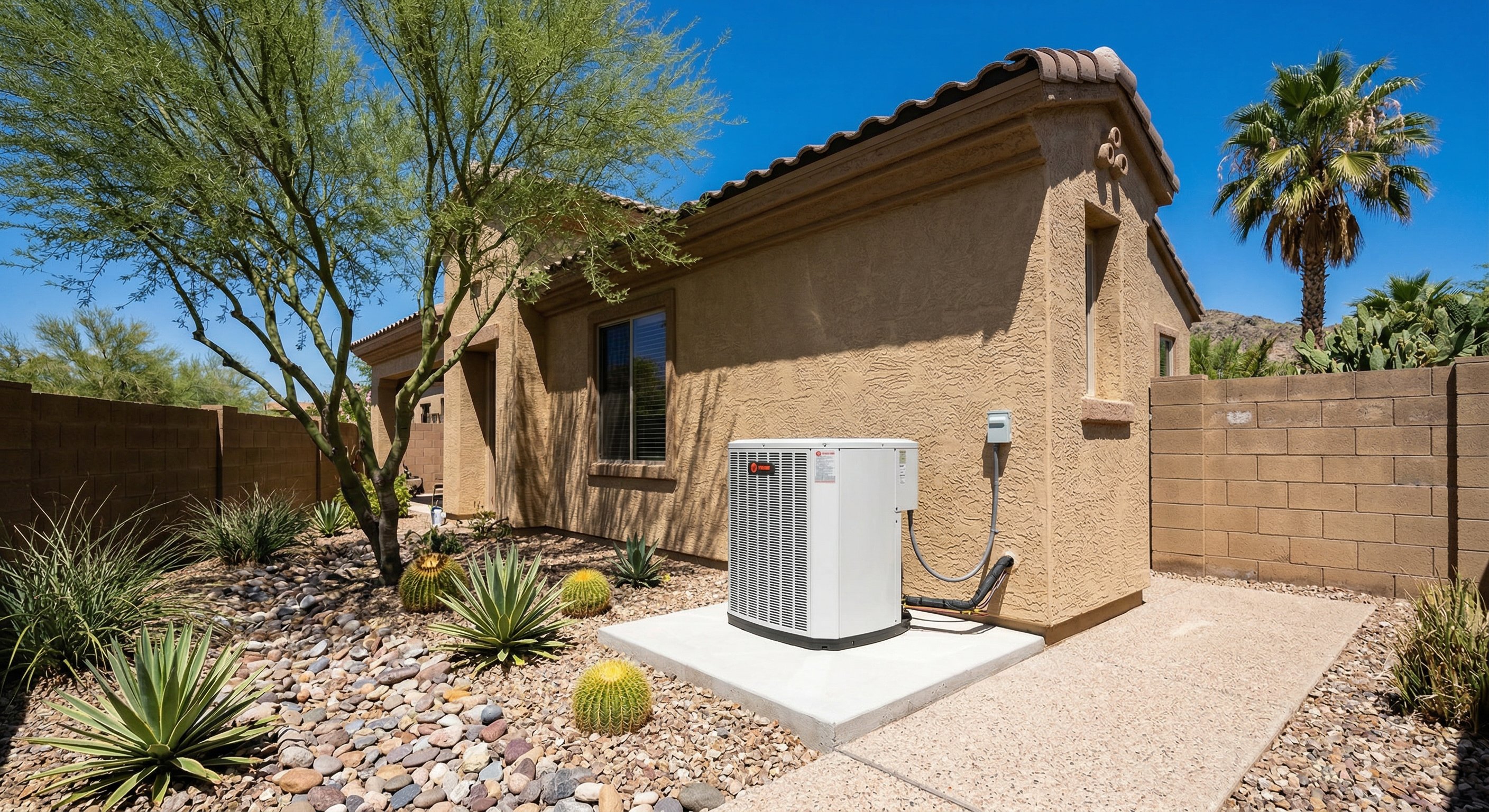
The sweet spot for most Peoria homes in subdivisions like Lake Pleasant Heights, Vistancia, Arrowhead Ranch, and Ridgewood is a 3-ton or 4-ton system landing between $7,500–$10,500 installed.
Why Peoria's AC Market Is a Specific Animal
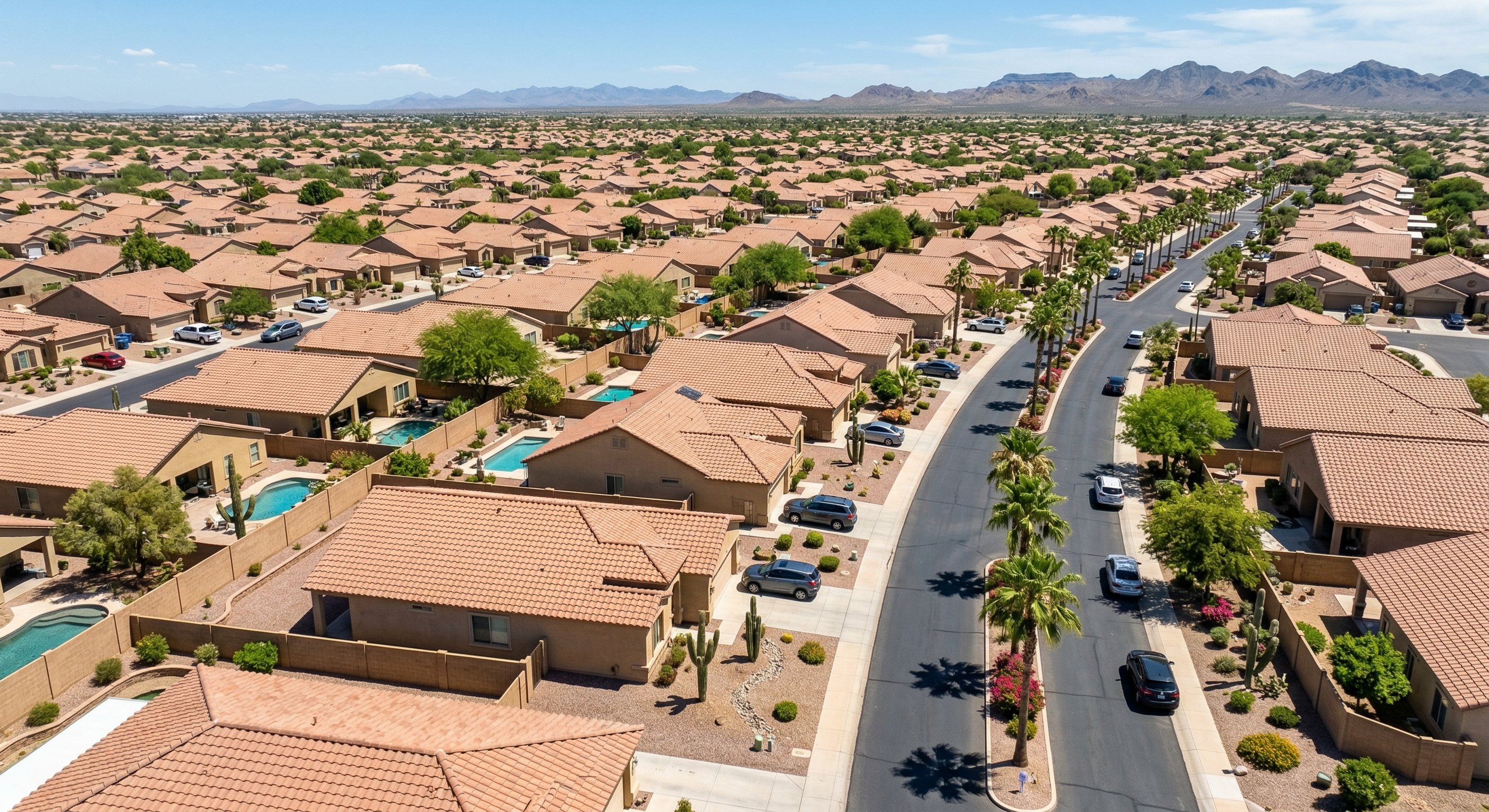
Peoria isn't just generic Phoenix metro. The city covers 175 square miles — one of Arizona's largest — and that sprawl matters for pricing in ways people don't expect.
The northwest corridor runs hot and runs old. Parts of Peoria near Thunderbird and Cactus Road have tract homes from the late 1980s and early 1990s. Those systems are hitting 30–35 years old. They're also likely to have R-22 refrigerant (the phased-out Freon), undersized ductwork for modern SEER requirements, and electrical panels that need upgrading for 15-SEER+ systems.
Vistancia and Lake Pleasant move differently. The newer master-planned communities in northern Peoria have larger, newer homes — 2,400–3,800 sq ft, often with dual-zone systems or package units on flat sections of the roof. Those jobs are bigger, more complex, and priced accordingly. A 5-ton system in a northern Peoria golf course home can legitimately reach $13,000–$16,000 with a split system install on a flat roof.
Monsoon season adds pressure. July through September, Peoria contractors are slammed. Emergency AC calls from Lake Pleasant down through Sun City West keep every HVAC crew fully booked. Quotes during monsoon season can run 10–20% higher than spring quotes for the same job — pure supply and demand. If you're reading this in March, you have time to get ahead of it.
The Equipment Breakdown: What You're Actually Buying
When you get a quote from a contractor, you're paying for three things:
1. The equipment itself This is the condenser (the outdoor unit), the air handler or furnace (indoor unit), and in many cases the coil. A standard 3-ton Carrier, Trane, or Lennox unit at SEER2 15.2 (the current minimum for Arizona) runs $1,800–$2,800 off the distributor. A premium 18-SEER variable-speed unit runs $3,200–$5,000.
The markup from contractor to homeowner? Typically 40–70% on the equipment alone.
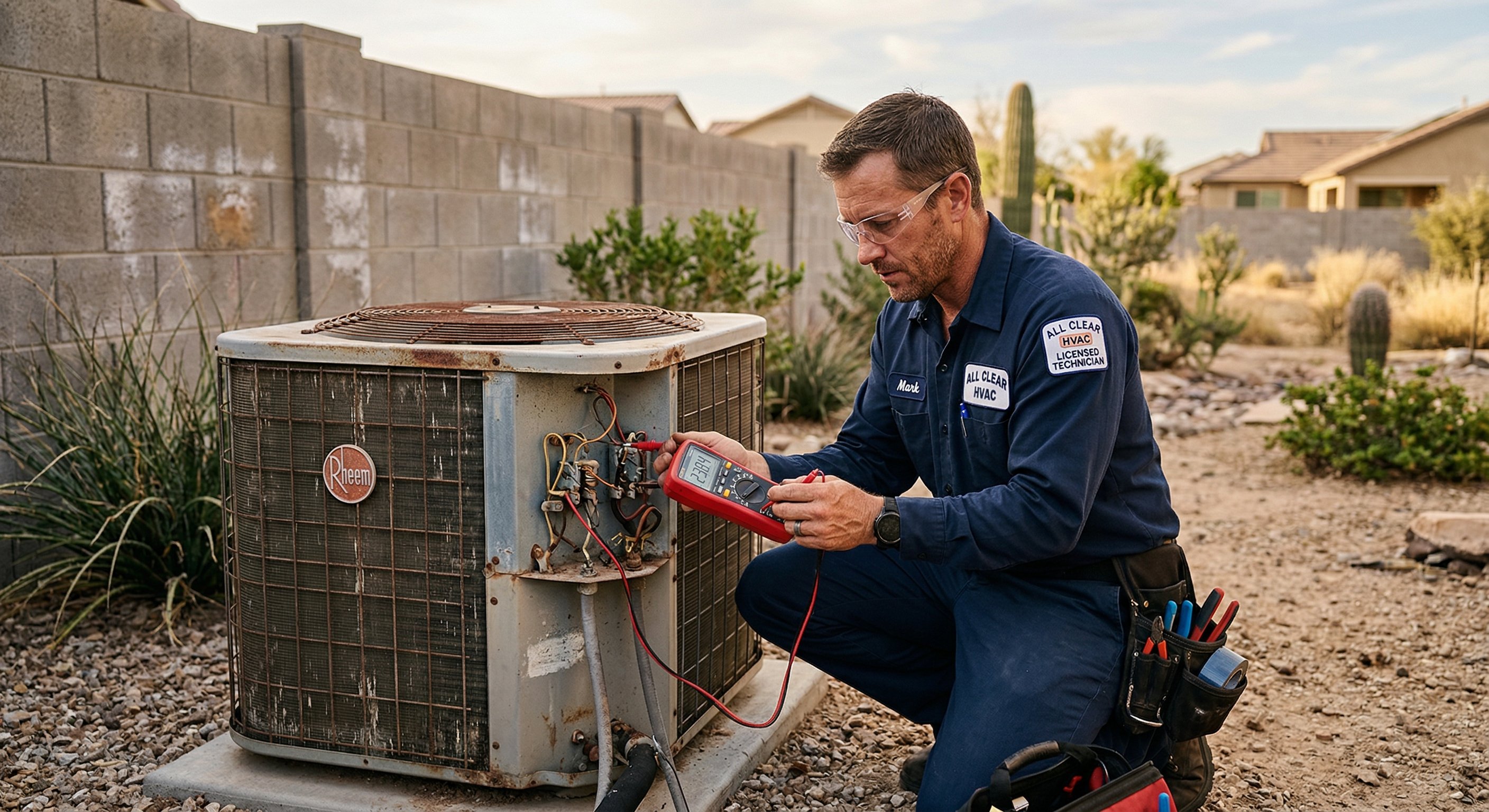
2. Labor and installation A straightforward swap-out in an existing system takes 4–8 hours for a two-person crew. Labor alone runs $800–$1,500 for a standard job. Complex installs — rooftop package units, new linesets, attic air handlers — push $2,000–$3,500 in labor.
3. Contractor overhead and profit This is the number nobody shows you — and where the spread between a $7,500 quote and a $10,000 quote for the same unit usually lives. Overhead is real (trucks, insurance, licensing), but the margin above that varies enormously between contractors.
Skip the dealer markup
See What a New AC Actually Costs in Peoria, AZ
AC Rebel shows you the real equipment price — no sales pitch, no inflated quote. Get matched with a licensed installer and keep $3,000–$5,000 in your pocket.
Get My Direct Price →What Pushes Your Cost Up (And How to Know Ahead of Time)
Before you get quotes, walk through these factors. Each one can add to your final number:
Old refrigerant (R-22/Freon): If your system is from before 2010, it probably runs on R-22, which has been phased out. Contractors can't add R-22 to an old system anymore (well, they can, but it's $50–$80 per pound and getting scarce). Most homeowners with R-22 systems are looking at full replacement — the math rarely pencils out for repair. If this is your situation, price for a full system, not a repair.
Ductwork condition: Peoria's older neighborhoods have leaky, undersized ducts. If your new system is bigger or more efficient than the old one, the ducts may need resizing or resealing. Duct sealing adds $800–$2,000; duct replacement adds $3,000–$7,000 depending on how much of the house needs work.
Electrical panel: Modern 18-SEER+ systems sometimes need a dedicated circuit or a panel upgrade if you're running on an older 100-amp service. Panel upgrades run $1,500–$3,000 and require an electrical permit. Ask your contractor if your panel is compatible before you sign anything.
Package unit vs. split system: Single-family homes with flat rooftops (common in parts of Peoria) often run package units — everything in one box on the roof. Rooftop installs take longer and cost more. Budget an additional $800–$1,500 for rooftop access and any curb or plenum work.
Permits: Peoria requires permits for AC replacements. A legitimate contractor pulls them. If a contractor says they'll skip permits to save you money — walk away. Unpermitted HVAC can kill a home sale and void your warranty.
How the Traditional Pricing Model Works (And Why It's Stacked Against You)
Here's the typical supply chain when you call a contractor:
Manufacturer → Distributor (+10–15%) → HVAC Contractor (+40–60%) → You
By the time equipment lands at your home, you're paying 1.5–2x the distributor price. The contractor buys a unit for $2,400 and charges you $4,200 for it — plus labor on top. That's just how the industry works. Nobody's getting arrested for it. But it means the "quote" you're getting is mostly markup on equipment you could theoretically buy yourself.
That's the gap AC Rebel was built to close. Instead of routing your purchase through a contractor who marks up the equipment, you buy the unit directly at near-wholesale pricing through AC Rebel, then connect with a vetted local installer for the labor-only portion. For a 3-ton system, that can mean $2,500–$4,000 less than a traditional contractor quote — same equipment, same install, no middleman markup on the unit.
If you're curious what that looks like for your specific home, you can see direct pricing on AC Rebel — the quote wizard takes about two minutes.
Realistic Peoria Scenarios
Scenario 1: Older home in Arrowhead Ranch, 1,850 sq ft, 20-year-old system The system is original equipment, R-22, struggling to keep up. Ductwork is intact but not great. New 3.5-ton 16-SEER split system, existing electrical fine, no ductwork repairs needed. Realistic range: $8,200–$10,500.
Scenario 2: Vistancia home, 2,800 sq ft, dual-zone system starting to fail Newer home with a 2015 system that's developed a refrigerant leak the tech says isn't worth chasing. Two-stage 4-ton system, compatible ductwork. Realistic range: $9,800–$12,500 depending on brand tier.
Scenario 3: Flat-roof home near 83rd Ave, package unit, 1,400 sq ft Rooftop package unit replacement, existing curb fits, electrical fine. 3-ton heat pump package unit. Realistic range: $7,500–$9,500 for a heat pump; $6,500–$8,500 for a standard packaged unit.
Scenario 4: Surprise/Peoria border area, 3,200 sq ft newer build, planning ahead System is 12 years old, working fine, but the homeowner is getting quotes now to avoid a summer emergency. 5-ton system, no complications. Realistic range: $10,500–$14,000 — spring timing means better contractor availability and no emergency premium.

Getting Your Quotes Right
Here's what to actually ask when you're comparing contractors:
- "What unit are you installing, and what's the unit cost?" Get the model number. Look it up. You'll know immediately if the markup is reasonable.
- "Does this price include permits?" Legitimate answer: yes, always.
- "Is there an extended labor warranty?" The AC unit comes with a manufacturer warranty (usually 5–10 years on parts with registration). Labor warranty is separate — one year is standard, some contractors offer more.
- "Will this require ductwork or electrical work?" Have them tell you before they start, not after.
- "What SEER2 rating is this unit?" Minimum in Arizona is 15.2 SEER2. Higher SEER means lower utility bills — worth the premium in a climate where your AC runs 8+ months a year.
Get at least three quotes. If one quote is dramatically lower, ask why — it could be a smaller, lower-SEER unit, skipped permits, or subcontracted labor.
Financing: Because $9,000 Is a Lot of Cash
Most Peoria homeowners don't have $8,000–$12,000 liquid for a sudden AC replacement. Financing is normal and often smart — especially when the alternative is patching a failing system through another brutal Arizona summer.
What you'll typically find:
- GreenSky financing: Available through some HVAC contractors, payments as low as $87–$130/mo for a standard system on a 60-month plan
- Synchrony or Service Finance: Similar programs, sometimes with deferred interest (read the fine print carefully)
- Utility rebates: APS and SRP both offer rebates for high-SEER systems — APS offers up to $150 for qualifying units, SRP up to $150 as well. Small, but worth grabbing
- Manufacturer rebates: Carrier, Trane, and Lennox all run periodic rebates. Spring is typically the best time to find them
AC Rebel offers GreenSky financing with payments starting as low as $47/mo for qualifying buyers. It's worth checking what your specific home qualifies for before you decide how to pay.
The Bottom Line
If you're replacing an AC in Peoria in 2026, you're looking at $7,000–$11,500 for most standard residential jobs. More if your home is large, older, or has complications. Less if your ductwork and electrical are in good shape and you're buying smart on the equipment.
The spread between quotes matters — and most of it lives in the equipment markup, not in legitimate labor cost differences. Understanding where your money is going is the first step to not overpaying.
Ready to see what direct pricing looks like for your Peoria home? The AC Rebel quote wizard takes 2 minutes — no sales pressure, just real numbers.
Frequently Asked Questions
How much does it cost to replace an AC unit in Peoria, AZ?
Most Peoria homeowners pay $7,200–$11,500 for a complete central AC replacement in 2026, including equipment and installation. Smaller homes under 1,600 sq ft often land at $6,500–$8,500; larger homes over 2,500 sq ft with complex installs can run $12,000–$15,000+.
What size AC unit does a Peoria, AZ home need?
Sizing depends on square footage, insulation, ceiling height, and sun exposure. General guidelines: 2-ton for under 1,000 sq ft; 3-ton for 1,200–1,800 sq ft; 3.5-to-4-ton for 1,800–2,500 sq ft; 5-ton for 2,800–3,500 sq ft. Always have a licensed technician do a Manual J load calculation — Arizona's heat means size errors are costly.
How long does an AC unit last in Peoria, AZ?
Arizona's extreme heat (115°F+ summers, 8–10 months of active cooling) shortens AC lifespan vs. national averages. Most Peoria homeowners see 10–14 years from a system, compared to the national average of 15–20. Systems running through monsoon season with poor maintenance often land at the low end.
Is spring the best time to replace an AC unit in Peoria?
Yes. March through May, contractors are less slammed and more willing to negotiate on labor pricing. Monsoon season (July–September) creates emergency call demand that raises prices and extends wait times. Replacing before summer heat hits is also less stressful — you won't be waiting 3 days for a crew while your house hits 92°F inside.
Does AC Rebel work in Peoria, AZ?
Yes. AC Rebel serves the full Peoria area and broader Maricopa County. You can buy your AC unit at direct pricing through the platform, then get matched with a vetted local installer for labor-only installation. The quote wizard at acrebel.com walks you through your options in about two minutes.
Do I need a permit to replace an AC unit in Peoria?
Yes. The City of Peoria requires permits for AC system replacements. Any licensed contractor should pull the permit — it's part of the job. Skipping permits creates problems when you sell your home and can void your equipment warranty. If a contractor offers to skip permits to save money, walk away.
Ready to stop overpaying?
See Your Direct AC Price in 2 Minutes
Skip the dealer. Buy your AC unit at direct pricing and pay a vetted local installer only for the installation. No sales calls. No hidden markup. Most homeowners save $3,000–$5,000+ compared to a traditional quote.
Get My Direct Price — No Credit Card2-minute quote · Licensed installers · 10-year warranty options