
Why Is My AC Running Constantly in Scottsdale? (And How to Fix It)

Why Is My AC Running Constantly in Scottsdale? (And How to Fix It)
TL;DR: In Scottsdale, an AC running nonstop is usually caused by one of seven things: an undersized unit, a dirty air filter, low refrigerant, a failing compressor, duct leaks, inadequate insulation, or extreme heat simply overwhelming an aging system. Some causes are free fixes you can do today. Others require a licensed HVAC technician. This guide walks through all seven, what each costs to fix, and when it's time to replace rather than repair.
If your AC has been running for the last six hours straight and your Scottsdale home still feels like the inside of a car in August, you're not imagining things — and you're definitely not alone.
Every summer, we hear the same story from Scottsdale homeowners: "The AC runs and runs and the house just won't cool down." Sometimes it kicks off briefly, then right back on. Sometimes it never shuts off at all. Either way, your electric bill is climbing, your equipment is taking a beating, and you're one monsoon storm away from a full breakdown.
Here's what's actually going on — and how to figure out which of the seven causes you're dealing with.
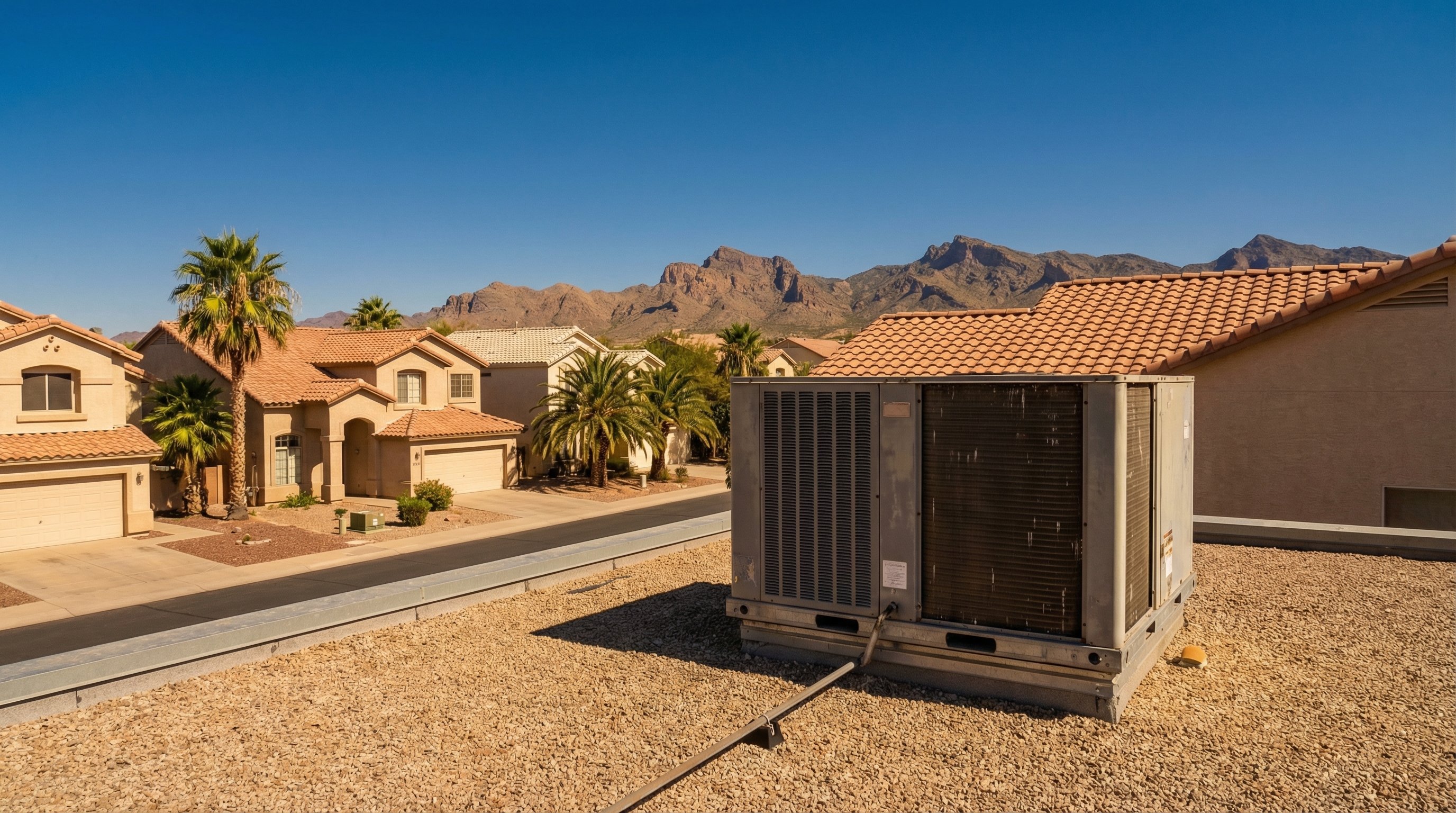
Why Scottsdale Is Harder on AC Systems Than Almost Anywhere Else
Before we get into causes, it helps to understand what your system is up against.
Most HVAC systems are engineered to maintain a 20°F temperature differential between outdoor and indoor air. So if you want 75°F inside and it's 95°F outside, your system is working hard but within design parameters.
In Scottsdale, summer temperatures regularly hit 110°F to 118°F. That's a 35-45°F differential. You're asking your equipment to do twice the work it was built for — and sustain it for months, not days.
Add in the dry desert air that pulls moisture from duct seals and connections, the dust storms that clog filters in a single afternoon, and homes that absorb heat through tile roofs and stucco walls like a solar oven, and you've got an environment that chews through average HVAC equipment fast.
The ENERGY STAR program notes that equipment in extreme climate zones loses efficiency roughly 15-20% faster than the rated lifespan. In Scottsdale, that's not a footnote — it's your reality.
The 7 Reasons Your AC Won't Stop Running
1. Your System Is Undersized for Your Home
This is the most common root cause in Scottsdale — and the most underdiagnosed.
What's happening: Your AC is doing everything it can, but the load (heat coming into the home) exceeds what the system can remove. It runs continuously because it's playing catch-up it can never win.
How to tell: The system runs all day, never shuts off, but your home temperature slowly creeps up — especially in the afternoon when the sun is hammering your west-facing walls.
The math behind it: AC capacity is measured in "tons" — one ton removes 12,000 BTUs of heat per hour. A rough rule of thumb for Phoenix/Scottsdale is 400-600 square feet per ton. A 2,000 sq ft home typically needs a 3.5 to 4-ton system. If you've got a 2.5-ton unit, you're undersized by a significant margin.
Sizing errors happen when:
- A previous owner "saved money" by installing the cheapest option
- The home was expanded without upgrading the AC
- A tech replaced an old unit with the same size without doing a proper Manual J load calculation
Fix: A proper Manual J load calculation costs $150-300 from a reputable HVAC company. If your system is undersized, you're looking at replacement. There's no "fix" for an undersized system — you can't add capacity to an existing unit.
Cost range: $3,500-$8,500 for proper-sized replacement, depending on brand and efficiency rating.
2. Dirty Air Filter — The Free Fix You're Probably Overlooking
What's happening: A clogged air filter restricts airflow across the evaporator coil. With reduced airflow, the coil can't absorb heat efficiently. The system has to run longer to remove the same amount of heat — and in extreme cases, the coil freezes, which makes things dramatically worse.
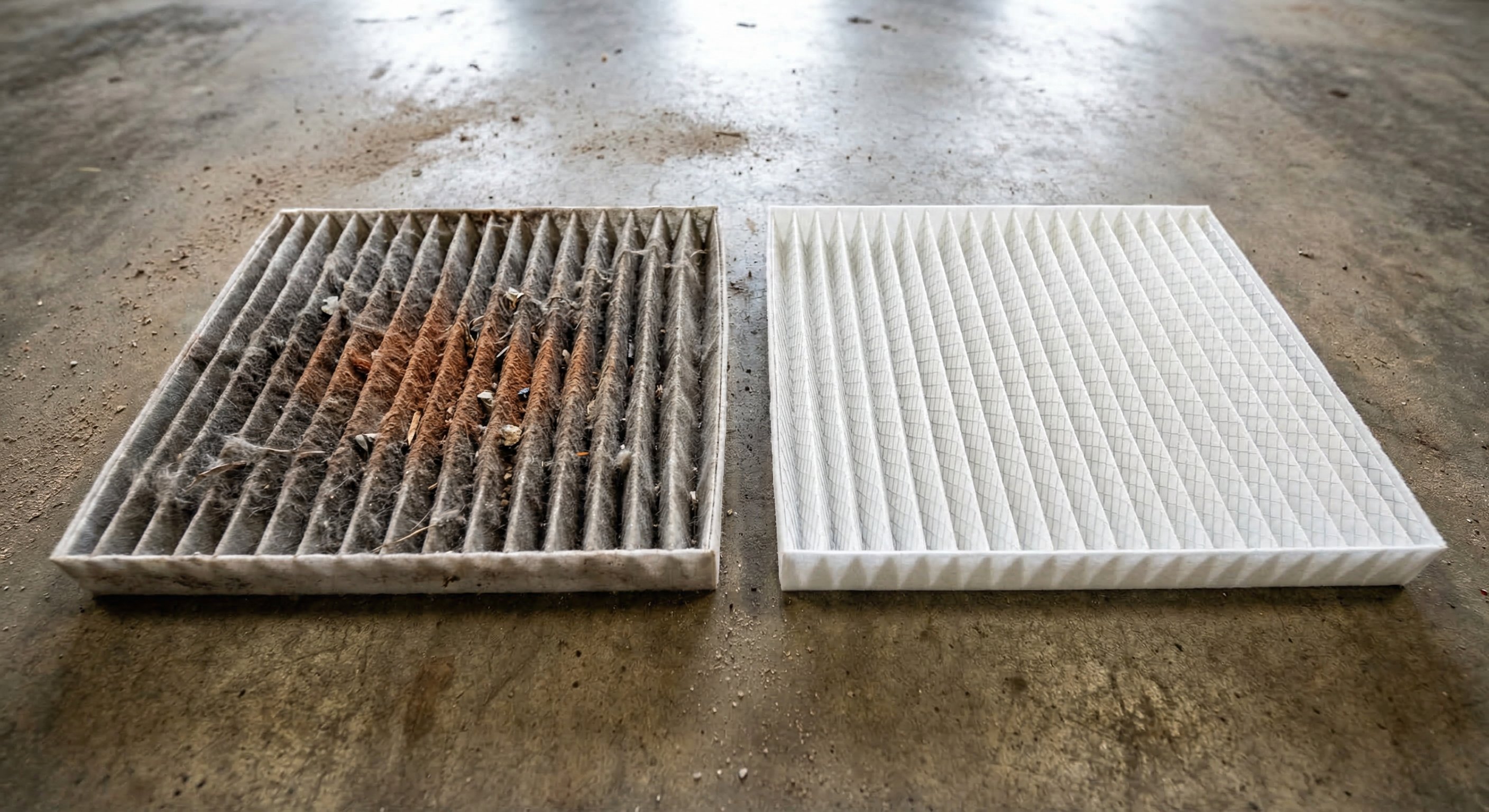
How to tell: Pull your filter out. If it's gray, visibly coated in dust, or you can't see light through it — that's your problem. In Scottsdale, during dust storm season (May-September), filters can go from clean to clogged in 2-4 weeks.
Fix: Replace the filter. Right now. A 1-inch pleated filter costs $8-15 at Home Depot. Use MERV 8-11 for Scottsdale homes — high enough to catch desert dust, low enough to not over-restrict airflow.
Important: If you have a high-efficiency MERV 13+ filter and a standard HVAC system, the filter itself might be your problem. Those thick filters are designed for systems with higher static pressure tolerance. Check your manufacturer specs.
Cost: $8-15. Done.
3. Low Refrigerant (Freon/Puron Leak)
This is one of the most common — and most frequently misdiagnosed — causes of an AC that runs forever.
What's happening: Refrigerant is the substance that actually absorbs heat from your home's air. It's a closed system that doesn't "use up" like fuel — if your levels are low, you have a leak somewhere. Low refrigerant means reduced heat absorption capacity, so the system runs longer to accomplish less.
How to tell:
- Your home feels humid as well as warm (refrigerant helps with dehumidification)
- You see ice on the refrigerant lines or outdoor unit (counterintuitive, but this signals a refrigerant problem)
- The AC runs long but indoor temperature creeps upward
What NOT to do: Don't let any tech "just add refrigerant" without finding and fixing the leak. It's both illegal (per EPA regulations) and pointless — you'll be back in the same situation in weeks.
Fix: Find the leak, repair it (or determine if it's economically viable to repair vs. replace), then recharge to manufacturer spec. The type of refrigerant matters significantly here:
- R-410A (Puron) — standard refrigerant for systems made before 2025. Still serviceable.
- R-32 or R-454B — newer systems (2025+) use these lower-GWP refrigerants
- R-22 (Freon) — if you have this, see our R-22 refrigerant guide. Short version: your old system is costing you.
Cost range: Leak detection and repair: $200-600. Refrigerant recharge: $100-400 depending on refrigerant type and quantity needed.
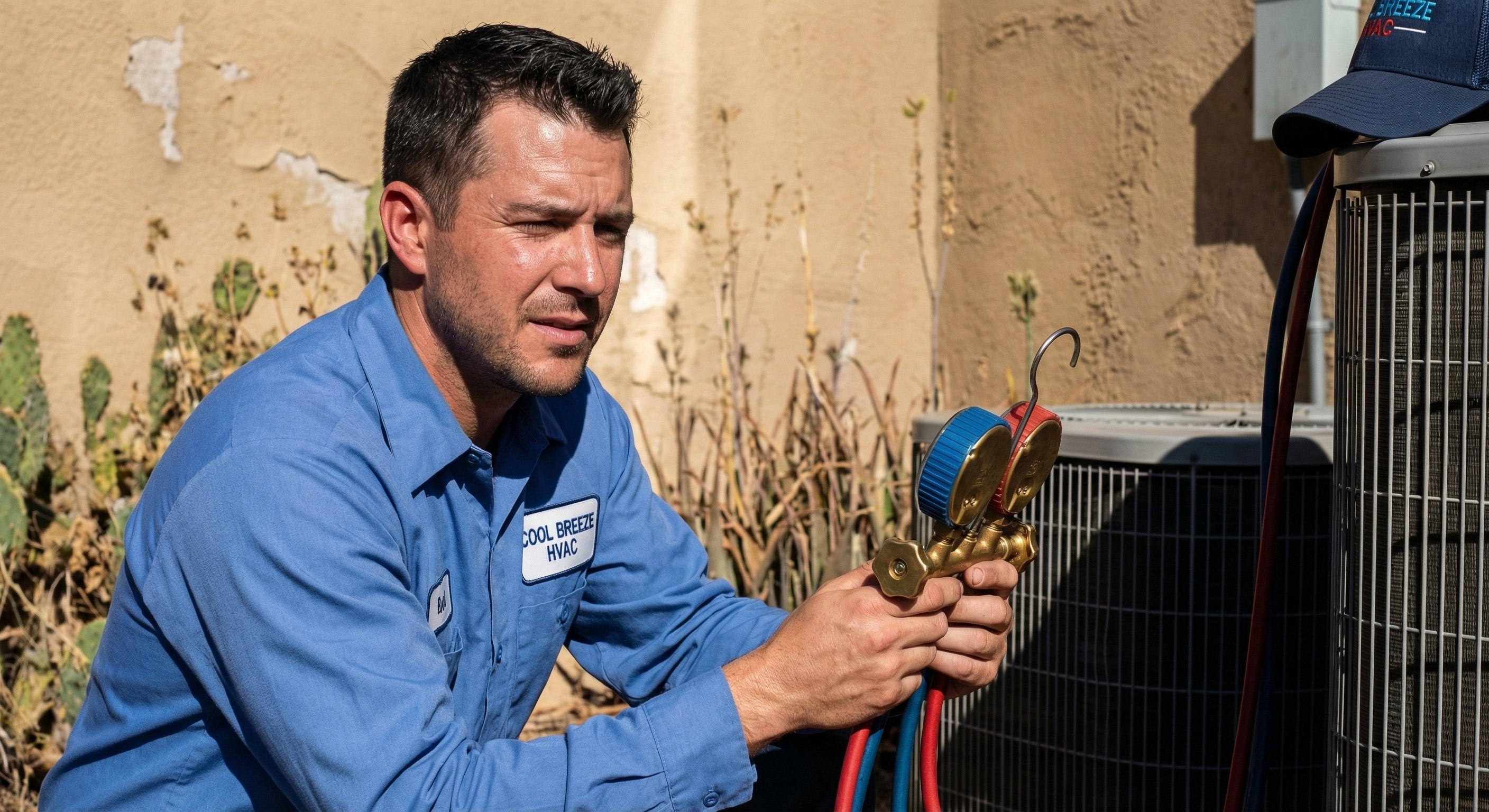
4. Dirty Evaporator or Condenser Coils
You know how a radiator gets less effective when it's caked with gunk? Same principle here.
Evaporator coil (indoor): Located in your air handler, this coil absorbs heat from your home's air. Dust, pet dander, and mold can build up on it over time, insulating it and reducing heat transfer.
Condenser coil (outdoor): Located in that big unit outside, this coil releases the heat outside. In Scottsdale's dusty environment, the fins can get coated with a fine layer of caliche dust and debris, dramatically reducing the system's ability to dump heat into the (already extremely hot) outdoor air.
How to tell: You'll need a technician with a camera or experience to properly assess coil condition. But if your last professional cleaning was more than 2 years ago, assume the coils need attention.
Fix: Professional coil cleaning. For outdoor coils, a technician will use coil cleaner solution and a low-pressure rinse. Indoor coils are more involved — sometimes the air handler needs to be accessed.
Cost range: $100-300 per coil cleaning as part of a maintenance visit. This is one of the highest-ROI maintenance items in Arizona — a clean condenser can improve system efficiency by 10-15%.
5. Duct Leaks — You're Cooling Your Attic
This one surprises people, but it's extremely common in Scottsdale homes — especially in homes built between 1985 and 2005.
What's happening: Your ductwork runs through your attic. In summer, attic temperatures in Scottsdale reach 150°F to 170°F. If your ducts have leaks, gaps, or disconnected sections, you're pumping cold air into your 160°F attic and pulling hot attic air into your return. The result: your system runs constantly because it can't actually deliver conditioned air to your living space.
According to ENERGY STAR, the average home loses 20-30% of conditioned air through duct leaks. In Phoenix metro, I've seen homes lose 40%+. That's your system running a third longer — minimum — just to compensate.
How to tell:
- Some rooms feel significantly hotter than others (uneven cooling)
- You can feel airflow in the attic near duct connections
- Your utility bill is unusually high relative to your home size and system age
Fix: Duct sealing or replacement. A technician can use a blower door test or duct pressure test to quantify leakage. Sealing is done with mastic (a paste-like sealant) or metal-backed tape — NOT regular duct tape, which dries out and fails in Arizona's heat.
Cost range:
- Duct sealing (minor leaks): $300-800
- Partial duct replacement: $1,000-2,500
- Full duct system replacement: $2,500-6,000 depending on home size
This is also something worth getting rebate help on — SRP and APS both offer duct sealing rebates. More on that in a moment.
6. Poor Insulation and Building Envelope Issues
Your AC system doesn't work alone — it works against your home's thermal envelope. If your home is leaking heat in from every seam, your AC will run continuously trying to stay ahead of it.
Common culprits in Scottsdale homes:
- Attic insulation below code: Arizona building code now requires R-38 insulation in attics. Many older Scottsdale homes have R-19 or less. Every hour your house sits in 115°F heat, your attic insulation is your first line of defense.
- Single-pane windows: Still present in some older Scottsdale homes. They transmit heat like a screen door.
- Weather stripping gaps: Around doors and windows. On a hot day, hold your hand near the edges — you'll feel it.
- Recessed lighting without insulation covers: Common in older homes, creates direct thermal shortcuts from attic to living space.
Fix: These aren't AC fixes — they're home improvement items. But they directly affect how hard your AC has to work. Upgrading attic insulation from R-19 to R-38 can reduce cooling load by 10-20% according to the Department of Energy.
Cost range: Attic insulation upgrade: $1,500-4,000 depending on home size and current condition. Window replacement: $500-1,200 per window (higher ROI options include solar screens and low-E film for existing windows).
Utility rebates: Both SRP and APS offer insulation rebates. SRP's current program offers up to $0.10 per square foot for attic insulation upgrades. Check aps.com or srpnet.com for current rebate amounts before getting work done.
7. Failing or Oversized Equipment
Counterintuitively, an oversized AC unit can behave almost like an undersized one in terms of running patterns — but for the opposite reason.
Oversized system ("short cycling"): If your system is too large for your home, it cools the home so quickly that it shuts off before completing a full humidity removal cycle. Then the home gets warm again quickly, and it kicks back on. You get frequent on-off cycles (short cycling) rather than long continuous runs. This hammers the compressor (which hates rapid starts), drives up electricity usage, and creates comfort problems because the humidity is never properly controlled.
Failing compressor or capacitor: As equipment ages (and Phoenix AC units age faster than the national average), components start to fail. A weak compressor draws more amperage to accomplish the same work, runs longer, and struggles against the heat load. A failing capacitor — the component that starts the compressor motor — can cause the system to try to start, fail, try again, and run inefficiently.
How to tell: A technician with electrical diagnostic tools can measure compressor draw and capacitor health in under 30 minutes. This should be part of every annual tune-up.
Cost range:
- Capacitor replacement: $150-300 (quick fix, high impact)
- Compressor repair: $800-1,800 (often not cost-effective on older units)
- When compressor fails on a system 10+ years old: replacement conversation
What It's Costing You Right Now
Let's put real numbers on continuous AC operation in Scottsdale.
The average 3-ton residential AC unit in Arizona draws approximately 3,000-4,200 watts when running. At APS's current Saver Choice rate (~$0.12/kWh on-peak, ~$0.07 off-peak), here's the math:
| Scenario | Daily Run Hours | Daily Cost | Monthly Cost |
|---|---|---|---|
| Normal operation (8-10 hrs) | 9 hrs | ~$4.50 | ~$135 |
| Running excessively (14-16 hrs) | 15 hrs | ~$7.50 | ~$225 |
| Running continuously (20+ hrs) | 22 hrs | ~$11 | ~$330 |
The difference between a properly functioning system and one running continuously can be $100-200 per month in Scottsdale during peak summer. Over a full cooling season (May-October), that's $600-1,200 in unnecessary electricity.
A single service call that finds and fixes the problem often pays for itself in under two months.
Ready to stop throwing money at a system that won't keep up? Get a free instant quote at acrebel.com — no pushy sales call, just honest numbers on what it actually costs to fix or replace.
Skip the dealer markup
See What a New AC Actually Costs
AC Rebel shows you the real equipment price — no sales pitch, no inflated quote. Get matched with a licensed installer and keep $3,000–$5,000 in your pocket.
Get My Direct Price →How to Diagnose It Yourself (Before Calling Anyone)
Before you call a technician, run through this quick checklist — it takes 10 minutes and might save you a $150 service fee:
Step 1 — Check your filter (2 minutes) Pull it out. If it's visibly dirty or gray, replace it and wait 2 hours to see if the system behavior improves.
Step 2 — Check your thermostat settings (1 minute) Make sure it's set to COOL, not FAN. Make sure the set temperature is actually below current room temperature. Obvious, but it's worth the 60-second check.
Step 3 — Walk outside and look at your condenser (3 minutes) Is ice forming on the refrigerant lines or the unit itself? Is the fan running? Are the fins visibly packed with debris? Can you see or hear the compressor running?
Step 4 — Check for airflow at vents (2 minutes) Walk through your home. Hold your hand at each supply vent — is air coming out? Are some rooms dramatically different from others? Uneven airflow often points to duct issues.
Step 5 — Check the air handler (2 minutes) Is it running? Is water dripping or pooling around it? (Pooling water often means a frozen/clogged drain line — related to the problems above.)
If steps 1-2 don't fix it, you need a technician. But the information you gather in steps 3-5 will make that service call faster and cheaper — you've already narrowed it down.
What to Tell Your HVAC Tech
When you call, describe:
- How long it's been running continuously (days, weeks, all summer?)
- Whether the house is getting cooler at all or not cooling at all
- Any unusual sounds (clicking, gurgling, high-pitched squeal)
- When the filter was last changed
- The system's age (check the data plate on the outdoor unit — it'll have a manufacture date)
A qualified tech should always:
- Take static pressure readings to check airflow
- Check refrigerant pressure (not just "add refrigerant")
- Measure supply and return air temperatures (delta T test)
- Inspect coil condition
- Test capacitor health
If a tech quotes you refrigerant without checking for a leak first — that's a red flag.
Key Takeaways
- Start with the free stuff: Filter, thermostat setting, outdoor unit inspection. These take 10 minutes and are the cause of roughly 20% of "AC won't stop running" calls.
- Refrigerant leaks are common in aging Arizona units — but topping off without finding the leak is a waste of money and illegal.
- Duct leaks are massively underdiagnosed in Scottsdale homes — and heavily rebated by SRP and APS.
- Undersized equipment can't be fixed — only replaced. A proper Manual J sizing calculation before replacement is non-negotiable.
- Scottsdale's heat is genuinely extreme. An AC running 12-14 hours a day during July is normal. One running 20+ hours is telling you something.
Frequently Asked Questions
Q: Is it normal for AC to run all day in Scottsdale?
During peak summer months (June-August), when outdoor temperatures are 110°F+, it's not unusual for a properly sized Scottsdale AC to run 12-16 hours per day. If your system is running 18-22 hours or running continuously without shutting off at all, something is wrong — either with the equipment, the duct system, or the building envelope.
Q: How long should an AC cycle run in Arizona?
A normal AC cycle in Arizona summer is typically 15-25 minutes of run time followed by a 5-10 minute rest. Shorter cycles (under 10 minutes) suggest an oversized system or electrical issue. Non-stop running with no cycles suggests the system is overwhelmed or has a capacity problem.
Q: Can a dirty filter really cause my AC to run nonstop?
Yes — and it's one of the most common causes. A severely clogged filter can reduce airflow by 40-50%, forcing the system to run much longer to achieve the same cooling. In extreme cases, reduced airflow causes the evaporator coil to freeze, which blocks airflow entirely and creates a cascade of problems. In Scottsdale, filters need to be checked every 2-4 weeks during dust season.
Q: My AC runs constantly but the house stays cool. Is that a problem?
Yes, even if the house is comfortable. Continuous operation means your system never gets rest cycles, which accelerates wear on the compressor and other components. It also means your utility bill is higher than it needs to be. Common causes: undersized equipment, a period of unusually extreme heat, or a refrigerant level that's low enough to reduce efficiency but not enough to prevent cooling entirely.
Q: How much does it cost to fix an AC that won't stop running in Scottsdale?
It depends entirely on the cause:
- Dirty filter: $8-15 (DIY)
- Dirty coils: $200-400 (professional cleaning)
- Refrigerant leak: $300-800 (leak repair + recharge)
- Duct leaks: $500-2,500 depending on severity
- Undersized equipment: $3,500-8,500 (replacement required)
- Failing compressor/capacitor: $150-1,800
Q: Should I replace my AC if it's running all the time in Scottsdale?
Not necessarily — not until you've diagnosed the root cause. If the system is under 8 years old, there's usually a fixable cause. If it's 10-15+ years old, running constantly, and multiple components are failing, replacement economics often win. A good rule: if the repair cost exceeds 50% of a new system's cost, replace. Get our repair vs. replace breakdown for the full decision framework.
Q: Does running my AC constantly damage it faster?
Yes. Compressors wear with every start cycle — the startup surge is the hardest moment on the equipment. Continuous operation also means continuous mechanical wear on the fan motor, bearings, and electrical components. Arizona AC units already have shorter lifespans than the national average (typically 12-15 years here vs. 15-20 nationally) because of the extreme operating conditions. Running it continuously accelerates that timeline.
Ready to Stop Guessing?
If your Scottsdale AC is running constantly and you've ruled out the simple stuff (filter, thermostat, obvious debris on the outdoor unit), the next step is a diagnostic service call — typically $75-150 in the Scottsdale area.
AC Rebel is direct-to-consumer: no dealer chain, no franchise markup. We install equipment at or near wholesale pricing and charge transparent, flat-rate labor. If your system needs replacement, you'll know exactly what you're paying for before anyone touches a wire.
Get a free instant quote at acrebel.com — takes about 2 minutes, no sales call required.
Sources: ENERGY STAR Residential HVAC Guidelines, AHRI Performance Certification, APS Residential Rebates Program
Ready to stop overpaying?
See Your Direct AC Price in 2 Minutes
Skip the dealer. Buy your AC unit at direct pricing and pay a vetted local installer only for the installation. No sales calls. No hidden markup. Most homeowners save $3,000–$5,000+ compared to a traditional quote.
Get My Direct Price — No Credit Card2-minute quote · Licensed installers · 10-year warranty options