
How to Lower Your Electric Bill in Phoenix (AC-Focused Strategies That Work)

How to Lower Your Electric Bill in Phoenix (AC-Focused Strategies That Work)
TL;DR: Phoenix summer electric bills routinely hit $400–$600 because your AC runs 12–16 hours daily in 110°F+ heat. The fastest savings come from switching to a time-of-use plan (APS/SRP), raising your thermostat 2–3 degrees, and changing filters monthly during dust season. A modern 16+ SEER AC unit can cut cooling costs 30–40% compared to a 10-year-old system. Most Phoenix homes see payback on a new efficient unit in 4–6 years through utility savings alone.
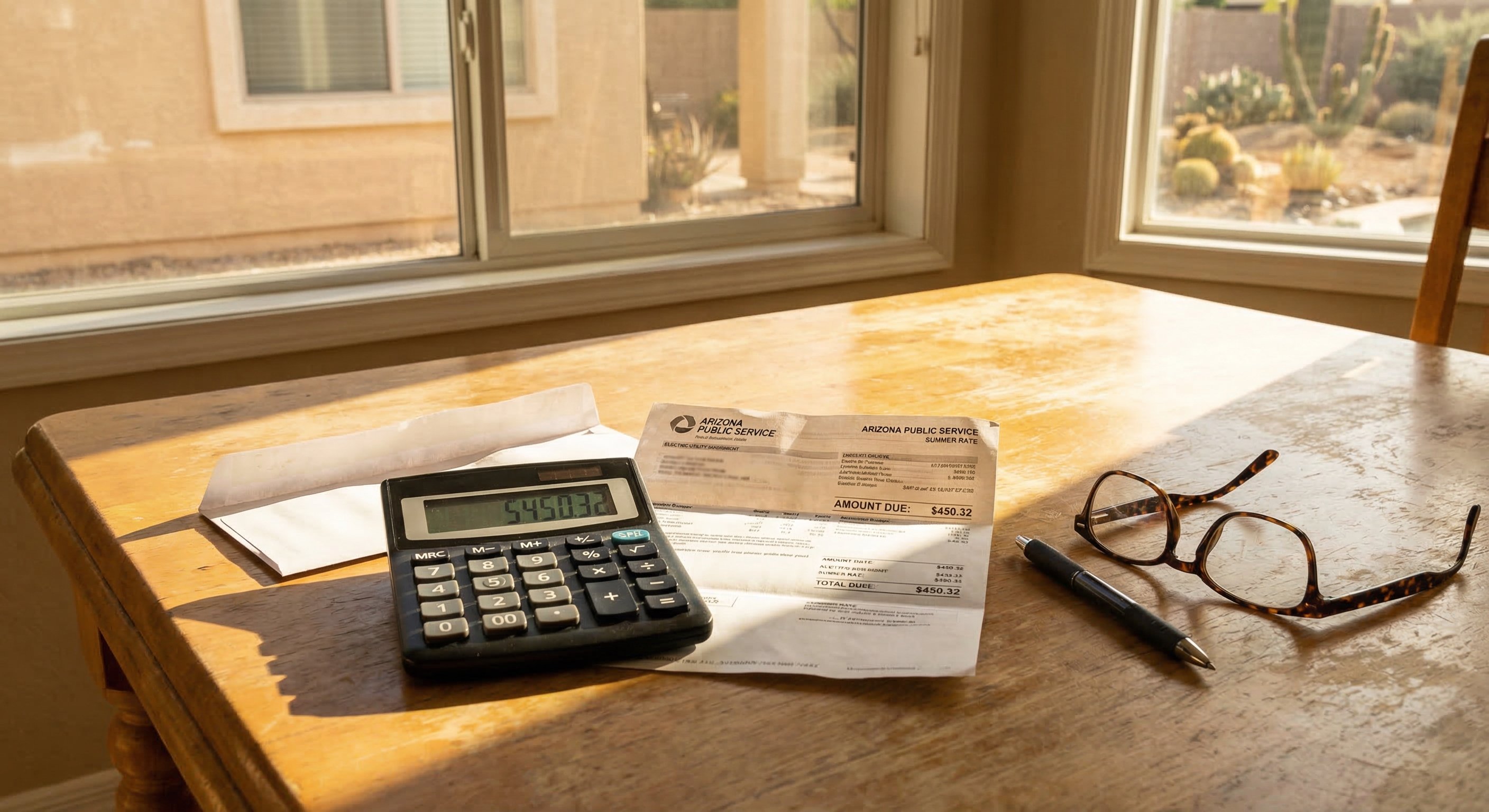
Last July, a homeowner in Ahwatukee opened her APS bill and stared at the number: $487. Her AC had been running constantly, the thermostat set to 72°F because anything higher felt unbearable when it was 114°F outside. She'd already sealed her windows, added weatherstripping, and unplugged devices. The bill barely budged.
Here's what nobody tells you about lowering electric bills in Phoenix: your AC accounts for 60–70% of your summer usage. All the LED bulbs and smart power strips in the world won't move the needle if you're bleeding electricity through an inefficient cooling system. Arizona's climate is unforgiving. While homeowners in Ohio worry about $150 summer bills, we're looking at $400–$600 monthly hits from June through September.
This guide covers what actually works to lower your summer electric bill here—focused on the AC strategies that deliver real dollars, not theoretical savings.
Why Phoenix Electric Bills Are So Much Higher Than National Average
The average US household pays around $140 monthly for electricity. In Phoenix, summer bills routinely triple that. Here's the math that explains why:
Extreme heat load: When it's 112°F outside and you want 78°F inside, your AC faces a 34-degree temperature differential. In milder climates, that differential might be 15–20 degrees. Your unit works 40–60% harder here.
Long cooling season: Phoenix sees 100+ days above 100°F annually. Your AC runs hard from May through October—six months of heavy usage versus 2–3 months in most of the country.
Monsoon humidity spikes: July and August bring humidity that makes 105°F feel worse and forces your AC to work harder removing moisture, not just dropping temperature.
Older housing stock: Many Phoenix-area homes built before 2000 have undersized ductwork, poor insulation by modern standards, and original AC units that are well past their efficient lifespan.
The result? Your AC compressor runs 12–16 hours daily during peak summer. At Arizona electricity rates ($0.13–$0.16 per kWh on average, higher during peak hours), that's $12–$18 daily just for cooling.

Understanding APS and SRP Time-of-Use Plans (The Easiest 15–20% Savings)
APS and SRP both offer time-of-use (TOU) plans that can slash your bill without changing your lifestyle. A lot of homeowners are still on standard plans simply because nobody ever told them to switch.
How TOU plans work: Electricity costs less during off-peak hours (typically 8 PM to 3 PM the next day) and more during on-peak hours (3 PM to 8 PM weekdays). Since your AC works hardest during those peak hours, shifting usage saves real money.
APS time-of-use options:
- Saver Choice: Lower off-peak rates, higher on-peak. Best if you can avoid heavy AC usage 3–8 PM weekdays.
- Saver Choice Plus: Even lower off-peak rates, but steeper on-peak penalties. Maximum savings if you can pre-cool your home before 3 PM, then coast through peak hours.
SRP time-of-use options:
- EZ-3: On-peak 3–6 PM only (shorter window than APS). Good for families who can't shift usage late.
- Time-of-Use: 2–8 PM peak window with lower off-peak rates. Better for night owls who can delay AC cooling until after 8 PM.
Real-world example: A 2,400 sq ft home in Gilbert with a 4-ton AC unit running standard APS rates pays roughly $520/month in July. Switching to Saver Choice Plus and pre-cooling the house to 74°F by 2:30 PM, then letting it drift to 79°F by 8 PM, drops that bill to approximately $410—saving $110 monthly during peak season.
Critical detail: You have to switch yourself. Neither APS nor SRP automatically moves you to the cheapest option for your usage pattern. Log into your account or call and verify which plan you're actually on. Both utilities publish plan details and comparison tools on their rate pages, which is worth checking before the next heat wave hits.
Thermostat Settings That Actually Make Sense for Phoenix
The standard advice—"set your thermostat to 78°F"—ignores desert reality. When it's 115°F outside, 78°F feels different than when it's 85°F. Here's what local HVAC contractors actually recommend:
The 20-degree rule: Your AC can realistically maintain about 20 degrees below outdoor temperature. When it's 110°F outside, expecting 72°F inside forces your unit to run continuously, shortening its lifespan and spiking your bill.
Smart settings for Phoenix summers:
- When home: 78–80°F (use ceiling fans to feel 4 degrees cooler)
- When away: 85–87°F (don't turn it off completely—re-cooling from 95°F costs more than maintaining 85°F)
- Sleeping: 76–78°F with ceiling fan overhead
Programmable thermostat strategy: If you're on a TOU plan, program aggressive pre-cooling 2–3 degrees below your comfort level starting at 12:30 PM. By 3 PM when peak rates hit, your thermal mass is already cool. Let the temperature drift up 2–4 degrees until 8 PM when off-peak rates resume.
Heat pump owners note: If you have a heat pump with electric resistance backup, aggressive setbacks (letting the house get hot then reheating) trigger expensive resistance heat. Keep setbacks modest—3–4 degrees maximum.
Skip the dealer markup
See What a New AC Actually Costs
AC Rebel shows you the real equipment price — no sales pitch, no inflated quote. Get matched with a licensed installer and keep $3,000–$5,000 in your pocket.
Get My Direct Price →AC Maintenance: The $50 Fix That Saves $300+ Monthly
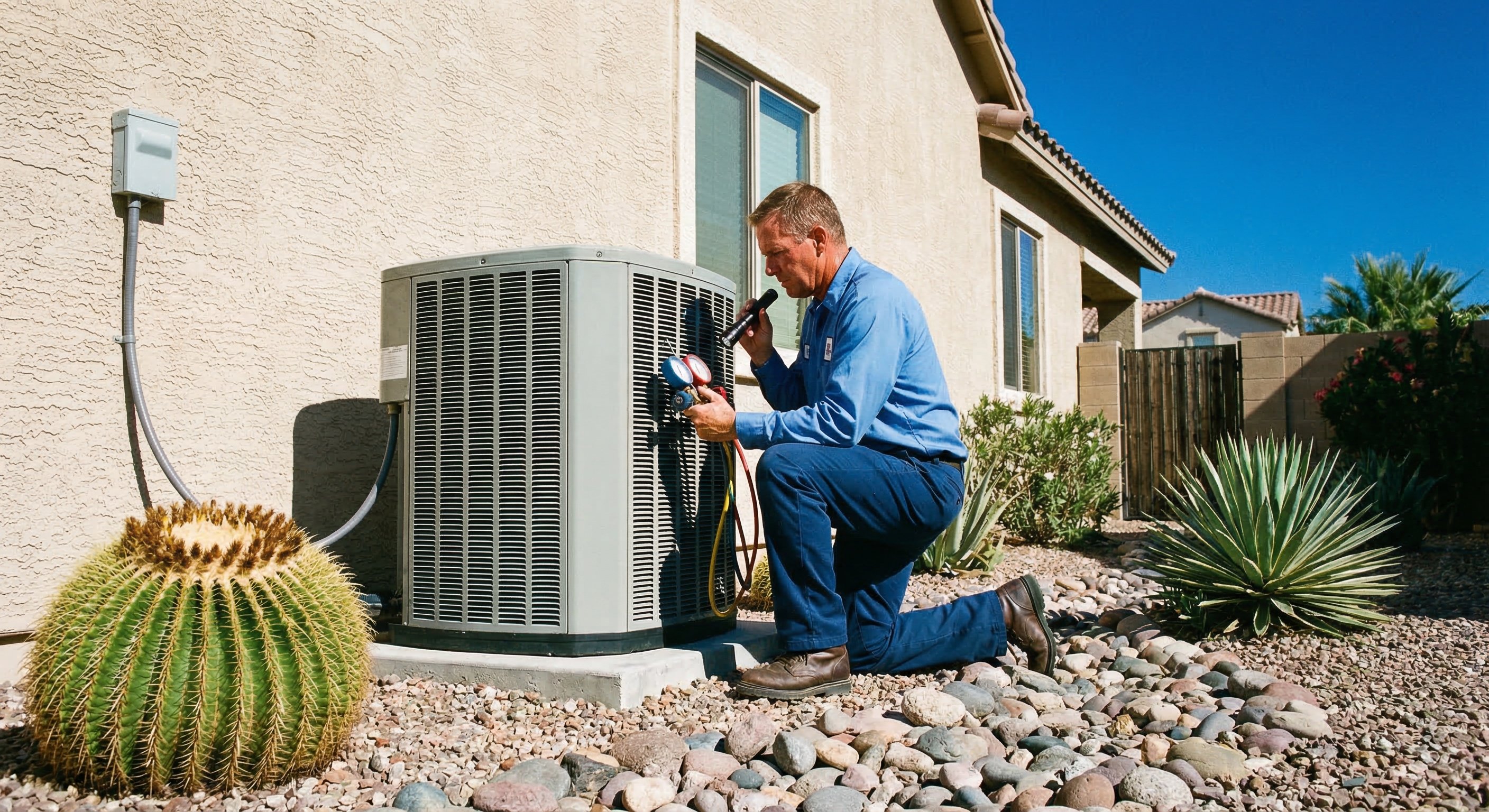
Desert dust is Phoenix's silent AC killer. The fine particulate that coats your car windshield in March? It's clogging your AC coils and filters year-round.
Monthly filter changes (non-negotiable): During dust season (February through May), check your filter every 3–4 weeks. A clogged filter restricts airflow, forcing your blower motor to work harder and reducing cooling capacity by 15–25%. At $0.15/kWh, that's $60–$100 monthly in wasted electricity for a typical home.
Annual coil cleaning: Your outdoor condenser coils dissipate heat. When coated in dust, they can't release heat efficiently, causing your compressor to run longer and hotter. Professional coil cleaning costs $75–$150 and pays for itself in one month of summer operation.
Condensate drain clearing: Arizona's hard water causes scale buildup in drain lines. A clogged drain triggers safety shutoffs or water damage. Annual clearing prevents emergency service calls during 110°F weekends when every contractor is slammed.
DIY maintenance you can do:
- Hose down outdoor condenser coils monthly (turn power off first)
- Keep vegetation 2+ feet clear around outdoor units
- Check and replace filters every 30 days during heavy use
- Verify all vents are open and unblocked by furniture
The SEER Rating: Why Your AC's Age Matters More Than You Think
SEER (Seasonal Energy Efficiency Ratio) measures how efficiently your AC converts electricity into cooling. The math is straightforward: higher SEER = lower electric bills.
Desert-relevant SEER facts:
- AC units made before 2006: 10 SEER or less
- Units from 2006–2015: 13 SEER minimum
- Current minimum (2023+): 14.3 SEER in the Southwest
- High-efficiency units: 16–20+ SEER
What this means in dollars: A 3-ton AC unit in Phoenix running 2,200 hours annually costs roughly:
- 10 SEER (old unit): $1,450/year in electricity
- 14 SEER (current minimum): $1,040/year
- 16 SEER (mid-efficiency): $910/year
- 18 SEER (high-efficiency): $805/year
That's $540–$645 annual savings jumping from an old 10 SEER unit to modern high-efficiency equipment. Over a 12-year lifespan, you're looking at $6,500–$7,700 in electricity savings—often more than the equipment cost itself.
The 2023 SEER2 standards: New testing procedures make current ratings slightly stricter. A "16 SEER2" unit is roughly equivalent to a 17 SEER unit under old testing. When comparing quotes, verify whether ratings are SEER or SEER2. ENERGY STAR and AHRI both publish efficiency guidance and certified equipment data, so if a quote sounds fuzzy, you can verify the numbers instead of taking someone's word for it.
When AC Replacement Pays for Itself (And When It Doesn't)
Not every old AC needs immediate replacement. Here's the decision framework Phoenix contractors use:
Replace now if:
- Your unit is 12+ years old AND needs a major repair ($800+)
- You're facing R-22 refrigerant recharge ($1,200–$2,500)
- Summer bills consistently exceed $400/month with reasonable thermostat settings
- Your unit runs constantly but can't maintain 78°F on 110°F days
Repair and wait if:
- Your unit is under 10 years old
- The repair is minor (capacitor, contactor, fan motor under $500)
- You've addressed other efficiency factors (insulation, duct sealing, filter changes)
- You're planning to sell within 2–3 years
The financing math: A new 16 SEER system might cost $7,500–$9,500 installed. At $500/year in electricity savings, that's a 6-year payback. But factor in avoided repair costs ($300–$800 annually on old units), improved comfort, and current financing rates (0% for 48+ months available through many providers), and the decision often tilts toward replacement for units over 12 years.
Ductwork and Insulation: The Hidden Energy Drains
Even a brand-new 18 SEER AC unit wastes electricity if your ductwork leaks or your attic insulation is inadequate. In Phoenix's 160°F attics during summer, these factors matter enormously.
Duct leakage: Homes here commonly lose 20–30% of conditioned air through leaky ductwork. That means a chunk of the air you already paid to cool is dumping into a superheated attic before it ever reaches your bedrooms or living room. Duct sealing costs $800–$2,000 depending on accessibility and can pay for itself in 1–2 summers.
Attic insulation: Current code requires R-38 insulation in Phoenix attics. Many homes built before 2010 have R-19 or less. Adding blown insulation to reach R-38 costs $1,200–$2,500 and reduces cooling load by 15–25%.
Radiant barriers: Reflective foil barriers in attics reduce radiant heat transfer from the roof deck. In Phoenix's intense sun, radiant barriers can lower attic temperatures 20–30°F, reducing the heat load on ductwork and living spaces. Cost: $800–$1,500 for typical home.
The whole-system approach: Addressing insulation and ductwork first allows you to install a smaller AC unit when replacement time comes. A properly sealed and insulated 2,400 sq ft home might need a 3-ton unit instead of 4-ton—a $1,000–$1,500 upfront savings plus ongoing efficiency gains.
Key Takeaways: Your Phoenix Electric Bill Action Plan
- Switch to time-of-use rates immediately—15–20% savings with one phone call or website visit
- Raise your thermostat 2–3 degrees and use ceiling fans—feels the same, costs 10–15% less
- Change filters every 30 days during dust season—prevents 15–25% efficiency loss
- Pre-cool before 3 PM if on TOU plans, then coast through peak hours
- Consider replacement if your unit is 12+ years old with high bills—new 16+ SEER units cut costs 30–40%
- Seal ductwork and upgrade insulation before buying oversized equipment
Most homeowners here can cut summer electric bills 25–35% through these AC-focused strategies—without sacrificing comfort during the brutal summer months.
Ready to stop overpaying for cooling? A modern, efficient AC system tailored to your home's specific load can slash your summer electric bills while keeping you comfortable even when it's 115°F outside. Get a free instant quote at acrebel.com—see direct pricing on high-efficiency units and calculate your potential savings.
Frequently Asked Questions
Q: What's the ideal thermostat setting for Phoenix summers?
A: 78–80°F when home, 85–87°F when away. Use ceiling fans to feel 4 degrees cooler without lowering the thermostat. The 20-degree rule applies—when it's 110°F outside, expecting 72°F inside forces your AC to run constantly and inefficiently.
Q: How much can I actually save with a time-of-use plan?
A: Most Phoenix homeowners save 15–20% switching from standard rates to TOU plans, assuming they can shift some usage away from 3–8 PM peak hours. Pre-cooling your home before peak hours, then letting the temperature drift 2–4 degrees until 8 PM, maximizes savings without discomfort.
Q: Is a higher SEER rating worth the extra cost?
A: In Phoenix's extreme heat, yes. Each SEER point improvement saves approximately $80–$120 annually for a typical 3–4 ton home. A jump from 14 SEER to 18 SEER saves $320–$480 yearly—often paying for the upgrade premium in 4–5 years, then delivering pure savings for the remaining system life.
Q: Should I turn my AC off when I leave the house?
A: No—turning it completely off forces your AC to work overtime re-cooling from 95°F+ when you return. Set it 7–10 degrees higher instead (85–87°F). The thermal mass of your home stays cooler, and your unit cycles normally rather than running non-stop for hours.
Q: How often should I change my AC filter in Phoenix?
A: Every 30 days during heavy use (May–September) and dust season (February–May). Desert dust clogs filters faster than in other climates. A dirty filter can increase electricity consumption 15–25% and damage your blower motor over time.
Q: Does duct sealing really make a difference?
A: Absolutely. Phoenix homes average 20–30% duct leakage into hot attics. Sealing ducts typically costs $800–$2,000 and saves $200–$400 annually in wasted cooling—paying for itself in 2–4 years while improving comfort in hard-to-cool rooms.
Q: When should I replace vs. repair my AC unit?
A: Replace if your unit is 12+ years old and needs a major repair ($800+), requires expensive R-22 refrigerant, or can't maintain comfortable temperatures. Repair if it's under 10 years old and the fix is minor. The $6,000+ question: would you be happy spending $800 on a unit that might die next summer anyway?
Ready to stop overpaying?
See Your Direct AC Price in 2 Minutes
Skip the dealer. Buy your AC unit at direct pricing and pay a vetted local installer only for the installation. No sales calls. No hidden markup. Most homeowners save $3,000–$5,000+ compared to a traditional quote.
Get My Direct Price — No Credit Card2-minute quote · Licensed installers · 10-year warranty options